Corporate Compliance · May 26, 2026
For foreign investors and multinational companies operating in the Philippines, the decision to wind down a Philippine subsidiary, branch office, or ROHQ is never simple — and until recently, the process could be protracted, opaque, and administratively punishing. The Bureau of Internal Revenue's issuance of Revenue Memorandum Circular No. 47-2026 on May 19, 2026 marks a meaningful inflection point: micro taxpayers, and taxpayers with gross sales of up to PHP 3 million or gross assets upon retirement of up to PHP 8 million (including small foreign-invested enterprises), can obtain a tax clearance within three working days of submitting complete documents and paying any outstanding liabilities, and micro taxpayers are not subject to a mandatory audit for closure. This article walks foreign investors step by step through the closure and dissolution procedure for foreign-owned entities in the Philippines — covering BIR registration cancellation under RMC 47-2026 and RA 11976 (the Ease of Paying Taxes Act), Securities and Exchange Commission voluntary dissolution procedures, PEZA or BOI deregistration if applicable, employee separation and DOLE compliance, post-closure tax obligations and the extended prescriptive periods under the McDonald's Philippines Realty Corp. v. CIR doctrine, and the practical checklist every foreign investor's Philippine counsel should run through before initiating wind-down.
Jose Ben Campos
Corporate Compliance · May 5, 2026
Two SEC issuances shape annual compliance for foreign-invested enterprises in the Philippines this year: SEC Memorandum Circular No. 9, Series of 2026, which sets the 2026 filing rules for Annual Financial Statements (AFS) and the General Information Sheet (GIS), and SEC Memorandum Circular No. 15, Series of 2025, on beneficial ownership disclosure. This article covers both, the mechanics of filing through the SEC's Electronic Filing and Submission Tool (eFAST), the 2026 deadlines, and the penalties that can follow late or deficient filings.
Jose Ben Campos
Corporate Compliance · March 29, 2026
From SEC filings to BIR tax returns, here are the yearly deadlines and requirements every foreign-owned company in the Philippines must meet to stay in good standing.
Garreth-Daniel Tungol
Corporate Compliance · March 22, 2026
Yes — but with limits. Here's a quick breakdown of which corporate roles foreigners can hold, which are reserved for Filipinos, and how nationality caps affect board composition.
Jennifer Denise Gueco
Corporate Compliance · March 11, 2026
The SEC's new HARBOR platform for beneficial ownership disclosure went live on January 30, 2026. Here's what foreign corporations — branch offices, representative offices, and ROHQs — need to know to stay compliant.
Joren Lex Tan
Corporate Compliance · February 28, 2026
A legal guide to corporate governance requirements for foreign-owned companies operating in the Philippines — covering the Revised Corporation Code (RA 11232), SEC Memorandum Circular No. 24 (2019), independent directors, beneficial ownership disclosure, reportorial obligations, related party transactions, and compliance best practices.
Jose Ben Campos
Regulated Sectors · May 19, 2026
The Philippines' Data Privacy Act of 2012 (Republic Act No. 10173) reaches well beyond companies with a Manila office. If you collect, process, or store personal data of people in the Philippines, you need to know how the law applies to you. This guide covers RA 10173's scope and extraterritorial reach, the obligations of personal information controllers and processors, data subject rights, Data Protection Officer registration, the 72-hour breach notification rule, cross-border transfers, the National Privacy Commission's 2024–2026 issuances on AI systems (NPC Advisory No. 2024-04) and data scraping (NPC Advisory No. 2026-01), the SEC's beneficial ownership rules, and the criminal and administrative penalties at stake — with a practical compliance checklist for foreign companies.
Jose Ben Campos
Foreign Ownership & Property · May 4, 2026
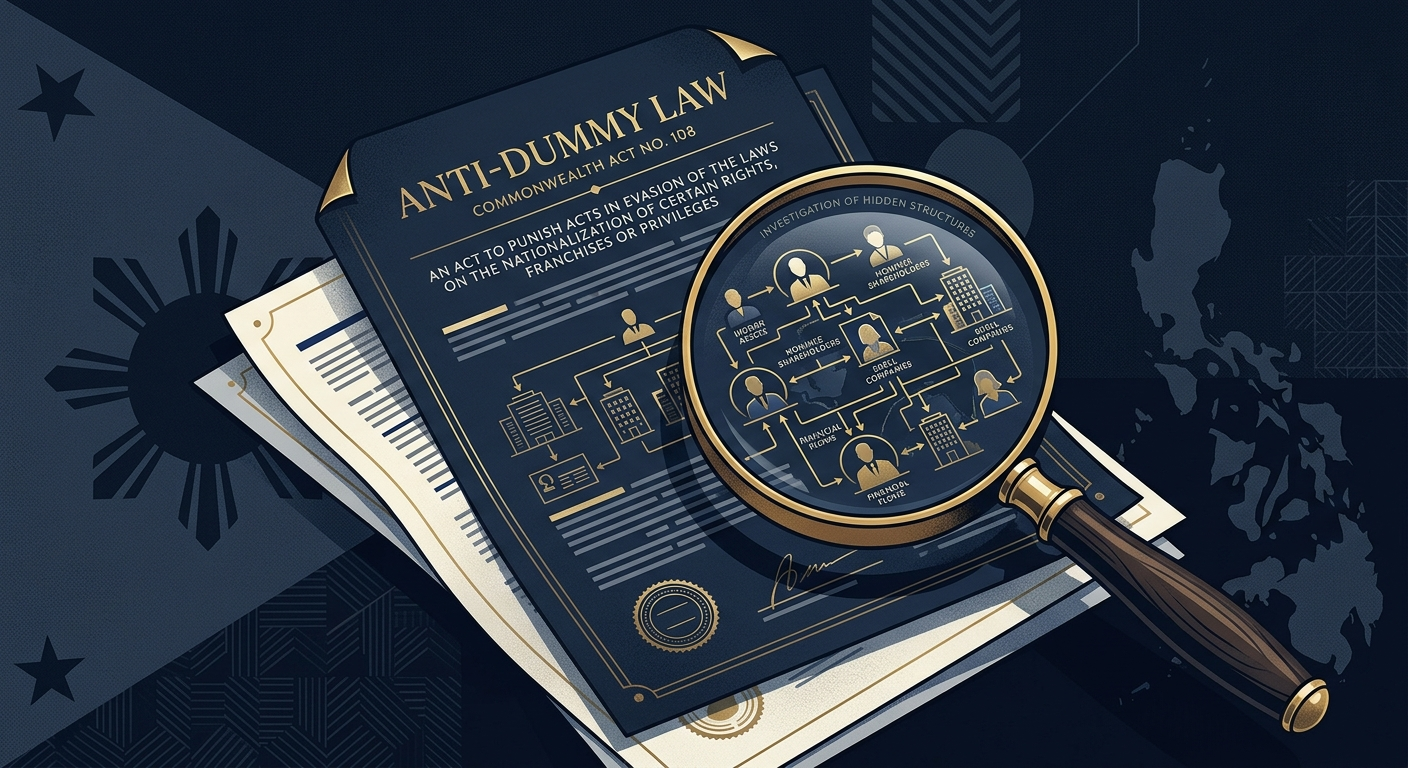
Commonwealth Act No. 108 — the Anti-Dummy Law — remains one of the most consequential and least understood statutes governing foreign business activity in the Philippines. Against the backdrop of the Philippines' liberalized investment climate and the Securities and Exchange Commission's Memorandum Circular No. 15, Series of 2025 establishing the Beneficial Ownership Disclosure Rules of 2026, beneficial ownership is now on the record with the SEC. This article explains the Anti-Dummy Law's statutory framework, the sectors it continues to affect despite recent reforms, the mechanics of beneficial ownership reporting under the new SEC rules, the criminal and civil consequences of violations, and a practical compliance roadmap for foreign investors seeking to establish or maintain a lawful presence in the Philippine market.
Joren Lex Tan
Fintech & Financial Regulation · April 21, 2026
From covered transaction reporting thresholds to FATF delisting milestones and BSP circular enforcement, this guide gives foreign investors a legal overview of AMLA compliance obligations in the Philippines — including who qualifies as a covered person, what transactions must be reported, the consequences of non-compliance, and the practical steps foreign companies can take to manage criminal and regulatory exposure under Republic Act No. 9160, as amended.
Garreth-Daniel Tungol
Foreign Ownership & Property · March 3, 2026
A practical checklist for foreign investors, expats, and business owners on how the Anti-Dummy Law (Commonwealth Act No. 108) restricts foreign participation in certain Philippine industries — and how to structure your investment legally.
Garreth-Daniel Tungol
Setting Up & Structuring · February 15, 2026
A legal guide to registering a foreign corporation with the Philippine Securities and Exchange Commission, covering branch offices, representative offices, regional headquarters, capital requirements, and the documentary process under the Revised Corporation Code and Foreign Investments Act.
Joren Lex Tan