The Foreign Investor's Compliance Crossroads: Stockholder Inspection Rights, Data Privacy, and Merger Notification Thresholds Every Foreign Buyer Must Navigate in 2026

Introduction: Why These Three Obligations Now Converge for Foreign Buyers
Foreign investors acquiring Philippine companies in 2026 face a more complex regulatory landscape than ever before. Three distinct but intersecting legal frameworks — each updated or recalibrated within the past year — now impose overlapping obligations on any foreign buyer conducting due diligence on, or assuming governance of, a Philippine corporation.
First, the National Privacy Commission (NPC), through Advisory Opinion (AO) Nos. 2026-005 and 2026-007, both dated August 25, 2026, issued landmark guidance on how corporations must balance stockholder inspection rights under the Revised Corporation Code (RCC) against personal data protection obligations under the Data Privacy Act of 2012 (DPA, RA 10173). These opinions represent the NPC’s most detailed guidance to date on a tension that foreign acquirers routinely encounter during due diligence.
Second, the Philippine Competition Commission (PCC), the agency enforcing Republic Act No. 10667 (the Philippine Competition Act), recalibrated its mandatory merger notification thresholds effective March 1, 2026. The new thresholds — a turnover-based threshold of Php 9.1 billion and a transaction-value threshold of Php 3.8 billion — affect virtually every mid-to-large acquisition by foreign investors in the Philippines.
Third, the interplay between these two frameworks creates practical due diligence complexities. A foreign buyer seeking to inspect the target company’s records — financial statements, employment contracts, related-party transactions — will immediately encounter personal data protection constraints that did not exist or were not aggressively enforced five years ago.
This guide provides a comprehensive analysis of all three frameworks, with specific attention to how they affect foreign investors at every stage: pre-acquisition due diligence, deal structuring, merger notification analysis, and post-closing corporate governance.
Part I: The Philippine Competition Commission’s Mandatory Merger Notification Regime
1.1 The Legal Framework: RA 10667 and Its Implementing Rules
Republic Act No. 10667, enacted in 2015, established the PCC as an independent quasi-judicial body tasked with enforcing Philippine competition law. Section 14 of RA 10667 imposes a mandatory pre-merger notification requirement on transactions that exceed the thresholds prescribed by the PCC’s rules. Under the law, parties to a covered transaction are prohibited from consummating the transaction until they receive PCC clearance.
The PCC’s authority to set and recalibrate thresholds is expressly recognized in RA 10667. The current thresholds — Php 9.1 billion for the ultimate parent entity’s annual turnover in, into, or from the Philippines, and Php 3.8 billion for the value of the transaction — have been in effect since March 1, 2026, following a recalibration exercise by the PCC.
Key Statutory Provision — RA 10667, Section 14:
“Any acquisition, merger, or consolidation of entities organized and existing under the laws of the Philippines wherein the ultimate parent entity of the acquiring or acquired entity meets the thresholds provided in the rules and regulations promulgated by the Commission, shall be subject to an advance notification to the Commission. No transaction covered by the compulsory notification requirement shall be consummated unless the Commission has issued a confirmation of its decision to not prohibit the transaction or has otherwise resolved the transaction within the period prescribed by law.”
The implementing rules specify that notification must be filed at least 30 days before the execution of definitive agreements relating to the transaction.
1.2 The Current Thresholds in Detail
The PCC’s recalibrated thresholds, effective March 1, 2026, are structured as a two-limb test. Both limbs must be satisfied for mandatory notification to apply:
| Threshold Limb | Amount | Basis |
|---|---|---|
| Turnover Threshold | Php 9.1 billion | Annual gross revenues in, into, or from the Philippines of the ultimate parent entity (UPE), including all entities it controls |
| Transaction Value Threshold | Php 3.8 billion | Value of the consideration for the acquisition, merger, or consolidation |
What Constitutes “Turnover”: The PCC’s rules define turnover broadly as gross revenues from sales in, into, or from the Philippines. This includes all entities controlled by the UPE, not merely the Philippine operating entity. Foreign acquirers must aggregate revenues across their global group when assessing whether the Php 9.1 billion threshold is met.
What Constitutes “Transaction Value”: For acquisitions, this is the total consideration paid or payable. For mergers, it is the value of the assets of the surviving or new entity in the Philippines. Foreign buyers should carefully structure how consideration is defined, as earn-outs, contingent payments, and working capital adjustments can all affect the calculated transaction value.
1.3 Exemptions and Carve-Outs
Not every acquisition above the thresholds triggers mandatory notification. The PCC’s rules provide several exemptions:
- Intra-group transactions: Acquisitions where both the acquiring and acquired entities are part of the same corporate group, provided there is no change in control, are generally exempt.
- Foreign-to-foreign transactions: Transactions where both parties are foreign entities and the transaction does not have a nexus to Philippine commerce may fall outside PCC jurisdiction. However, the PCC has asserted jurisdiction over foreign-to-foreign transactions that produce effects in the Philippines — a position that has been contested but remains the operational standard.
- Acquisition of shares solely as treasury shares or for purposes of resale: Certain passive acquisition structures are carved out.
- Liquidations and dissolutions: Transactions effectuating the dissolution of a corporation are generally exempt.
1.4 Foreign Investor Implications: When Does a Foreign Acquisition Trigger PCC Review?
A foreign investor acquiring a Philippine target must conduct a threshold analysis from day one of deal planning. Consider the following scenario:
Scenario 1: Foreign Buyer Acquiring a Philippine Subsidiary
A US-based private equity fund seeks to acquire 100% of a Philippine manufacturing company with gross revenues of Php 8.5 billion in the Philippines. The target itself falls below the Php 9.1 billion turnover threshold. However, the fund’s global portfolio companies — including other Philippine portfolio companies — generate aggregate revenues well above Php 9.1 billion. Under the PCC’s rules, the relevant entity for threshold calculation is the ultimate parent entity — in this case, the US fund. The Php 9.1 billion threshold is assessed at the UPE level, and the transaction value (acquisition price of the Philippine target) must then be assessed against the Php 3.8 billion limb.
This is a critical point for foreign private equity and sovereign wealth funds: even if the Philippine target is a mid-sized company, a global fund with substantial revenues may trigger PCC review at the fund level. Foreign investors should conduct a UPE-level threshold analysis early in deal planning.
Scenario 2: Foreign Strategic Acquisition
A Japanese conglomerate seeks to acquire a Philippine logistics company for Php 4.2 billion. The target’s annual gross revenues are Php 6 billion. The Japanese conglomerate’s global revenues far exceed Php 9.1 billion. Both limbs are triggered: the UPE’s global turnover exceeds Php 9.1 billion, and the transaction value of Php 4.2 billion exceeds Php 3.8 billion. Mandatory PCC notification is required, and the transaction cannot close until at least 30 days after PCC receipt of a complete notification.
1.5 The Notification Process: Timeline and Procedure
Once mandatory notification is triggered, the PCC’s process follows a defined timeline:
-
Pre-notification consultation (optional but strongly recommended): Parties may request an informal pre-notification conference with PCC staff to discuss the transaction and confirm notification obligations.
-
Filing: The notification must be filed through the PCC’s electronic filing system. The filing must include: (a) the parties’ corporate structures; (b) financial statements; (c) description of the transaction; (d) market share data; and (e) any efficiencies claims.
-
Waiting period: The statutory waiting period is 30 days from PCC receipt of a complete notification, extendable under certain circumstances. During this period, the parties may not consummate the transaction.
-
Review: The PCC may (a) clear the transaction; (b) clear the transaction with conditions; or (c) initiate a full review, which extends the timeline significantly.
-
Consummation: Only after PCC clearance may the transaction close.
For foreign investors accustomed to US Hart-Scott-Rodino (HSR) or EU merger control timelines, the PCC’s 30-day waiting period is comparatively short. However, the PCC’s resource constraints and the complexity of multi-jurisdictional filings mean that transactions requiring extensive review can take three to six months to clear.
1.6 Penalties for Failure to Notify
RA 10667 imposes substantial penalties for non-compliance. Parties who fail to notify a covered transaction face:
- Administrative fines under RA 10667, Section 17: parties who fail to notify a covered transaction are subject to an administrative fine of one percent (1%) to five percent (5%) of the value of the transaction — a percentage-based penalty that scales with deal size, making it a significant financial risk for large acquisitions.
- Unenforceability of the transaction: Covered transactions that close without PCC clearance are unenforceable under Philippine law. This is an extraordinary remedy that renders the transaction a legal nullity.
- Criminal liability for willful violations, with fines and imprisonment for responsible officers.
Foreign investors should treat PCC notification as a non-negotiable legal requirement, not an administrative formality.
Part II: Stockholder Inspection Rights Under the Revised Corporation Code
2.1 The Statutory Framework: Section 73 of RA 11232
The Revised Corporation Code (RCC), enacted as Republic Act No. 11232 and effective February 23, 2019, governs the rights and obligations of stockholders in Philippine corporations. Section 73 of the RCC is the foundational provision establishing the stockholder’s right to inspect corporate records:
Section 73. Stockholder’s Right to Inspection. — “Stockholders shall have the right to inspect the corporate books and records, including the financial statements, at reasonable times during business hours, and for proper purposes, upon written demand under oath. They may make copies of the information retrieved at their own expense.”
The scope of this right is broad. Under the RCC, “corporate books and records” encompasses:
- Minutes of meetings of stockholders and directors
- The stock and transfer book
- Financial statements and auditor’s reports
- All contracts, resolutions, and corporate records
- Bank account records
- Tax returns
- Employment contracts and compensation records
The phrase “at reasonable times during business hours” and “for proper purposes” introduces a limitations framework that courts and regulators have been refining since the RCC’s enactment.
2.2 “Proper Purposes” and the Philippine Courts’ Evolving Standard
The RCC does not define “proper purposes,” and Philippine courts have been developing this concept through case law. As a general principle, a proper purpose is one that is reasonably related to the stockholder’s interest as a stockholder — not a purpose personal to the stockholder that happens to involve the corporation.
Examples of recognized proper purposes include:
- Investigating the management of corporate affairs
- Ascertaining the value of shares
- Identifying related-party transactions and potential conflicts of interest
- Evaluating the competence and independence of directors
- Preparing for stockholder meetings
Examples of improper purposes (as recognized in Philippine jurisprudence and SEC opinions):
- Inspections motivated by hostility toward management
- Inspections aimed at obtaining trade secrets for competitive use
- Inspections for purposes unrelated to stockholder interests (e.g., investigating a rival company)
2.3 Section 73’s Interaction with Confidentiality Obligations
The RCC itself recognizes that the inspection right is subject to applicable confidentiality rules. The statute’s full text acknowledges that the right to inspect does not override other laws. This creates the intersection between stockholder inspection rights and the Data Privacy Act — a tension the NPC’s 2026 advisory opinions directly address.
Part III: The Data Privacy Act and Its Constraints on Corporate Records Disclosure
3.1 The Framework: RA 10173 and Its Implementing Rules
The Data Privacy Act of 2012 (RA 10173) is the Philippines’ primary legislation governing the processing of personal information. Administered by the NPC, the DPA establishes rules on how personal data must be collected, processed, stored, and disclosed.
For corporations, the DPA imposes obligations on two levels:
- As personal information controllers (PICs): Corporations that determine the purposes and means of processing personal data (e.g., employer-employee relationships, customer databases).
- As personal information processors (PIPs): Corporations that process personal data on behalf of another entity.
3.2 Key DPA Concepts Relevant to Stockholder Inspection
Personal Information under RA 10173 means any information from which the identity of an individual is apparent or can be reasonably and directly ascertained, or from which a determination can be made when combined with other readily available information. Corporate records — employment contracts, payroll data, board compensation packages, employee performance records — routinely contain personal information.
Sensitive Personal Information is a subset that includes information about an individual’s health, education, financial history, criminal records, and other specifically enumerated categories. The disclosure of sensitive personal information is subject to even stricter rules.
Criteria for Lawful Processing (Section 12 of RA 10173): Personal information may only be processed if at least one of the following applies:
- The data subject consents
- Processing is necessary to perform obligations under a contract
- Processing is required by law
- Processing is necessary to protect life or public safety
- Processing is for legitimate purposes
3.3 The Statutory Prohibition on Unauthorized Disclosure
Section 14 of RA 10173 prohibits the disclosure of personal information to third parties unless:
- The data subject consents
- The disclosure is required by law
- The disclosure is necessary to fulfill a lawful purpose that does not violate the DPA
For corporations receiving stockholder inspection demands, this creates a dilemma: the RCC gives stockholders the right to inspect corporate records, but those same records may contain personal information that cannot be disclosed without satisfying the DPA’s requirements.
Part IV: NPC Advisory Opinions 2026-005 and 2026-007: The Landmark Guidance
4.1 Background: The August 25, 2026 Advisory Opinions
On August 25, 2026, the NPC issued two closely related advisory opinions — AO Nos. 2026-005 and 2026-007 — that provide the most detailed guidance yet on how Philippine corporations must navigate the tension between stockholder inspection rights and data privacy obligations. These opinions respond to queries from corporations facing inspection demands that included personal data of directors, officers, and employees.
AO No. 2026-005 involved a request to inspect records concerning the compensation and benefits of the company’s seven most highly compensated directors or officers, including compensation policies, benchmarking data, job descriptions, and board committee minutes.
AO No. 2026-007 involved records concerning retirement and employee benefits for the top seven most compensated officers, as well as records related to related-party transactions and conflict-of-interest assessments.
4.2 The NPC’s Core Holding: Three-Layer Analysis
The NPC’s opinions establish a three-layer analytical framework that corporations — and foreign investors conducting due diligence — must apply:
Layer 1: Is the Inspection Demand Valid Under the RCC?
The NPC first asks: is the stockholder entitled to inspect the requested records under Section 73 of the RCC? The answer depends on whether (a) the requesting party is a stockholder, (b) the demand is made under oath, (c) the demand specifies a proper purpose, and (d) the request is made at a reasonable time.
Critically, the NPC notes: “The DPA neither creates a blanket prohibition against stockholder inspection nor independently authorizes access to corporate records.” The DPA does not expand or contract the RCC’s inspection right. It operates on a separate axis — governing how personal data contained in those records may be disclosed once disclosure is determined to be proper under the RCC.
Layer 2: Is Disclosure of Personal Data in the Records Permissible Under the DPA?
If the inspection demand is valid under the RCC, the corporation must then separately assess whether disclosing the specific records — particularly those containing personal data — complies with the DPA. This requires identifying the legal basis for disclosure under Section 12 of RA 10173.
The NPC has recognized several potentially applicable lawful processing bases in the inspection context:
- Legitimate interest of the data subject: For records directly concerning the stockholder’s own employment or contractual relationship with the company, the stockholder’s own personal data may be disclosed to that stockholder.
- Fiduciary duty of the corporation: The NPC has acknowledged that corporations have fiduciary duties to their stockholders that may, in some circumstances, support limited disclosure.
- Compliance with a legal obligation: If the inspection right is established under the RCC, disclosure of personal data necessary to fulfill that right may qualify as disclosure required by law.
Layer 3: Proportionality and Data Minimization
Even where disclosure is legally permissible, the NPC requires that corporations apply data minimization principles. Corporations may disclose an individual’s identity only when it is responsive and necessary to the stated inspection purpose, such as:
- Evaluating a specific related-party transaction
- Assessing a conflict-of-interest concern
- Ascertaining whether corporate governance standards were followed
If the inspection purpose can be served by disclosing aggregate or anonymized data, the corporation should do so. Disclosure of the full personal data set — names, specific compensation amounts, detailed benefit structures — is not justified if the same purpose can be achieved through redacted or summarized records.
4.3 Key Holdings of AO 2026-005 and 2026-007
The NPC’s opinions contain several holdings directly relevant to foreign investors:
-
The DPA does not override stockholder inspection rights: The NPC explicitly rejected the argument that data privacy laws categorically prohibit disclosure of corporate records to stockholders. The inspection right under the RCC remains operative, but must be exercised in a manner consistent with the DPA.
-
Proportionality is mandatory: Corporations must assess the proportionality of any disclosure — the extent of personal data disclosed must be commensurate with the legitimate inspection purpose.
-
Redaction is a permissible and recommended tool: Where specific personal data is not necessary to fulfill the inspection purpose, corporations should proactively redact that data. This is consistent with the DPA’s principle of data minimization.
-
Corporations may limit inspection scope: A corporation may limit the scope of an inspection or the documents produced to those that are genuinely responsive to the stated proper purpose. Stockholders cannot conduct a fishing expedition under the guise of a proper-purpose inspection.
-
The “Top Seven” standard: Both advisory opinions involved requests for records of the top seven most compensated directors or officers. The NPC treated this as a potentially proper scope — related to evaluating corporate governance and executive compensation — but held that the corporation retains the right to redact data that exceeds what is necessary to serve that purpose.
4.4 Practical Implications for Foreign Investors During Due Diligence
A foreign investor acquiring a Philippine company conducts due diligence partly through the exercise of stockholder inspection rights — either directly (if acquiring shares in the target) or through contractual inspection rights in a share purchase agreement. The NPC’s advisory opinions have several practical implications:
Due Diligence Phase:
-
A foreign buyer’s due diligence requests for employment contracts, executive compensation records, and related-party transaction documents are now subject to a formal data privacy analysis. The target company cannot simply produce these documents in full without assessing whether DPA-compliant lawful processing bases exist for disclosure.
-
The foreign buyer’s status as a prospective stockholder (or its nominee’s status) may itself constitute a legitimate processing basis under the DPA, but the target company should document its lawful processing rationale.
-
Redacted document production — producing board minutes with director names redacted where not directly relevant — is now a recognized and recommended practice, not an obstruction of due diligence.
Post-Closing Phase:
-
Once the foreign investor becomes a stockholder (or the target becomes a subsidiary of the foreign investor), the investor’s ongoing inspection rights remain subject to the NPC’s framework. A foreign investor seeking to inspect employee compensation records to assess post-acquisition integration decisions must frame the request around proper purposes (e.g., evaluating related-party transactions, assessing conflicts of interest) rather than operational management purposes.
-
Post-closing corporate governance must account for the fact that other stockholders — including minority stockholders — also have inspection rights. Foreign investors acquiring majority stakes should anticipate that minority stockholders may exercise their Section 73 rights to access records the acquirer considers sensitive.
Part V: How the Three Frameworks Intersect in Practice — Scenarios for Foreign Investors
Scenario A: Foreign Strategic Buyer Acquiring a Philippine Target
Facts: A Singapore-based company (“Buyer”) is acquiring 100% of a Philippine retail company (“Target”) for Php 5 billion. Target’s annual gross revenues are Php 8 billion. Buyer’s global revenues exceed Php 9.1 billion.
Analysis:
-
PCC Notification: Both thresholds are triggered. Buyer’s UPE revenues exceed Php 9.1 billion. Transaction value (Php 5 billion) exceeds Php 3.8 billion. Mandatory PCC notification required at least 30 days before signing. Filing must occur even before signing the definitive agreement.
-
Due Diligence and Inspection Rights: Buyer’s inspection of Target’s records (employment contracts, related-party leases, compensation packages for key executives) during due diligence is subject to the DPA. Target’s production of these records must be grounded in a lawful processing basis — likely the buyer’s legitimate interest as a prospective stockholder and the processing necessary to perform the share purchase contract.
-
Data Privacy Compliance in Disclosure: Target must apply data minimization: if the due diligence purpose is to assess related-party transactions, the names of counterparties and transaction values are relevant, but detailed personal information about employees who are not counterparties to those transactions may be redacted.
Scenario B: Foreign Private Equity Fund’s Portfolio Acquisition
Facts: A Cayman Islands PE fund (“Fund”) is acquiring a controlling stake in a Philippine manufacturing company (“MfgCo”) through a newly incorporated Philippine holding company (“NewCo”). The acquisition price is Php 2.5 billion. MfgCo’s revenues are Php 7 billion. Fund’s global revenues exceed Php 9.1 billion.
Analysis:
-
PCC Notification: Transaction value (Php 2.5 billion) is below the Php 3.8 billion threshold. While Fund’s global revenues exceed Php 9.1 billion, the transaction-value limb is not triggered. The transaction does not appear to require mandatory PCC notification. However, Fund should verify whether any other filing obligations arise — for example, if the acquisition involves a sector with specific regulatory requirements (e.g., financial services, telecommunications, energy).
-
Inspection Rights During Hold Period: Once Fund acquires NewCo shares in MfgCo, Fund has stockholder inspection rights under Section 73 of the RCC. Fund’s exercise of these rights — for example, inspecting the CEO’s employment contract or the board’s minutes on related-party matters — must comply with the NPC’s proportionality framework.
Scenario C: Post-Acquisition Minority Stockholder Inspection Demand
Facts: A foreign investor (“ForeignCo”) acquired 60% of a Philippine technology company (“TechPh”). The remaining 40% is held by the founders (“Founders”). The Founders request to inspect TechPh’s financial statements, the compensation packages of all senior executives, and the board minutes related to a recent executive appointment.
Analysis:
-
Inspection Rights Validity: The Founders, as stockholders, have a facially valid inspection demand under Section 73 of the RCC. The stated purposes — reviewing financial performance and assessing executive appointments — are proper purposes reasonably related to their interest as stockholders.
-
Data Privacy Constraints: TechPh must assess what personal data in the requested records can lawfully be disclosed:
- Financial statements (corporate-level, not personal data) should be produced in full.
- Executive compensation packages: The NPC’s AO 2026-005 and 2026-007 framework applies. The Founders may be entitled to aggregate executive compensation information to assess corporate governance, but detailed individual compensation breakdowns may be subject to data minimization.
- Board minutes on executive appointments: Board minutes that do not contain personal data beyond what is necessary to record the appointment decision should be produced. Compensation discussions within board minutes may be redacted.
-
Redaction Protocol: TechPh should implement a structured redaction protocol, producing the Founders with a log of redactions and the legal basis for each, to demonstrate good-faith compliance with both the RCC and the DPA.
Part VI: A Practical Compliance Roadmap for Foreign Investors
Step 1: Conduct PCC Threshold Analysis at Deal Inception
Before signing any term sheet or letter of intent, foreign investors should conduct a preliminary PCC threshold analysis:
- Identify the ultimate parent entity and its global revenues.
- Determine the transaction structure and calculate the transaction value.
- If both limbs of the threshold test are triggered, build a minimum 30-day (plus review time) buffer into the transaction timeline.
- Engage Philippine competition counsel to manage the PCC notification process.
Step 2: Structure Due Diligence Requests with DPA Compliance in Mind
When conducting due diligence on a Philippine target:
- Frame due diligence requests around proper purposes under Section 73 of the RCC.
- Request data in categories (financial records, related-party agreements, corporate governance documents) rather than requesting full employee files indiscriminately.
- Anticipate that the target company may implement redactions and document the redaction basis.
- Obtain representations and warranties in the transaction documents regarding the target’s data privacy compliance and the existence of lawful processing bases for producing personnel records.
Step 3: Prepare for PCC Review Process
If PCC notification is required:
- Engage experienced Philippine competition counsel immediately.
- Prepare a comprehensive notification package, including market share analysis, competitive landscape description, and efficiency arguments.
- Request a pre-notification consultation with PCC staff to confirm the filing’s completeness.
- Do not close the transaction until PCC clearance is received. The penalties for non-compliance — including unenforceability of the transaction — are severe.
Step 4: Plan Post-Acquisition Corporate Governance
After closing:
- Establish a corporate records management policy that addresses both RCC inspection obligations and DPA compliance requirements.
- Train the board and corporate secretary on the NPC’s three-layer analytical framework for inspection demands.
- Implement a redaction protocol for responding to inspection demands, with legal review of each redaction.
- Ensure that personal data processed in the ordinary course of the Philippine subsidiary’s business has appropriate DPA compliance documentation (privacy notices, consent records, data sharing agreements).
Step 5: Monitor Regulatory Developments
Both the PCC’s threshold regime and the NPC’s data privacy guidance are subject to ongoing evolution:
- The PCC recalibrates thresholds periodically. Foreign investors should monitor officialgazette.gov.ph and the PCC’s official communications for threshold updates.
- The NPC continues to issue advisory opinions and circulars that may affect how inspection rights and data privacy intersect. Counsel should be engaged to monitor these developments.
- The DPC’s Implementing Rules and Regulations, referenced in the recent August 2026 developments, may undergo further amendment.
Conclusion: The New Normal for Foreign Investors in Philippine M&A
The convergence of the PCC’s recalibrated merger thresholds, the NPC’s landmark 2026 advisory opinions, and the Revised Corporation Code’s inspection framework represents a fundamental shift in the compliance landscape for foreign investors in Philippine M&A. What was once a relatively straightforward process — file for PCC approval, inspect the target’s records, close the deal — now requires sophisticated navigation of competing statutory obligations.
Foreign investors who understand these three frameworks — and how they interact — will be better positioned to structure transactions efficiently, manage due diligence risks, and govern their Philippine investments post-closing. Those who do not risk encountering enforcement actions from the PCC, data privacy complaints before the NPC, and litigation with minority stockholders over inspection disputes.
The message for foreign investors is clear: engage qualified Philippine legal counsel with expertise spanning competition law, corporate governance, and data privacy at the earliest stage of any acquisition planning. The cost of that engagement is a fraction of the potential penalties and litigation risks of getting these intersecting obligations wrong.
This article is for informational purposes only and does not constitute legal advice. Foreign investors should consult with qualified Philippine legal counsel regarding their specific circumstances. All legal citations have been verified against publicly available official sources including lawphil.net, the Official Gazette, and the Philippine Competition Commission.
Related Articles

The Philippine Privacy Impact Assessment Revolution: What the 2026 Draft Circular Means for Foreign Companies
The NPC's August 2026 draft circular would replace the blanket Privacy Impact Assessment obligation that has governed Philippine data privacy compliance since 2017 with a risk-tiered framework. For foreign companies operating in or serving the Philippine market, the shift from a one-size-fits-all requirement to a threshold-based trigger system carries significant compliance and cost implications. This guide explains the eight mandatory PIA trigger categories, the new quantitative thresholds, what the draft circular means for AI systems and cross-border transfers, and the practical steps foreign companies must take now.
The Philippine Dual-Regulatory Framework for Cryptocurrency and Virtual Assets: A Comprehensive Guide for Foreign Investors in 2026
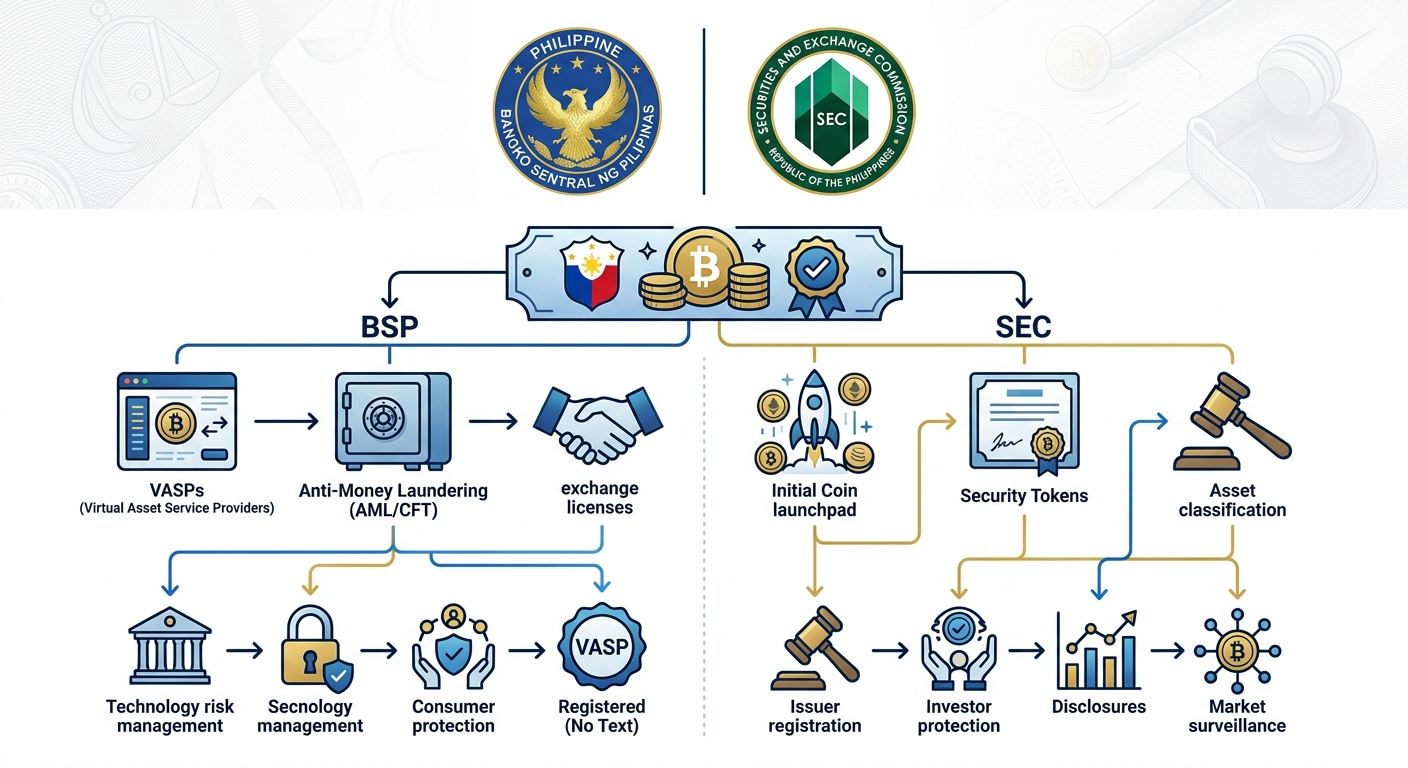
With the BSP's Circular No. 1108 and the SEC's CASP Rules (MC Nos. 04 and 05 of 2025) now both in force, foreign investors entering the Philippine virtual asset space face a bifurcated regulatory landscape that did not exist three years ago. This guide maps the jurisdictional boundaries between the Bangko Sentral ng Pilipinas and the Securities and Exchange Commission, explains the licensing pathways, capitalization requirements, AML/CTF obligations, the BSP's continued VASP license moratorium, and the practical steps a foreign investor must take to operate lawfully in the Philippines' digital asset market.

The Philippine E-Invoicing Mandate: A Comprehensive Compliance Guide for Foreign Companies in 2026
With the December 31, 2026 deadline for mandatory e-invoicing under BIR Revenue Regulations No. 11-2025 fast approaching, foreign companies operating in the Philippines face an urgent compliance obligation that cannot be deferred. This guide provides a complete analysis of who must comply, what constitutes a compliant electronic invoice, the step-by-step implementation process, tax deduction opportunities under the CREATE MORE Act, and the penalties for non-compliance — with every legal citation verified against primary sources.