The Philippine Dual-Regulatory Framework for Cryptocurrency and Virtual Assets: A Comprehensive Guide for Foreign Investors in 2026
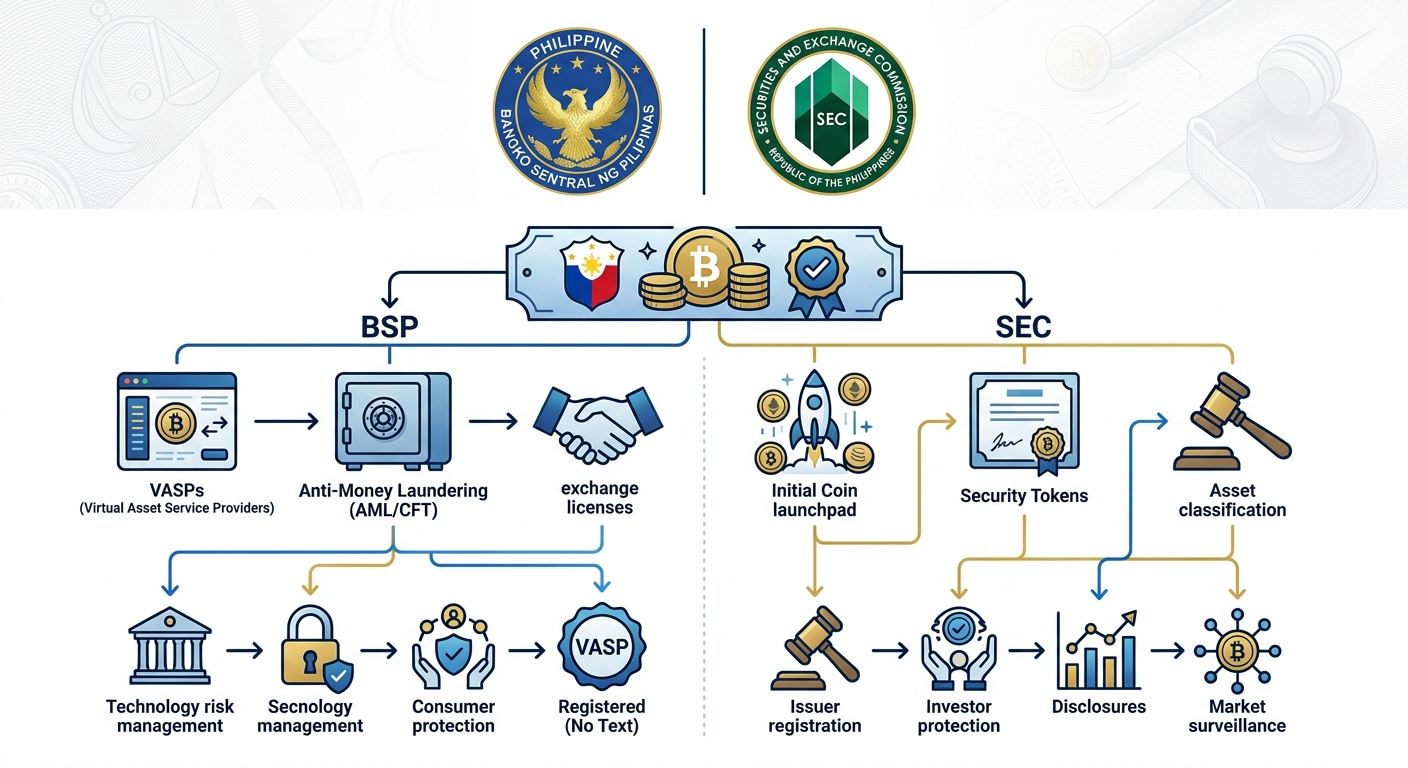
The Philippine regulatory landscape for virtual assets and cryptocurrency has undergone a fundamental structural change that foreign investors cannot afford to ignore. Until 2025, the Bangko Sentral ng Pilipinas (BSP) was effectively the sole financial regulator overseeing digital asset activities in the country through Circular No. 1108, Series of 2021 — the Guidelines for Virtual Asset Service Providers. That singular authority has now been shared, and in some areas superseded, by the Securities and Exchange Commission (SEC) following its issuance of Memorandum Circular (MC) Nos. 04 and 05, Series of 2025, the Crypto-Asset Service Provider (CASP) Rules and Guidelines.
For a foreign investor or foreign-controlled entity seeking to participate in the Philippine digital asset market — whether as an exchange operator, custodian, broker-dealer, or payment service provider leveraging blockchain technology — understanding which regulator has jurisdiction over which activities is not a theoretical exercise. It determines whether you apply to the BSP or the SEC, how much capital you must commit, what AML/CTF controls you must implement, and whether your intended business model is even permissible under Philippine law.
This guide provides a comprehensive analysis of both regulatory frameworks, their overlapping and distinct jurisdictions, the practical compliance obligations each imposes, and a step-by-step roadmap for foreign investors seeking to establish a lawful presence in the Philippines' virtual asset sector.
The Legal Architecture: Two Regulators, Two Frameworks
BSP Circular No. 1108: The Foundation
The BSP's regulatory framework for virtual assets traces its formal origins to Circular No. 944, Series of 2017, which established the first set of rules for virtual currency exchanges operating in the Philippines. That framework was substantially replaced and expanded by Circular No. 1108, Series of 2021, which the BSP's Monetary Board approved on January 21, 2021, and which took effect on February 16, 2021.
Circular No. 1108 was deliberately modeled on the Financial Action Task Force (FATF) standards on virtual asset service providers, using the internationally recognized terminology of VASPs rather than the narrower "virtual currency exchange" concept. The Circular defines a VASP as any person or entity who, as a business, engages in:
- Exchange between virtual assets and fiat currencies;
- Exchange between one or more forms of virtual assets;
- Transfer of virtual assets; and
- Safekeeping or administration of virtual assets, or instruments enabling control over virtual assets.
The Circular explicitly excludes from its scope participation in or provision of financial services related to an issuer's offer or sale of a virtual asset — a carve-out that would prove significant once the SEC issued its own framework. This exclusion reflects the BSP's recognition that securities-law issues arising from token offerings fell outside central bank jurisdiction, even in 2021.
In December 2024, the BSP issued Circular No. 1206, which consolidated money service business regulations into the Manual of Regulations for Non-Bank Financial Institutions (MORNBFI-M). This circular deleted and superseded the former MORNBFI Sections 901-N and 902-N, incorporating the VASP rules into the consolidated M-Regulations while retaining the substantive requirements of Circular No. 1108. As of 2026, the operative VASP framework for BSP-supervised institutions is found in the MORNBFI-M M-Regulations.
SEC MC Nos. 04 and 05 of 2025: The New Securities Overlay
The SEC issued its CASP framework on May 30, 2025, in Makati City. The two circulars — MC No. 04, Series of 2025 (the SEC Rules on Crypto-Asset Service Providers) and MC No. 05, Series of 2025 (the SEC Guidelines on the Operations of Crypto-Asset Service Providers) — were filed with the University of the Philippines Law Center on June 2, 2025, published in two newspapers of general circulation on June 4, 2025, and are treated as in force from July 5, 2025.
The SEC's framework responds to a gap that Circular No. 1108 did not fully address: when does a virtual asset activity cross from a simple value-conversion service (BSP territory) into an activity that constitutes a securities offering or securities intermediation requiring SEC oversight? The SEC's answer, embodied in MC Nos. 04 and 05, is that entities engaged in the following activities fall within SEC jurisdiction:
- Public offerings of crypto-assets;
- Operation of a crypto-asset trading venue;
- Crypto-asset intermediation; and
- Other crypto-asset services as may be determined by the SEC.
The SEC's framework also covers third-party service providers involved in marketing crypto-assets or crypto-asset services, a category broad enough to encompass social media promoters, influencers, airdrop operators, and paid advertisers who promote token offerings to Philippine users.
Jurisdictional Boundaries: Who Regulates What
The most pressing practical question for any foreign investor is straightforward: which regulator governs my intended business? The answer depends on a careful analysis of the specific activities your Philippine entity will conduct.
BSP Jurisdiction: Payment and Value-Transfer Activities
The BSP maintains primary regulatory authority over VASPs engaged in the following activities:
- Fiat-to-virtual asset exchange — converting Philippine pesos or other fiat currencies into Bitcoin, Ethereum, or other digital assets;
- Virtual asset-to-virtual asset exchange — trading one cryptocurrency for another;
- Virtual asset transfer services — moving digital assets between wallets or between platforms;
- Custody and safekeeping — holding private keys or administering virtual assets on behalf of customers.
In a significant clarification provided to BitPinas in mid-2026, the BSP stated that speculative crypto-to-crypto trading conducted through an order-book trading venue "fits naturally under the SEC's perimeter." This represents a notable shift from the pre-2025 posture, where the BSP treated all virtual asset conversions as falling within its money service business framework regardless of whether the activity had investment or speculative characteristics. The BSP and SEC are reportedly coordinating on defining the boundary between simple value conversion and investment-driven trading as the regulatory perimeter continues to evolve.
The BSP has confirmed that it plans to release proposed amendments to Circular No. 1108 for public comment to reflect these jurisdictional clarifications and the evolving regulatory landscape. Foreign investors should monitor the BSP's regulatory agenda closely as these amendments could materially affect the scope of BSP-covered activities.
SEC Jurisdiction: Securities and Investment Activities
The SEC's CASP framework targets activities with securities law characteristics. This includes:
- Initial coin offerings (ICOs) and token public offerings — where a crypto-asset is offered to the public as an investment with an expectation of profit;
- Crypto-asset trading venues with order-book matching — platforms that facilitate speculative trading between buyers and sellers;
- Crypto-asset broker-dealer activities — intermediation in crypto-asset trades for compensation;
- Marketing of crypto-assets and crypto-asset services — a broadly drafted category covering promotional activities conducted in the Philippines.
Under MC No. 04, crypto-assets may not be sold, offered for sale, or distributed in the Philippines without complying with the CASP Rules and Guidelines. For offerings of crypto-assets that qualify as securities — termed "crypto-asset securities" — the circular requires a registration statement filed with and approved by the SEC under the Securities Regulation Code (Republic Act No. 8799) and its implementing rules.
The Cross-Border Dimension: M-2026-003
For foreign investors, BSP Memorandum M-2026-003, issued January 30, 2026, is particularly significant. The Memorandum reminded all BSP-supervised financial institutions (BSFIs) that direct retail access in the Philippines to offshore VASPs is not permitted unless the offshore provider is registered with the BSP or the SEC.
M-2026-003 establishes the following compliance requirements for Philippine financial institutions dealing with virtual asset counterparties:
- Transactions may only be routed to BSP-authorized VASPs, SEC-authorized CASPs, or offshore VASPs that are duly licensed or authorized in their home jurisdiction;
- Domestic institutions must conduct rigorous counterparty due diligence to verify the regulatory standing of foreign counterparties;
- The BSP's "unbroken chain" rule requires that both the originating and receiving institutions in a virtual asset transfer maintain and transmit required originator and beneficiary information.
Critically, M-2026-003 also confirms that BSP-regulated activities — including fiat transaction rails and VASP activities — remain within the BSP's purview and are not covered by the SEC's sandbox programs. Any domestic VASP that partners with SEC sandbox participants remains fully subject to BSP regulatory and supervisory requirements.
BSP VASP Licensing: Requirements and the Ongoing Moratorium
Certificate of Authority Requirements
Any person or entity seeking to operate as a VASP in the Philippines must first secure a Certificate of Authority to Operate as a Money Service Business from the BSP, as required under Circular No. 1108. The application process requires submission of:
- A comprehensive business plan describing the VASP's intended operations, governance structure, and risk management framework;
- Proof of minimum paid-in capital (discussed below);
- Details of beneficial ownership, with assessment of beneficial owners against fit-and-proper standards;
- Technology infrastructure documentation, including cybersecurity architecture and wallet-security programs;
- AML/CTF policies, procedures, and internal controls;
- Consumer protection policies, including fee disclosure, risk disclosure, and complaint-handling mechanisms;
- Business continuity and disaster recovery plans; and
- Outsourcing arrangements, where applicable.
VASPs must also comply with ongoing BSP supervision requirements, including regular reporting, examination, and compliance with BSP AML/CTF guidelines.
Minimum Capital Requirements
Circular No. 1108 established a two-tier minimum paid-in capital structure:
- PHP 50 million for VASPs that provide safekeeping, custody, or administration of virtual assets on behalf of customers; and
- PHP 10 million for VASPs that do not provide custody services.
These thresholds were retained in the MORNBFI-M M-Regulations following the consolidation under Circular No. 1206. For foreign investors, it is important to note that the minimum capital must be contributed in cash and must be fully paid in before operations commence.
The VASP License Moratorium
The most significant practical barrier facing foreign investors today is the BSP's continued moratorium on the issuance of new VASP licenses. The BSP first closed the regular application window for new VASP licenses for three years beginning September 1, 2022, through Memorandum M-2022-035. The moratorium has subsequently been extended — most recently through Memorandum M-2025-031, which continued the suspension from September 1, 2025, subject to reassessment.
The practical implication is stark: a foreign investor seeking to establish a new Philippine subsidiary to operate as a BSP-regulated VASP cannot currently submit a regular VASP license application through the standard process. The BSP has provided no firm timeline for when the moratorium will be lifted, indicating only that reassessment will occur.
This creates several strategic considerations for foreign investors, which are discussed in the pathways section below.
SEC CASP Registration: Requirements and Process
Registration Prerequisites
The SEC's CASP framework, under MC No. 05, sets the following operating gateway for entities seeking to register as CASPs:
- Corporate form: The applicant must be a corporation registered with the SEC under the Corporations Code of the Philippines (Republic Act No. 11232);
- Primary corporate purpose: CASP operations must be included in the corporation's primary corporate purpose as reflected in its SEC registration documents;
- Minimum paid-up capital: At least PHP 100 million in paid-up capital, excluding the value of any crypto-assets held;
- Physical presence: The CASP must maintain a staffed physical office in the Philippines; and
- Application submission: The complete application package is submitted to the SEC's PhiliFintech Innovation Office, including trading and disclosure rules, business conduct rules, system descriptions, custodian or registrar information, risk disclosures, business plans, governance materials, and proof of filing-fee payment.
The PHP 100 million paid-up capital requirement under the SEC framework is notably higher than the BSP's tiered requirements (PHP 10 million or PHP 50 million). Foreign investors must factor this significantly higher capitalization requirement into their business planning.
Operational Requirements for Registered CASPs
Once registered, CASPs must comply with extensive ongoing operational requirements under MC No. 05:
- Fair-access standards: CASPs must maintain non-discriminatory access policies for customers;
- System capacity and security controls: Adequate technological infrastructure to support operations and protect customer assets;
- Risk management frameworks: Comprehensive risk identification, measurement, and control systems;
- Customer support and complaint handling: Accessible mechanisms for customer grievance resolution;
- Market monitoring controls: Systems to detect and report market manipulation and abusive trading practices;
- Wind-down plans: Documented procedures for orderly cessation of operations;
- Cybersecurity safeguards: Robust information security programs proportionate to the risks posed by the CASP's activities.
For CASPs providing custody services, the Guidelines impose additional requirements: legal and operational segregation of client crypto-assets from the CASP's own assets, safeguards for client access mechanisms, and an absolute prohibition on using client crypto-assets for the CASP's own account.
Disclosure and Marketing Requirements
The SEC's marketing rules under MC No. 04 are notably broad. Covered promotional activity includes:
- Promotional content and advertising materials;
- Social media posts, blogs, videos, podcasts, and livestreams;
- Events and conferences;
- Paid or earned media;
- Airdrops; and
- Educational content that is not made in good faith and purely for educational purposes.
Prior to any sale, offer for sale, or distribution of a crypto-asset in the Philippines, a disclosure document must be filed with the SEC and published through the relevant platform at least 30 days before marketing activity or the offering, whichever comes first. For crypto-asset securities, an SEC-approved registration statement under the Securities Regulation Code is additionally required.
Reporting Obligations
SEC-registered CASPs face substantial reporting burdens under the CASP framework:
- Operational reports — regular submissions on business operations and compliance status;
- Monthly financial and wallet-address reporting — detailed financial data and cryptocurrency wallet address disclosures;
- Quarterly board and compliance reporting — governance and regulatory compliance updates;
- Annual audited financial reporting — audited financial statements filed with the SEC; and
- Five-year recordkeeping — maintenance of transaction records and customer identification data.
AML/CTF Obligations: The Travel Rule and Beyond
BSP AML/CTF Framework for VASPs
The BSP's VASP framework integrates AML/CTF controls as a core component of prudential supervision. Under Circular No. 1108 and the consolidated MORNBFI-M M-Regulations, VASPs must:
- Conduct Customer Due Diligence (CDD) for transactions above the PHP 5,000 occasional-transaction threshold;
- Implement enhanced due diligence for large-value transactions, particularly pay-outs above PHP 500,000, which must be made through check, direct credit to deposit accounts, or electronic fund transfer;
- Comply with the Virtual Asset Travel Rule: virtual asset transfers are treated as cross-border wire transfers, requiring originator and beneficiary information for transfers of PHP 50,000 or more; and
- Report suspicious transactions to the Anti-Money Laundering Council (AMLC).
The AML/CFT framework under the VASP regime draws directly from FATF Recommendations 15 and 16, reflecting the international standard-setting body's guidance on virtual asset regulation.
SEC AML/CTF Framework for CASPs
The SEC's CASP framework incorporates AML/CTF requirements by reference to the Anti-Money Laundering Act of 2001 (Republic Act No. 9160), as amended, and its implementing rules. CASPs are required to establish AML/CTF programs that include:
- Customer identification and verification procedures;
- Risk-based customer due diligence;
- Suspicious transaction reporting to the AMLC;
- Record-keeping and retention; and
- Training programs for officers, employees, and agents.
Foreign investors operating CASPs should ensure that their AML/CTF frameworks are calibrated to satisfy both SEC requirements and the specific obligations applicable to their operational activities.
The Cross-Border Transfer Problem: Unbroken Chain Rule
The "unbroken chain" rule — requiring that both the originating and receiving institutions in a virtual asset transfer maintain and transmit originator and beneficiary information — creates particular complexity for foreign investors operating cross-border platforms. Under M-2026-003, the BSP has confirmed that routing transaction flows to a foreign platform can maintain the chain's integrity, provided the offshore counterparty is duly authorized and licensed in its home jurisdiction.
However, the BSP's response to specific transaction models has been carefully worded: it describes in general policy terms how the unbroken chain principle applies, but does not confirm that any specific cross-border arrangement is compliant. For foreign investors, this means that each cross-border transaction structure requires individualized legal assessment.
Strategic Pathways for Foreign Investors in 2026
Given the dual regulatory framework, the BSP's continued VASP license moratorium, and the SEC's higher capitalization requirements, foreign investors must carefully evaluate their entry strategy. Several pathways are available:
Pathway 1: SEC CASP Registration (New Market Entry)
The most direct pathway for a foreign investor seeking to operate a new virtual asset business in the Philippines is to incorporate a Philippine subsidiary and apply for SEC CASP registration under MC Nos. 04 and 05 of 2025. This pathway is available because the moratorium applies only to BSP VASP licensing, not to SEC CASP registration.
The practical requirements are demanding: a PHP 100 million minimum paid-up capital, a staffed Philippine office, and a comprehensive application through the SEC's PhiliFintech Innovation Office. For foreign investors with sufficient capital and a genuine intention to operate a trading venue, exchange, or broker-dealer in the Philippines, this is the legally appropriate pathway.
Foreign investors pursuing this pathway should also plan for the 30-day pre-marketing disclosure period and, where applicable, the SEC securities registration process under the Securities Regulation Code.
Pathway 2: Partnership with an Existing Licensed VASP or CASP
Foreign investors can consider partnering with an existing BSP-authorized VASP or SEC-registered CASP rather than seeking independent licensure. Under this model, the foreign entity provides technology, liquidity, or operational support to an existing Philippine licensee.
This pathway is particularly relevant while the BSP moratorium remains in effect. However, it requires careful structuring to ensure that the foreign entity does not itself engage in regulated VASP or CASP activities without appropriate authorization. M-2026-003 makes clear that BSP-supervised financial institutions dealing with VASP counterparties must verify the counterparty's regulatory standing — a due diligence burden that may complicate informal technology partnerships.
Pathway 3: SEC Strategic Sandbox Participation
The SEC's Strategic Sandbox (StratBox) framework provides a structured environment for testing innovative financial products and services, including virtual asset-related offerings. A foreign entity can potentially participate in the StratBox through a domestic subsidiary or partnership arrangement.
Participation in the SEC sandbox does not exempt entities from complying with applicable laws and regulations. Critically, VASP activities and fiat transaction rails remain within the BSP's purview and are not covered by the sandbox framework. Any domestic VASP that partners with sandbox participants remains fully subject to BSP regulatory and supervisory mandates. Foreign investors considering sandbox participation should seek specific legal advice on the scope of activities permitted within the sandbox and the transition requirements once sandbox testing concludes.
Pathway 4: Offshore Operation Serving Philippine Users Remotely
M-2026-003 makes clear that this pathway carries significant legal risk. The BSP has stated explicitly that direct retail access in the Philippines to offshore VASPs is not allowed unless the provider is registered with the BSP or SEC. Philippine financial institutions are prohibited from facilitating retail access to unregistered offshore platforms.
For foreign investors, this means that operating an offshore exchange or VASP platform and marketing it to Philippine residents without Philippine regulatory authorization creates both regulatory exposure for the foreign entity and compliance risks for any Philippine persons or institutions that facilitate access to the platform.
Foreign Ownership Considerations
For foreign investors considering entry into the Philippine virtual asset sector, the applicable foreign ownership restrictions under the Foreign Investment Act of 1991 (Republic Act No. 7042), as amended by Republic Act No. 11647, and the 2024 Foreign Investment Negative List (FINL) must be factored into the corporate structure analysis.
Certain virtual asset activities may fall within categories where foreign ownership is restricted or prohibited. For example, activities classified under payment system regulations, money service businesses, or retail trade may trigger foreign ownership ceiling issues depending on how the specific activity is characterized by the relevant regulator.
Foreign investors should conduct a thorough ownership-structure analysis before committing capital, particularly given the BSP's fit-and-proper assessment of beneficial owners under the VASP framework and the SEC's corporate governance requirements for CASPs.
Enforcement and Penalties
BSP Enforcement
The BSP has broad supervisory and enforcement powers over VASPs under the MORNBFI-M M-Regulations. Enforcement tools include:
- Administrative sanctions, including fines and penalties;
- Suspension or revocation of the Certificate of Authority;
- Referral for criminal prosecution where violations constitute offenses under applicable law; and
- Cease and desist orders.
The BSP's examination authority extends to on-site and off-site supervision of VASP operations, with particular focus on AML/CTF compliance, consumer protection, cybersecurity, and capital adequacy.
SEC Enforcement
The SEC's CASP framework confers extensive enforcement powers over registered CASPs and covered third-party service providers:
- Visitorial powers — authority to examine books, records, and operations;
- Examination and investigation — formal investigative proceedings;
- Suspension and cancellation of CASP registration;
- Cease and desist orders;
- Disgorgement of ill-gotten gains;
- Settlement agreements; and
- Criminal penalties for willful violations under the circulars and applicable Philippine law.
The SEC's reach extends to third-party marketers and promoters operating in the Philippines, including foreign entities whose promotional activities target Philippine users.
2026 Regulatory Outlook and Practical Recommendations
Several regulatory developments are expected to shape the Philippine virtual asset landscape through the remainder of 2026 and into 2027:
- BSP Circular 1108 amendments: The BSP has committed to releasing proposed amendments to Circular No. 1108 for public comment, which may clarify jurisdictional boundaries with the SEC and update the VASP framework to reflect evolving market and regulatory developments;
- BSP moratorium reassessment: The continued moratorium on new VASP license issuance remains under BSP review, with no firm timeline for reopening the regular application window;
- SEC-CASP enforcement ramp-up: With the CASP framework now in force since July 2025, the SEC is expected to increase enforcement activity against unregistered CASPs and non-compliant marketing operations; and
- International regulatory convergence: Both the BSP and SEC continue to align their frameworks with FATF standards and IOSCO guidance, reflecting the global trend toward more comprehensive virtual asset regulation.
For foreign investors and their Philippine counsel, the practical imperative is clear: the era of operating in the Philippine virtual asset market without clear regulatory authorization is over. The dual-regulatory framework, combined with active enforcement by both the BSP and SEC, creates an environment where regulatory compliance is both a legal obligation and a competitive differentiator.
Conclusion
The Philippine virtual asset regulatory landscape in 2026 is characterized by regulatory maturity, jurisdictional clarity (albeit still evolving), and significantly higher barriers to entry than existed even three years ago. For the foreign investor who takes the time to understand and navigate these frameworks properly, the Philippines remains an attractive market: a population with high digital financial engagement, a government that has signaled openness to fintech innovation, and a regulatory system that has developed substantive frameworks modeled on international best practices.
The keys to successful market entry are straightforward in principle but demanding in execution: select the appropriate regulatory pathway based on your specific business model, ensure your capitalization is adequate for the applicable requirements, establish a genuine Philippine operational presence, implement robust AML/CTF controls from day one, and engage experienced Philippine counsel who understand both the regulatory frameworks and the practical realities of BSP and SEC supervision.
The investment in proper structuring and compliance is not merely a cost of doing business — it is a prerequisite for doing business at all in the Philippines' regulated virtual asset market.
This article is for informational purposes only and does not constitute legal advice. Foreign investors should consult qualified Philippine legal counsel before making any investment or business decisions involving virtual assets or crypto-asset services in the Philippines.
Related Articles
The Philippine E-Invoicing Mandate: A Comprehensive Compliance Guide for Foreign Companies in 2026
With the December 31, 2026 deadline for mandatory e-invoicing under BIR Revenue Regulations No. 11-2025 fast approaching, foreign companies operating in the Philippines face an urgent compliance obligation that cannot be deferred. This guide provides a complete analysis of who must comply, what constitutes a compliant electronic invoice, the step-by-step implementation process, tax deduction opportunities under the CREATE MORE Act, and the penalties for non-compliance — with every legal citation verified against primary sources.

BIR RMC No. 24-2026: The Definitive Guide to Cross-Border Services Taxation for Foreign Investors in the Philippines
Revenue Memorandum Circular No. 24-2026 resolves years of confusion over when Philippine income tax applies to cross-border services. This guide explains every key provision, the essential elements test, documentary requirements, treaty implications, and the step-by-step compliance roadmap for foreign investors and their Philippine counsel.

NPC Advisory No. 2026-01: The National Privacy Commission's New Rules on Data Scraping and What Foreign Companies in the Philippines Must Do Now
On April 13, 2026, the National Privacy Commission issued Advisory No. 2026-01, titled 'Guidelines on Scraping Publicly Available Personal Data' — the most direct regulatory statement yet on one of the most contested practices in the digital economy. For foreign companies that scrape, purchase, aggregate, or commercially exploit publicly available personal data of Philippine residents, this Advisory removes any remaining ambiguity: public availability is not consent, and automated data collection is regulated processing under Republic Act No. 10173. This article explains every provision of the Advisory, the legal consequences of non-compliance, and the concrete steps foreign investors and their Philippine legal counsel must take to align their data practices with NPC expectations in 2026.