Employment & Labor · Visas & Immigration
Hiring Foreign Employees in the Philippines: A 2026 Legal Guide for Employers and Investors
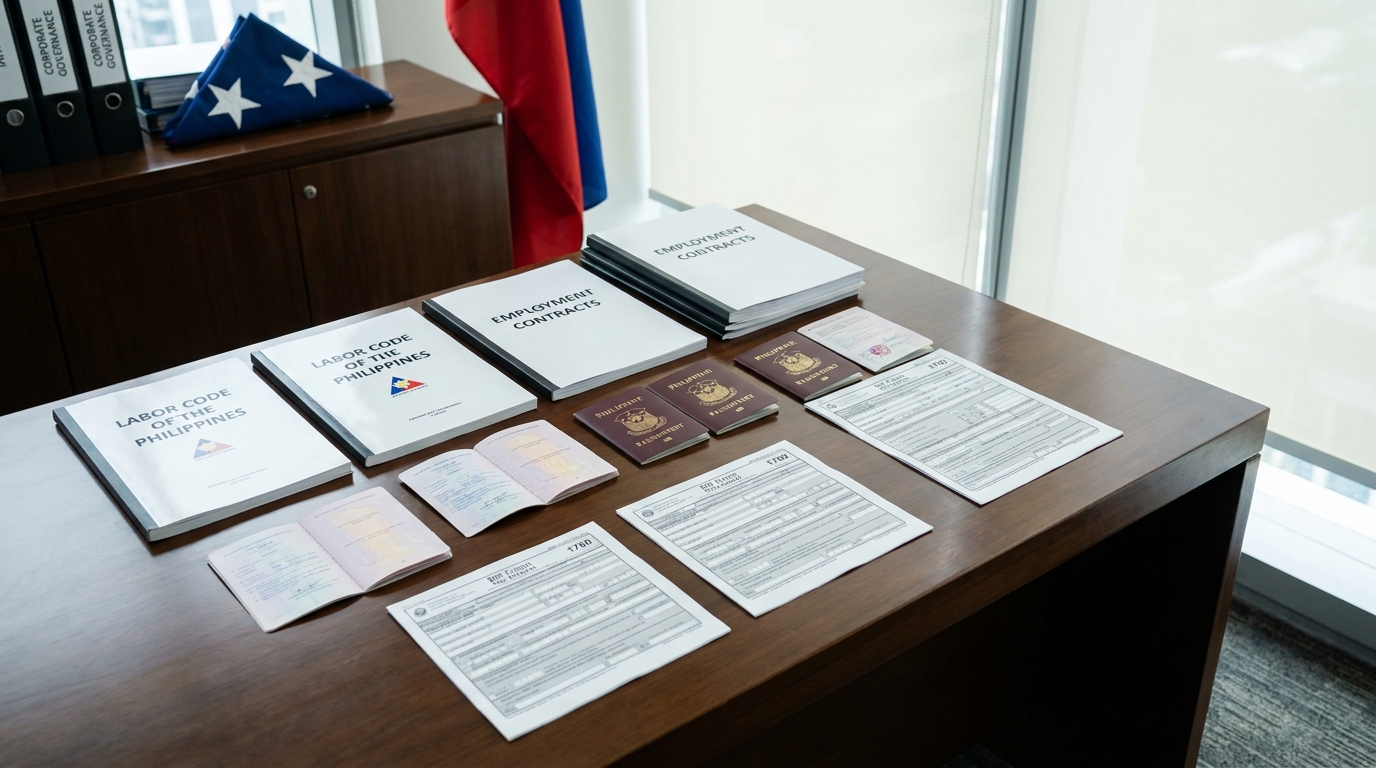
Every foreign company that establishes a presence in the Philippines — whether as a subsidiary, a branch office, a representative office, or a regional operating headquarters — eventually faces the same challenge: hiring the right people. And more often than not, at least some of those hires will be foreign nationals. Bringing in talent from abroad is not simply a matter of extending an offer and issuing a contract. Philippine law imposes a layered system of visa requirements, employment permit obligations, labor law compliance, and reporting rules that apply specifically to foreign workers — and the penalties for getting it wrong fall on the employer, not the employee.
This guide is written for HR directors, compliance officers, legal counsel, and investors who are building out their Philippine teams. It covers the complete legal framework for employing foreign nationals in the Philippines in 2026 — the visa categories, the Alien Employment Permit process, the labor law obligations, the tax implications, the compliance checkpoints, and the practical steps employers should take before, during, and after onboarding a foreign employee.
I. The Foundational Legal Framework
The Philippine Immigration Act of 1940
The employment of foreign nationals in the Philippines begins with the Philippine Immigration Act of 1940 (Commonwealth Act No. 613), which establishes the basic visa categories under which foreigners may enter, stay, and work in the country. CA 613 classifies foreign nationals and defines the conditions under which each class may engage in employment. Section 9(g) of CA 613 provides the legal basis for the most common work visa — the pre-arranged employment visa, or "9(g) visa" — which is available to foreign nationals coming to the Philippines for pre-arranged employment, on a petition showing that no person in the Philippines is willing and competent to do the work (Section 20).
CA 613 is administered by the Bureau of Immigration (BI), which processes visa extensions, conversions, and cancellations. Understanding the Immigration Act is foundational because it determines which visa category a foreign employee falls under, which in turn determines the employment permit requirements, the reporting obligations, and the permitted duration of stay.
The Labor Code of the Philippines
The Labor Code of the Philippines (Presidential Decree No. 442, as amended) governs the employment relationship within the Philippines. Article 40 of the Labor Code expressly provides that before a foreign national may be employed in the Philippines, the employer must first secure a work permit from the Department of Labor and Employment (DOLE). This work permit is the Alien Employment Permit (AEP).
Philippine law also establishes a general preference for the employment of Filipino citizens. Article XII, Section 12 of the 1987 Constitution directs the State to promote the preferential use of Filipino labor, and Article 40 of the Labor Code allows an employment permit to be issued to a non-resident alien only after a determination that no one in the Philippines is competent, able and willing to do the work. While this does not prohibit the employment of foreign nationals, it creates the legal and policy framework within which work permit applications are evaluated — DOLE will scrutinize whether the foreign hire is truly necessary and whether a qualified Filipino worker could perform the same role.
Commonwealth Act No. 613 — The Immigration Act in Detail
CA 613 establishes the following categories of foreign nationals relevant to employment:
- Non-immigrants (Section 9): Foreign nationals admitted for a specific purpose and limited period, including temporary visitors (9(a)), treaty traders and investors (9(d)), students (9(f)), and foreign nationals coming to pre-arranged employment (9(g)). Of these, the 9(g) class is the one built for employment.
- Immigrants (Section 13): Foreign nationals admitted for permanent residence, including quota immigrants and non-quota immigrants such as the spouses and children of Philippine citizens.
- Special non-immigrants (Section 47(a)(2)) and special resident visas under other laws: Section 47(a)(2) allows the admission, when the public interest warrants, of aliens not otherwise provided for in the Act. Separate laws create special visas such as the Special Investor's Resident Visa administered by the Board of Investments and the Special Resident Retiree's Visa administered by the Philippine Retirement Authority.
For most foreign employees of Philippine corporations, the relevant classification is a non-immigrant admitted under Section 9(g), where the purpose of entry is specifically to engage in pre-arranged employment with a specific Philippine employer, and the visa is petitioned for by that employer.
II. The Alien Employment Permit (AEP): Requirements and Process
Legal Basis and Governing Regulations
The Alien Employment Permit (AEP) is the primary work authorization document for foreign nationals employed in the Philippines. It is issued by the DOLE under Article 40 of the Labor Code. The AEP confirms that the employment of a specific foreign national in a specific position has been reviewed and approved by the government labor authorities.
The governing regulations for AEP processing are found in:
- DOLE Department Order No. 248, Series of 2025 ("New Rules and Regulations on the Employment of Foreign Nationals in the Philippines", signed January 21, 2025) — this is the current regulatory framework, which significantly revised the application requirements and timelines of the earlier AEP rules.
- DOLE Department Order No. 248-A, Series of 2025 — supplemental guidelines clarifying and amending DO 248.
DO 248, Series of 2025 states as its policy that Filipino citizens be given due preference in employment and that skills and technology be transferred from foreign hires to Filipino workers. The new rules introduced a wider labor market test, an economic needs test, and training-program requirements for certain employers.
Who Must Secure an AEP
Any foreign national who wishes to engage in gainful employment in the Philippines must secure an AEP before commencing work: DO 248 requires the employer to secure the AEP before the actual start of employment, and makes the employment contract effective only once the AEP is issued. DO 248 recognises two groups who do not need an AEP, but each must still obtain a certificate from DOLE before taking up employment:
- Exempted (Rule V, Section 1) — among others, the dependent spouse of a member of the diplomatic corps (where a reciprocity agreement exists); accredited officials and personnel of international organisations; embassy officers and staff; visiting, exchange or adjunct professors under a formal agreement; permanent, probationary or temporary resident visa holders; recognised refugees and stateless persons; and anyone exempted by law. These need a Certificate of Exemption.
- Excluded (Rule V, Section 3) — members of the governing board with voting rights only who do not take part in management; a president or treasurer who is a part-owner of the employer (subject to the Anti-Dummy Law); certain intra-corporate transferees and contractual service suppliers under trade agreements; and authorised representatives of foreign principals of licensed recruitment or manning agencies. These need a Certificate of Exclusion.
The key nuance here is that investor status alone does not authorize employment. A foreign national who holds a special resident visa and wishes to work should confirm whether the visa falls within the resident-visa exemption and, if so, obtain a Certificate of Exemption before starting; otherwise, a regular AEP is required.
Application Requirements Under DO 248, Series of 2025
The AEP application is filed by the employing Philippine entity with the DOLE Regional Office that has jurisdiction over the intended place of work. Under Rule II, Sections 1 to 6 of DO 248:
- Labor market test (publication) — before filing, the employer must publish the vacancy and the name of the foreign national in a newspaper of general circulation. As amended by DO 248-A (Sec. 1), posting on PhilJobNet and with the Public Employment Service Office (PESO) or Job Placement Office is encouraged but is not a precondition to filing. The publication is valid for 45 days. Corporate officer positions identified in the Articles of Incorporation, By-Laws or General Information Sheet are exempt from publication.
- Filing window — the application may be filed no earlier than 15 calendar days after publication, and within 15 calendar days from execution of the employment contract or issuance of the appointment.
- Accomplished application form — signed by the employer and the foreign national, including the Employer Registration Number.
- Copy of the passport bio-page with the appropriate valid visa.
- Proof of the foreign national's Taxpayer Identification Number — BIR Form 1904 or 1902 received by the BIR, or an equivalent BIR certification or e-registration.
- Notarised or authenticated employment contract or appointment — stating the position, scope of work, duties, salary and other benefits.
- Proof of the employer's legal personality — e.g., SEC Certificate of Registration, Articles of Incorporation and By-Laws and updated GIS, a business permit, or an economic zone registration.
- Proof of publication (unless exempt), with an affidavit that no Filipino applied or was found competent, able and willing for the position.
- Proof of the foreign national's qualifications — educational credentials, work experience, licences or certifications.
- Additional permits where applicable — a Special Temporary Permit from the Professional Regulation Commission for regulated professions; an Authority to Employ Alien from the DOJ where the employer is covered by the Anti-Dummy Law; a DENR Authority to Hire Foreign National for mining; and PCAB, DOLE contractor-registration or PAGCOR documents for the relevant sectors.
- Training program — employers granted fiscal incentives, engaged in priority or strategic investments, or operating public utilities must submit an Understudy Training Program or Skills Development Program with the application (Rule VI, Section 3).
- DOLE fee — PHP 6,000 for an AEP valid for one year, plus PHP 5,000 for every additional year or fraction of a year.
Processing Timeline and Validity
Under DO 248, the DOLE Regional Office acts on a new AEP application within fifteen (15) working days from payment of the fee, and issues the AEP within one working day of approval. The application may be processed while the foreign national is still abroad, but the AEP is released only after the foreign national has entered the Philippines on the appropriate 9(g) or working visa. The AEP is valid for one year unless the employment contract supports a shorter or longer period, but never more than three (3) years. Renewal may be filed within 60 calendar days before expiry. Employers should plan for a longer window in practice, given the publication period and the common need to supplement incomplete applications.
The AEP is employer-specific and position-specific. It is non-transferable, only one AEP may be issued to a foreign national at a time, and it may be used only for the position for which it was issued; an additional position with the same employer or a related company requires a separate application. Under Article 41 of the Labor Code, the foreign national may not transfer to another job or change employers without prior DOLE approval.
III. Visa Categories for Foreign Employees
9(g) Pre-Arranged Employment Visa — The Standard Work Visa
The most common visa for foreign employees in the Philippines is the Section 9(g) pre-arranged employment visa, issued under CA 613. This visa is processed by the Bureau of Immigration on a petition filed by the Philippine employer. The application sequence is:
- The employer files the AEP application with DOLE. Under DO 248 the application may be processed while the foreign national is abroad, but the AEP is released only once the foreign national has entered on the appropriate 9(g) or working visa.
- The employer files a petition with the Bureau of Immigration, accompanied by the employment contract, corporate documents, and the foreign employee's passport and biographical data. Under Section 20 of CA 613, the petition must show that no one in the Philippines is willing and competent to do the work and that the admission would benefit the public interest.
- The foreign employee applies for the consular visa at the nearest Philippine Embassy or Consulate in their country of residence (if not already in the Philippines on another visa).
- Upon entry, the foreign employee completes the 9(g) visa implementation and registration with the BI.
Foreign employees already in the Philippines on another valid visa (e.g., a tourist visa) may apply for conversion to a 9(g) visa without leaving the country, provided they have not violated the conditions of their current visa. This process is commonly used by foreign nationals who enter as visitors and subsequently receive a job offer.
Section 47(a)(2) Special Non-Immigrant Visa
Section 47(a)(2) of CA 613 authorises the admission, when the public interest warrants, of aliens not otherwise provided for in the Act, for a temporary period and under conditions the government prescribes. It is used for specific categories of foreign workers rather than as the general work visa, and holders still need DOLE work authorisation unless they fall within an exemption or exclusion.
Critically, in 2024 and 2025, there have been legislative discussions about reforming the 9G visa system. The proposed changes include longer validity periods (potentially up to five years for qualified foreign professionals), higher application fees, and additional reporting requirements. Employers and foreign employees should monitor BI announcements for updates, as these changes could affect renewal timelines and compliance costs. As of the date of this guide, the 9G remains governed by existing BI regulations, but proposed amendments are pending Congressional action.
Special Categories: SIRV, SRRV, and Treaty Trader Visas
Foreign investors and retirees who hold special visas should be aware of the employment restrictions attached to their status:
- Special Investors Resident Visa (SIRV) — Under the Omnibus Investments Code (Executive Order No. 226) and administered by the BOI, SIRV holders may reside in the Philippines while they maintain a qualifying investment. The SIRV itself is not a work permit: before taking up employment, the holder needs DOLE authorisation — a Certificate of Exemption if the visa falls within DO 248's exemption for resident visa holders, or otherwise an AEP.
- Special Resident Retiree's Visa (SRRV) — Under the retirement program of the Philippine Retirement Authority (created by Executive Order No. 1037), SRRV holders have the right to reside in the Philippines. The SRRV is a retirement visa, not an employment visa; the same DOLE certificate-or-AEP rule applies before the holder starts work.
- Treaty Trader Visa (Section 9(d) of CA 613) — Available to nationals of countries that have a treaty of commerce and navigation with the Philippines, who come solely to carry on substantial trade between the two countries or to develop and direct the operations of an enterprise in which they have invested substantial capital. This category is narrow and depends on the specific treaty.
IV. Labor Law Obligations for Employers of Foreign Nationals
Foreign Hires in BOI-Registered Enterprises and Training Obligations
Under Article 40 of the Omnibus Investments Code (Executive Order No. 226), a BOI-registered enterprise may employ foreign nationals in supervisory, technical or advisory positions for a period not exceeding five (5) years from its registration, extendible for limited periods at the Board's discretion. Where foreign investors own the majority of the capital stock, the positions of president, treasurer and general manager (or their equivalents) may be held by foreign nationals beyond that period. Key conditions under current rules include:
- Foreign nationals in these enterprises are meant for supervisory, technical or advisory positions — the incentive does not generally cover rank-and-file positions.
- Under DO 248, employers granted fiscal incentives, engaged in priority or strategic investments, or operating public utilities must adopt an Understudy Training Program (at least two next-in-rank regular employees per foreign national) or a Skills Development Program (at least two regular rank-and-file Filipino employees per foreign national), and report on it to DOLE. Failure to implement the program is a ground to revoke the AEP.
- Foreign nationals still need an AEP (or a certificate of exemption or exclusion) from DOLE.
For all employers, the AEP is granted only where no Filipino is competent, able and willing to do the job, and DO 248 adds an economic needs test under which DOLE weighs labor shortages, the local availability of the required skills, and the national economic interest. DOLE Regional Offices may also conduct verification inspections of the employer's premises when evaluating an application.
Working Hours, Benefits, and the Labor Code
Foreign employees employed in the Philippines are entitled to the same basic labor rights as Filipino employees under the Labor Code — including the rule on normal hours of work (not more than eight hours a day under Article 83 of the Labor Code), overtime pay, night shift differentials, and holiday pay. Employers who assume that foreign employees are exempt from these protections because they are on expatriate contracts are making a serious compliance error.
This is particularly relevant for foreign employees on international contracts that provide benefits and working conditions less favorable than Philippine law requires. If a foreign employee's contract provides for fewer paid leaves or lower overtime rates than Philippine law mandates, the Labor Code provisions prevail. Philippine courts and DOLE apply this principle consistently — contractual provisions that diminish statutory rights are void as contrary to public policy.
Social Security and Employee Benefits
Foreign nationals employed in the Philippines for more than six months are covered by the Social Security System (SSS) and the Home Development Mutual Fund (HDMF, or Pag-IBIG Fund). The employer must register the foreign employee with SSS and HDMF within 30 days of employment and remit contributions. Employers also contribute to the Employees' Compensation Insurance System (ECIS) under the State Insurance Fund.
Foreign employees who are only in the Philippines for a short assignment (e.g., less than six months) may be covered by a bilateral social security agreement with their home country, if such an agreement exists. The Philippines has social security totalization agreements with several countries. Employers should verify whether the foreign employee's home country has such an agreement with the Philippines to determine whether local SSS registration is required.
Grounds for Cancellation of Work Permits and Visas
Under Rule IV of DO 248, DOLE cancels an AEP when it is not claimed on time, when the employer reports closure or cessation of the activity, or on the foreign national's resignation or separation. DOLE may revoke an AEP, after due process, on grounds that include:
- Any ground for denying the application, such as failing the labor market test or the economic needs test
- Misrepresentation, false statements, tampering or fraud in securing the AEP
- Substituting a different employment contract or appointment from the one submitted
- Failure to implement a required Understudy Training Program or Skills Development Program
- Violation of DO 248, the Labor Code, or related guidelines — for example, assigning the foreign national to functions or workplaces outside those approved
Revocation can disqualify both the employer and the foreign national from applying for an AEP for five or ten years, depending on the ground.
The BI, similarly, may cancel a work visa if the foreign employee is found to be working beyond the scope of the approved petition, if the employment has been terminated, or if the foreign employee has become a threat to public order or national security. DO 248 also directs DOLE to set up referral and data-sharing systems with other government agencies concerned with foreign nationals and their employers.
V. Tax Obligations for Foreign Employees and Their Employers
Income Tax Treatment of Foreign Employees
Foreign nationals employed in the Philippines are subject to Philippine income tax under the National Internal Revenue Code of 1997, as amended (particularly by the Tax Reform for Acceleration and Inclusion Act, or TRAIN Act — RA 10963). The tax treatment depends on whether the foreign employee is classified as a resident alien or a non-resident alien.
Under Section 23(D) of the NIRC, an alien individual, whether a resident or not, is taxable only on income derived from sources within the Philippines; only resident Filipino citizens are taxed on worldwide income. A resident alien pays tax on Philippine-source taxable income at the same graduated rates as citizens. A non-resident alien who stays in the Philippines for an aggregate of more than 180 days in a calendar year is deemed engaged in trade or business and is likewise taxed at the graduated rates; a non-resident alien who stays 180 days or less is taxed at a flat 25% on gross Philippine-source income.
For most foreign employees on 9(g) work visas who spend significant time in the Philippines, the practical result is that their Philippine compensation is taxed at the regular graduated rates. Salaries for work performed in the Philippines are Philippine-source income even if paid from abroad, so foreign employees and their employers should review how home-country payroll and split-pay arrangements are reported.
The 15% Preferential Rate and Its Limits
Section 25(C) to (E) of the NIRC provides a flat 15% tax on the gross compensation of alien individuals (and Filipinos in the same positions) employed by regional or area headquarters and regional operating headquarters of multinational companies, offshore banking units, and foreign petroleum service contractors and subcontractors. It is not a general rate for employees of PEZA- or BOI-registered companies.
The TRAIN Act (Section 25(F)) also closed this rate to RHQs, ROHQs, offshore banking units and petroleum service contractors registering with the SEC after January 1, 2018; entities already availing of it before then may continue to apply it to present and future qualified employees. The CREATE MORE Act (RA 12066, enacted November 2024) amended corporate tax and incentive rules and did not reopen this preferential rate.
Employer Withholding Tax Obligations
Philippine employers are required to withhold tax on compensation paid to foreign employees at source. The withholding is remitted to the BIR monthly. The employer files BIR Form 1601-C (Monthly Remittance Return of Income Taxes Withheld on Compensation), files the annual information return with the alphalist of employees (BIR Form 1604-C), and gives the BIR Form 2316 (Certificate of Compensation Payment/Tax Withheld) to the employee at year-end for use in their Philippine income tax return.
Foreign employees who must file an annual return — for example, because they have more than one employer in the year, have other taxable income, or their tax was not correctly withheld — file BIR Form 1700 (Annual Income Tax Return) by April 15 of the following year. Employees with purely compensation income from a single employer whose tax was correctly withheld qualify for substituted filing under Section 51-A of the NIRC and need not file. Employers should remind foreign employees of any filing obligation, as failure to file is the employee's personal liability — not the employer's — but can create compliance complications for the employer if the employee's tax affairs are not in order.
VI. Bringing Foreign Family Members: Dependent Visas
Foreign employees holding valid 9(g) visas may bring their immediate family members as dependents — under Section 9(g) of CA 613 itself, the spouse and unmarried children under 21 who accompany or follow to join the employee. The dependent visa allows the spouse and children to reside in the Philippines and, if desired, to enroll in local schools. However, dependent visa holders are not authorized to work without securing their own AEP.
For foreign employees planning extended assignments in the Philippines, this is an important planning consideration. Dual-career households where both spouses intend to work will need to budget for a second AEP application for the working spouse.
VII. Termination of Employment: Compliance Points
When a foreign employee's employment ends — whether through resignation, termination, or the expiry of the employment contract — employers have specific compliance obligations:
- Notify the Bureau of Immigration — employers are required to inform the BI when a foreign employee's employment has terminated. This is typically done through the employer-sponsored visa petition, which is considered abandoned upon termination of employment.
- Foreign employee must convert to another visa category or depart — a foreign national whose employment has ended cannot continue to stay in the Philippines on a work visa. They must either depart, convert to a tourist or other non-work visa, or secure a new employer-sponsored petition within the grace period provided under BI regulations.
- AEP cancellation — DO 248 requires the employer to report the foreign national's resignation or separation to the DOLE Regional Office within ten (10) calendar days, and the employer may request cancellation of the AEP on that ground. This prevents the situation where a former foreign employee's permit remains active with a former employer.
- Final pay and benefits — foreign employees are entitled to all earned wages, prorated 13th month pay, and any other benefits under the Labor Code at the time of termination. If the termination is by the employer (not resignation), the foreign employee may be entitled to notice and separation pay for authorized causes under Article 298 (formerly Article 283) of the Labor Code.
Failure to properly cancel the visa petition and AEP can create compliance liabilities for both the employer and the foreign employee — the BI actively monitors visa status, and an employee whose petition has lapsed while remaining in the country is vulnerable to overstay penalties.
VIII. Compliance Checklist for Employers
Below is a practical checklist for Philippine employers hiring foreign nationals, based on the current regulatory framework as of April 2026:
- Before hiring: Confirm that the position is not one where Filipino professionals are readily available. Prepare the local hire justification for the DOLE application.
- Pre-filing: Publish the vacancy in a newspaper of general circulation, and consider also posting it on PhilJobNet and with the PESO (unless the position is an exempt corporate officer post), then file within the DO 248 windows: no earlier than 15 calendar days after publication, within 15 calendar days of signing the contract, and within the 45-day life of the publication. Obtain a notarised or authenticated employment contract.
- File AEP with DOLE before the foreign national commences work. Do not allow the employee to start work until the AEP is in hand. The AEP is a prerequisite, not a concurrent filing.
- File the BI 9(g) petition in coordination with the AEP application — DOLE releases the AEP only once the foreign national has entered on the appropriate 9(g) or working visa. Monitor the BI processing timeline.
- Register foreign employee with SSS and Pag-IBIG within 30 days of first day of work.
- Set up payroll withholding for income tax, SSS, Pag-IBIG, and PhilHealth contributions.
- Monitor AEP and visa renewal deadlines — set internal reminders 90 days before expiry. An AEP is valid for one year by default (up to three years if the contract supports it), and renewal may be filed within 60 calendar days before expiry.
- Report to DOLE — a quarterly list of foreign nationals with AEPs within 30 days after each quarter, and changes in material information within 10 calendar days.
- On termination: Notify BI, DOLE (within 10 calendar days), SSS, and Pag-IBIG of the termination. Process final pay and benefits in accordance with the Labor Code.
IX. Key Risks and How to Mitigate Them
The most common compliance failures we see in practice are:
Allowing foreign employees to work before the AEP is issued. This is a common violation. Employers assume they can start the process and have the employee begin working while the AEP is pending. This exposes both the employer and the employee to administrative penalties under DO 248 — a fine of up to PHP 10,000 each for every prohibited act, and a bar on future AEP applications — as well as penalties under the Labor Code.
Using investor or retiree visas as a workaround for work permits. Some foreign nationals enter on SIRV or SRRV and simply begin working without disclosing this to their employer. Employers should require foreign hires to disclose their visa status and confirm whether an AEP or a DOLE Certificate of Exemption is required before work starts. The employer is ultimately responsible for ensuring that every person working in its Philippine operations has the appropriate authorization.
Failing to renew on time. The 9(g) visa and the AEP both carry fixed validity periods. Given the processing times involved, employers should begin renewal preparations 90 days before the current permit's expiration and file the AEP renewal within the 60-day window before expiry. A lapsed permit creates a gap during which the foreign employee is working without legal authorization.
Not accounting for incentive-related conditions. Companies that scale up foreign headcount rapidly — particularly in IT, operations, or finance functions — without tracking the BOI limits on foreign supervisory, technical and advisory staff, or their UTP/SDP reporting under DO 248, can face compliance actions, especially if they are PEZA- or BOI-registered.
X. Looking Ahead: Proposed Regulatory Changes in 2026
As of early 2026, several regulatory developments are in various stages of implementation or Congressional consideration that could affect the employment of foreign nationals in the Philippines:
- Proposed amendments to the 9G visa structure — BI and Congress have been exploring longer-validity visas (up to 5 years) for qualified foreign professionals, with higher associated fees and more stringent documentation requirements. Employers should monitor BI announcements for revised procedures.
- Further guidance under DO 248 — DOLE has already issued supplemental guidelines (DO 248-A, Series of 2025), and DO 248 itself contemplates further advisory guidelines on the economic needs test and possible "negative and positive lists" of occupations for foreign nationals (Rule II, Section 8; Rule VIII, Section 1).
- FIRB threshold adjustments — The Fiscal Incentives Review Board (FIRB) has been incrementally adjusting the capital thresholds for projects that qualify for fiscal incentives under the CREATE MORE Act. Foreign investors establishing new Philippine operations should verify the current applicable thresholds with their legal counsel or the relevant IPA.
The direction of Philippine immigration and labor policy is toward greater selectivity — the government wants foreign talent that fills genuine skills gaps rather than foreign workers who displace qualified Filipino professionals. Employers who can demonstrate that their foreign hires bring specialized expertise, industry knowledge, or technology transfer that benefits the Philippine workforce will have the smoothest path through the permit process.
Conclusion
Hiring foreign employees in the Philippines is legally straightforward when the process is followed correctly. The key compliance points are deceptively simple: secure the AEP first, then the visa, then bring the employee on board. Maintain the permits, renew on time, and follow the Labor Code in the employment relationship. But the details — which documents need authentication, how to justify the hire to DOLE, what tax treatment applies, when to notify the BI of a termination — are where employers most commonly stumble.
The cost of getting this wrong is not merely financial. An improperly documented foreign employee working in the Philippines creates criminal liability exposure for both the employer and the individual, potential deportation consequences for the employee, and reputational damage to the employer's regulatory standing. For investors building out Philippine operations, getting the employment authorization framework right from the first hire is not optional — it is foundational.
For assistance with AEP applications, BI petitions, employment contract review, or compliance audits for your Philippine operations, contact our team.
Keep reading
New AEP Rules in 2025: What Foreign Workers in the Philippines Must Know
DOLE Department Order No. 248 overhauled the Alien Employment Permit process with stricter requirements. Here is what changed and how it affects foreigners planning to work in the Philippines.

Can a Foreign Company Hire Filipino Remote Workers Without a Local Entity?
Many foreign startups and businesses hire Filipino talent remotely — but doing it legally requires understanding the line between independent contractors and employees under Philippine law.

Employment Law for Foreign Employers in the Philippines: A Legal Guide
A legal guide to Philippine employment law for foreign employers — covering the Labor Code (PD 442), alien employment permits, mandatory benefits (SSS, PhilHealth, Pag-IBIG), 13th month pay, termination procedures, leave entitlements, and compliance obligations that every foreign company hiring in the Philippines must understand.