International Commercial Arbitration for Foreign Investors in the Philippines: The 2026 Legal Framework

For foreign investors entering the Philippine market — whether through a subsidiary, a joint venture, a branch office, or a distribution agreement — disputes are not a question of if but when. Philippine courts handle commercial cases with increasing sophistication, but court litigation brings procedural delay, docket congestion, and a public record, which is why many international parties treat it as a last resort. For most cross-border commercial disputes, the more practical path is arbitration.
The Philippines has had a modern framework for international commercial arbitration for two decades. The Philippines ratified the New York Convention on the Recognition and Enforcement of Foreign Arbitral Awards in 1967. Republic Act No. 9285 (the Alternative Dispute Resolution Act of 2004, or the "ADR Act") then adopted the 1985 UNCITRAL Model Law on International Commercial Arbitration for international arbitrations, and in 2009 the Supreme Court issued the Special Rules of Court on Alternative Dispute Resolution to govern court involvement in arbitration. Arbitral institutions such as the Philippine Dispute Resolution Center, Inc. (PDRCI) and the Construction Industry Arbitration Commission (CIAC) support arbitrations seated in the Philippines, and awards from Singapore, Hong Kong, London, Paris and other Convention seats can be enforced here.
This guide is written for foreign investors and their counsel. It covers the legal framework, the rights and obligations of foreign parties, the enforcement of foreign arbitral awards, the institutions and rules in play, recent developments, and the practical steps to take before a dispute arises. It also covers the other routes a dispute can take (mediation, the courts, tax proceedings, and investor-state arbitration under investment treaties) so you can see where arbitration fits.
I. The Legal Framework: The ADR Act, the Model Law, RA 876 and the Special ADR Rules
The ADR Act: Scope and Purpose
Republic Act No. 9285, approved on April 2, 2004, is the foundational statute governing alternative dispute resolution in the Philippines. It declares a State policy of promoting party autonomy and the use of ADR, covers mediation, arbitration and other forms (conciliation, early neutral evaluation, mini-trial, and combinations such as med-arb), and established the Office for Alternative Dispute Resolution (OADR) as an agency attached to the Department of Justice (Section 49). The OADR's functions include setting training standards for ADR practitioners and certifying those who have completed its training (Section 50).
Under Section 19, international commercial arbitration is governed by the 1985 UNCITRAL Model Law, and under Section 20, Philippine courts must interpret it with regard to its international origin and the need for uniform interpretation. Several other provisions matter directly to foreign parties:
- Foreign counsel (Section 22). In an international arbitration conducted in the Philippines, a party may be represented by any person of its choice. A representative who is not admitted to Philippine practice may not, however, appear as counsel in any Philippine court or quasi-judicial body.
- Default seat and language (Sections 30 and 31). If the parties do not agree on a place of arbitration, it defaults to Metro Manila unless the tribunal decides otherwise; if they do not agree on a language, an international arbitration is conducted in English.
- What cannot be arbitrated under the Act (Section 6). The ADR Act does not apply to, among others, labor disputes covered by the Labor Code, the civil status of persons, the validity of a marriage, the jurisdiction of courts, criminal liability, and matters that by law cannot be compromised. Employment claims by Philippine staff, for example, generally remain with the labor tribunals.
When Is an Arbitration "International"?
The ADR Act uses the Model Law's definition. Section 32 defines domestic arbitration as any arbitration that is not international under Article 1(3) of the Model Law, which treats an arbitration as international where:
- The parties to the arbitration agreement have, at the time the agreement is concluded, their places of business in different states; or
- The place of arbitration, if fixed in or under the arbitration agreement, is outside the state in which the parties have their places of business; or
- Any place where a substantial part of the obligations of the commercial relationship is to be performed, or the place with which the subject matter of the dispute is most closely connected, is outside that state; or
- The parties have expressly agreed that the subject matter of the arbitration agreement relates to more than one country.
Section 21 of the ADR Act then gives "commercial" a broad meaning: all relationships of a commercial nature, whether contractual or not, including supply of goods or services, distribution, construction, agency, licensing, investment, financing, banking, insurance, and joint ventures.
One point to watch: the test turns on the parties' places of business, not their ownership. A contract between your Philippine subsidiary and a Philippine counterparty will usually be a domestic arbitration, even though the subsidiary is foreign-owned. (The ADR Act's own definition of an "international party" in Section 3(p) likewise excludes a domestic subsidiary of a foreign entity.) If you want the international regime, structure the contracting party, the seat, or the express agreement accordingly.
Domestic Arbitration: Republic Act No. 876
Domestic arbitration continues to be governed by Republic Act No. 876 (the Arbitration Law of 1953), as amended by the ADR Act (Section 32). Section 33 of the ADR Act applies several Model Law articles and Sections 22 to 31 of the ADR Act to domestic arbitration as well, so the two regimes are closer than they once were. Under RA 876:
- Parties may submit an existing controversy to arbitration, or include an arbitration clause covering future disputes (Sections 2 and 4).
- If the parties cannot agree on arbitrators, the court may appoint them (Section 8).
- The award must be in writing and signed by the arbitrators or a majority of them (Section 19).
- An award may be confirmed by the Regional Trial Court (Section 23; ADR Act Section 40) and, once confirmed, is enforced like a final and executory RTC decision.
- An award may be vacated only on the narrow grounds listed in Section 24 of RA 876: corruption or fraud, evident partiality or corruption of the arbitrators, misconduct (such as refusing to postpone a hearing on sufficient cause or to hear pertinent evidence), or the arbitrators exceeding their powers. Section 41 of the ADR Act directs courts to disregard any other ground.
Under the Special ADR Rules, a petition to vacate a domestic award must be filed not later than 30 days from receipt of the award (Rule 11.2(C)).
The Special ADR Rules
The Special Rules of Court on Alternative Dispute Resolution (A.M. No. 07-11-08-SC), which took effect on October 30, 2009, govern every court proceeding connected with arbitration: referral to arbitration, interim measures, appointment of arbitrators, setting aside, and recognition and enforcement. They are designed to limit judicial intervention.
Under Rule 2.2, where the parties have agreed to arbitrate, courts must refer them to arbitration and may not refuse on the grounds that referral would oust the court of jurisdiction, that the court is in a better position to resolve the dispute, that referral would result in multiple suits, that the arbitration has not yet commenced, that the place of arbitration is in a foreign country, or that one or more arbitrators are not lawyers, are not Philippine nationals, or allegedly lack required qualifications. Section 24 of the ADR Act requires the request for referral to be made not later than the pre-trial conference (or later, by both parties).
For foreign investors, this means a Philippine counterparty that sues in court despite an arbitration clause can generally be sent back to arbitration, including arbitration seated abroad and before foreign arbitrators, provided you raise the clause in time.
Key Provisions of the UNCITRAL Model Law as Adopted
Article 7 — Arbitration Agreement
An arbitration agreement may be a clause in a contract (an arbitration clause) or a separate agreement (a submission agreement). It must be in writing, a requirement that extends to agreements recorded in exchanges of letters, telexes or other telecommunications; Section 4 of the ADR Act also applies the Electronic Commerce Act (Republic Act No. 8792) and its implementing rules to proceedings under the Act.
Article 16 — Competence-Competence and Separability
The tribunal may rule on its own jurisdiction, including objections to the existence or validity of the arbitration agreement. An arbitration clause is treated as an agreement independent of the other terms of the contract, so a decision that the contract is null and void does not automatically invalidate the clause.
Article 20 — Seat and Place of Arbitration
The Model Law distinguishes the juridical seat of arbitration (which determines the procedural law governing the arbitral process, the lex arbitri) from the physical place of hearings, which the tribunal may hold elsewhere. Choosing the seat is among the most consequential decisions in drafting an arbitration clause. A Philippine seat means the Model Law applies as the lex arbitri, Philippine courts have supervisory jurisdiction, and any setting-aside proceedings are brought in Philippine courts.
Article 34 — Setting Aside Proceedings
For an international award made in the Philippines, a party may apply to set the award aside only on limited grounds: that a party was under some incapacity or the arbitration agreement was invalid, that a party was not given proper notice or was otherwise unable to present its case, that the award deals with matters beyond the scope of the submission, that the tribunal or procedure did not conform to the parties' agreement, that the subject matter is not arbitrable, or that the award conflicts with public policy. Under the Special ADR Rules, the petition must be filed within three months from receipt of the award (Rule 12.2(B)), and the court "shall not disturb the arbitral tribunal's determination of facts and/or interpretation of law" (Rule 12.13). Philippine courts read "public policy" narrowly in this context.
II. The New York Convention: Enforcement of Foreign Awards
The Philippines signed the New York Convention on June 10, 1958 and ratified it on July 6, 1967; it entered into force for the Philippines on October 4, 1967. Section 42 of the ADR Act confirms that the Convention governs the recognition and enforcement of awards it covers. For foreign investors, this is one of the most practically significant parts of the framework.
The Philippines' Two Reservations
On ratification, the Philippines declared that it will apply the Convention:
- Reciprocity reservation — only to awards made in the territory of another contracting state; and
- Commercial reservation — only to differences arising out of legal relationships, whether contractual or not, that are considered commercial under Philippine law.
In practice neither is often an obstacle. The Convention has more than 170 contracting states, including every major arbitral seat, and Section 21 of the ADR Act defines "commercial" broadly. Under Section 42, the party applying for enforcement must show that the award was made in a Convention state. Awards from non-Convention states are not shut out: under Section 43, the court may, on grounds of comity and reciprocity, recognize and enforce a non-Convention award as if it were a Convention award.
Under the Convention, an award made in another contracting state is entitled to recognition and enforcement in the Philippines subject only to the limited defenses in Article V. A foreign investor who obtains an ICC, SIAC, HKIAC, LCIA or UNCITRAL award in Singapore, Hong Kong, London or Paris can therefore enforce it in Philippine courts through a defined, limited procedure.
The Article V Defenses
Section 45 of the ADR Act and Rule 13.4 of the Special ADR Rules limit the grounds for refusal to those in Article V of the Convention. A Philippine court may refuse recognition or enforcement only if the party opposing enforcement proves that:
- A party was under some incapacity, or the arbitration agreement was invalid under the law the parties chose (or, failing that, the law of the country where the award was made);
- The party was not given proper notice of the appointment of the arbitrator or of the proceedings, or was otherwise unable to present its case;
- The award covers matters beyond the scope of the submission to arbitration, although the parts of the award within scope may be enforced if they can be separated from those outside it;
- The composition of the tribunal or the arbitral procedure did not follow the parties' agreement or, failing agreement, the law of the seat; or
- The award has not yet become binding on the parties, or has been set aside or suspended by a competent authority of the country in which it was made.
The court may also refuse on its own if the subject matter is not capable of settlement by arbitration under Philippine law, or if enforcement would be contrary to Philippine public policy. The burden of proving any of these grounds is on the party resisting enforcement, and any other ground raised is disregarded (ADR Act, Section 45). A court reviewing a foreign award does not re-try the merits; an arbitral tribunal's mistakes of fact or law are not, by themselves, grounds for refusal. In Mabuhay Holdings Corporation v. Sembcorp Logistics Limited (G.R. No. 212734, December 5, 2018), the Supreme Court upheld the enforcement of an ICC award against objections that included arbitrability and public policy.
Enforcement Procedure in the Philippines
A petition to recognize and enforce a foreign award may be filed at any time after receipt of the award (Rule 13.2). It is a special proceeding filed with the Regional Trial Court (RTC) of, at the applicant's option, the place where the arbitration was conducted, where the assets to be attached or levied on are located, where any party resides or has its place of business, or the National Capital Judicial Region (ADR Act, Section 47). The petition must state, among other things, the country where the award was made and whether it is a Convention state, and must attach authentic copies of the arbitration agreement and the award, with certified English translations of any document not in English (Rule 13.5; ADR Act, Section 42).
The proceeding is summary; there is no full trial on the merits, and the court's role is to determine whether any Article V ground is proven. Once recognized, the award is enforced as a foreign arbitral award, not as a foreign judgment, and in the same manner as a final and executory Philippine court decision (Section 44).
An RTC decision recognizing or refusing to recognize a foreign award may be appealed to the Court of Appeals by petition for review (Rule 19.12). The appeal does not stay the decision unless the Court of Appeals directs otherwise, and a stay of execution of an arbitral award requires a bond equal to the amount of the award (Rule 19.22; see also ADR Act, Section 46).
Practitioners note that Philippine courts have become increasingly familiar with the New York Convention framework, and uncontested cases move faster than they once did. Contested enforcement proceedings, where the debtor raises Article V objections, can still take one to three years to resolve through the court system.
III. Institutional Arbitration in the Philippines
Philippine Dispute Resolution Center, Inc. (PDRCI)
The Philippine Dispute Resolution Center, Inc. (PDRCI) is a non-stock, non-profit institution incorporated in 1996 out of the Arbitration Committee of the Philippine Chamber of Commerce and Industry. It administers domestic and international arbitrations under its own rules and also offers mediation. Its roster includes Filipino and foreign arbitrators, and its rules allow parties to shape the procedure, including the language, the governing law, and the rules of evidence. PDRCI arbitration is often considered for mid-sized disputes where the parties, assets and evidence are mainly in the Philippines. Like any Philippine-seated award, a PDRCI award is enforced as a domestic award or an international award made in the Philippines, depending on whether the arbitration is domestic or international (see Section I).
Construction Industry Arbitration Commission (CIAC)
The Construction Industry Arbitration Commission (CIAC) was created by Executive Order No. 1008 (1985), the Construction Industry Arbitration Law, as a body within the Construction Industry Authority of the Philippines. Under Section 4 of EO 1008, the CIAC has original and exclusive jurisdiction over disputes arising from, or connected with, contracts entered into by parties involved in construction in the Philippines, whether the dispute arises before or after completion, abandonment or breach of the contract. Covered disputes include violations of specifications and contract terms, interpretation of contract provisions, damages and penalties, delays, defects, and payment defaults.
For the CIAC to acquire jurisdiction, the parties must have agreed to arbitrate. Once there is an arbitration agreement in a construction contract:
- CIAC jurisdiction continues even if the arbitration is "commercial" under Section 21 of the ADR Act, and it extends to project owners, contractors, subcontractors, quantity surveyors, bondsmen and insurers bound by the agreement (ADR Act, Section 35).
- A court in which a construction dispute is filed must dismiss the case once it becomes aware, no later than pre-trial, that the parties agreed to CIAC arbitration, unless both parties agree in writing to have the court decide it (ADR Act, Section 39).
- The CIAC must have rules allowing a foreign arbitrator who is not CIAC-accredited to sit where one party is an international party, subject to conditions including nomination by the international party and a nationality different from that party's (ADR Act, Section 37).
- A CIAC award is final and cannot be appealed except on questions of law (EO 1008, Section 19), and it is executory without RTC confirmation (ADR Act, Section 40).
For foreign investors engaged in infrastructure projects, real estate development, or construction contracts, including public-private partnerships and contracts with government entities, CIAC arbitration is therefore often the applicable forum. Consider this when choosing a seat or institution, because a clause pointing elsewhere does not by itself remove a construction dispute from CIAC jurisdiction.
International Chamber of Commerce (ICC)
ICC arbitrations are administered by the ICC International Court of Arbitration and its Secretariat under the ICC Rules of Arbitration, which are widely used in international commerce. ICC Philippines is the ICC's national committee in the country; it promotes ICC arbitration locally and may be asked to propose arbitrators. The Philippines can serve as the seat of an ICC arbitration, and ICC awards made in the Philippines are enforceable domestically under the ADR Act and internationally under the New York Convention.
Singapore International Arbitration Centre (SIAC) and Other Offshore Seats
Many foreign investors with Philippine operations choose to arbitrate outside the Philippines, typically in Singapore (under SIAC rules), Hong Kong (under HKIAC rules), or London (under LCIA rules). These seats have courts experienced in supervising arbitration, deep pools of arbitrators, and established enforcement practice. Singapore, Hong Kong and the United Kingdom are all New York Convention jurisdictions, so an award rendered there is enforceable in the Philippines under the Convention framework described above.
IV. Drafting Arbitration Clauses for Philippine Contracts: A Foreign Investor's Checklist
The most important arbitration work happens before a dispute arises, in the drafting of the clause. A poorly drafted clause can undermine the entire process. Address the following in every arbitration clause governing a Philippine contract with foreign elements.
Arbitration or Litigation
For cross-border contracts, arbitration is usually preferred because awards are enforceable under the New York Convention, proceedings are confidential, the parties can choose arbitrators with relevant expertise, and the dispute stays out of congested court dockets. Decide this expressly: a contract with no dispute resolution clause defaults to the courts.
Seat and Place of Arbitration
The seat determines the lex arbitri and which courts supervise the arbitration. A Philippine seat means the ADR Act, the Model Law and the Special ADR Rules apply, and any challenge to the award is brought before Philippine courts. A seat such as Singapore, Hong Kong or London means that jurisdiction's arbitration statute applies and its courts hear any challenge. Because the Philippines and those jurisdictions are all New York Convention parties, the award can be enforced in the Philippines either way: a Philippine-seated award is enforced here as a domestic or international award, and a foreign-seated award through the Rule 13 recognition procedure. The practical trade-offs are neutrality, the supervising courts' track record, cost, proximity to witnesses and evidence, and where the counterparty's assets are. If a construction dispute is likely, keep CIAC jurisdiction in mind (Section III).
Governing Law and Procedural Rules
Specify both the substantive law governing the contract (often Philippine law for transactions performed in the Philippines) and the rules governing the arbitration. They are different things: the substantive law decides the parties' rights and obligations, while the procedural rules and the lex arbitri govern how the arbitration is conducted.
Language of the Arbitration
Philippine court proceedings and commercial documents are generally in English, and English is the default language for international arbitrations under Section 31 of the ADR Act. Specify English expressly to avoid disputes over translation of testimony and documents.
Applicable Rules
Specify whether you will arbitrate under institutional rules (ICC, SIAC, HKIAC, PDRCI) or ad hoc under the UNCITRAL Arbitration Rules. Institutional rules offer case management, administrative support, and a default mechanism for appointing arbitrators, which matters when the respondent is uncooperative. UNCITRAL Rules remain popular for their flexibility. In an ad hoc Philippine arbitration where the parties have not agreed on an appointing authority, the default appointing authority is the National President of the Integrated Bar of the Philippines (ADR Act, Section 26).
Number of Arbitrators
For disputes below USD 5 million, a sole arbitrator is usually sufficient and more cost-effective. For larger or more complex disputes, a three-member tribunal (each party appoints one arbitrator, and the two appoint the presiding arbitrator) is common in international practice, though it costs more and moves more slowly. State the number clearly to avoid deadlock over appointments.
Scope of the Arbitration Clause
The clause should cover not only disputes arising from the contract itself but also disputes about its breach, termination or invalidity, and about the existence, validity or scope of the arbitration clause. Under the competence-competence principle, those questions are best resolved by the tribunal, not the courts.
Multi-Tiered Clauses
Many cross-border agreements require the parties to negotiate or mediate before arbitrating. A typical structure is (a) executive-level negotiation for 30 days, (b) mediation (for example, under PDRCI rules) for 60 days, and (c) arbitration if mediation fails. These clauses can resolve disputes early, but draft each step with a clear trigger and time limit so that the negotiation step does not become an unenforceable "agreement to agree" or a basis for arguing that arbitration was started too early.
Interim and Emergency Relief
Standard clauses often do not address urgent relief before the tribunal is constituted. Consider an express provision allowing either party to seek interim relief from a court without waiving arbitration, and select rules that provide an emergency arbitrator procedure (see Section V).
Sample Arbitration Clause
A basic clause for a cross-border agreement with a Philippine seat might read:
"Any dispute, controversy, or claim arising out of or relating to this Agreement, or the breach, termination, or invalidity thereof, shall be settled by arbitration administered by the Philippine Dispute Resolution Center, Inc. (PDRCI) in accordance with the PDRCI Arbitration Rules in force at the time of the commencement of the arbitration. The seat of arbitration shall be Makati City, Philippines. The tribunal shall consist of three (3) arbitrators. The language of the arbitration shall be English. The substantive law governing this Agreement shall be the laws of the Republic of the Philippines."
Treat this as a starting point, not a template to copy. A foreign-seated clause, a multi-tiered clause, or a clause in a construction or joint venture agreement will need different wording. For joint ventures in particular, see our guide to joint venture and partnership structures for foreign investors.
V. Interim Measures and Court Assistance
A practical challenge in arbitration is the need for urgent interim relief — for example, to freeze assets, prevent the loss of evidence, or stop ongoing infringement — sometimes before the tribunal exists.
Interim Measures under the ADR Act and the Special ADR Rules
Section 28 of the ADR Act provides that it is not incompatible with an arbitration agreement for a party to ask a court for an interim measure of protection before the tribunal is constituted. Once the tribunal is constituted, requests go to the tribunal, and to the court only to the extent the tribunal has no power to act or is unable to act effectively. Relief may be granted to prevent irreparable loss or injury, to provide security for the performance of an obligation, to produce or preserve evidence, or to compel any other appropriate act or omission, and may be conditioned on the applicant posting security. Rule 5 of the Special ADR Rules sets out the court procedure and allows a petition before arbitration is commenced, after commencement but before the tribunal is constituted, or afterwards within the limits above.
Under Section 29 of the ADR Act and Article 17 of the Model Law, the tribunal itself may order interim measures, including preliminary injunctions, the appointment of receivers, and the detention, preservation or inspection of property in dispute. Either party may ask the court for help implementing or enforcing the tribunal's order, and a party that does not comply is liable for the resulting damages, expenses and reasonable attorney's fees (Section 28(b)).
Emergency Arbitrator Procedures
The ICC and SIAC rules both provide for emergency arbitrators, allowing a party to obtain urgent relief within days of filing, before the main tribunal is constituted. This can be critical for asset preservation where time matters. Verify that the rules you select include emergency arbitrator provisions, and do not assume that a Philippine court will defer to an emergency arbitrator's order in the same way as to a tribunal's: plan for court relief under Section 28 as a parallel option.
Parallel Court Proceedings
Philippine courts apply anti-suit relief cautiously, and the Supreme Court has held that arbitration agreements should be respected and arbitral proceedings not interfered with absent compelling circumstances. If a counterparty files suit in breach of an arbitration clause, the usual remedy is to ask the court to refer the parties to arbitration under Section 24 of the ADR Act and Rule 2.2 of the Special ADR Rules, not later than the pre-trial conference.
VI. Confidentiality and Data Protection
One practical advantage of arbitration over court litigation is confidentiality. Section 23 of the ADR Act provides that arbitration proceedings, including the records, evidence and the award, are confidential and may not be published except with the parties' consent or for the limited purpose of disclosing relevant documents to a court where resort to the court is allowed. A court may also issue a protective order to prevent disclosure of trade secrets and similar information where disclosure would materially prejudice the applicant.
Mediation has its own, stronger protection. Under Section 9, information obtained through mediation is privileged and confidential, is not subject to discovery, and is inadmissible in any adversarial proceeding, and a mediator may not be called to testify about information gathered in the mediation.
For foreign investors, confidentiality matters. Business disputes litigated in Philippine courts become part of the public record, which can affect a foreign investor's standing in the market. Arbitration and mediation offer a private alternative.
The relationship between arbitration confidentiality and the Data Privacy Act of 2012 (Republic Act No. 10173) is still developing. Where proceedings involve personal data, such as customer or employee records produced as evidence, the parties and arbitrators must still comply with the Act's data minimization, purpose limitation and security obligations. Address this in the arbitration agreement or in the tribunal's procedural orders.
VII. Recognition and Enforcement: Practical Realities
An arbitral award is only as valuable as the assets available to satisfy it. Enforcement in the Philippines requires identifiable, attachable assets here.
Securing Assets
Preliminary attachment under Rule 57 of the Rules of Court can secure a debtor's property pending final satisfaction of a claim, on specific grounds such as that the debtor has removed or disposed of property, or is about to do so, with intent to defraud creditors. In the arbitration context, a party may also ask the court under Section 28 of the ADR Act and Rule 5 of the Special ADR Rules for interim measures, including relief "to provide security for the performance of any obligation." Venue for these applications may be laid where the assets are located (ADR Act, Section 47).
Enforcement Against Government Entities
Arbitration clauses in government contracts are enforceable, and government agencies regularly arbitrate, including before the CIAC. Collecting on an award against the government is a separate step. Government funds cannot be garnished or levied on execution, and money claims against the government, including those arising from final judgments, generally must first be filed with the Commission on Audit, which has primary jurisdiction over them (University of the Philippines v. Dizon, G.R. No. 171182, August 23, 2012, applying Presidential Decree No. 1445). Build this step and its timeline into your expectations when contracting with a government entity or government-owned corporation.
Timeframes and Costs
In uncontested enforcement cases, where the debtor does not appear or raises no substantive Article V defense, a foreign investor can expect to obtain an enforcement order from the RTC within three to six months. Contested proceedings typically take twelve to thirty-six months, depending on the complexity of the objections and the caseload of the assigned court. An appeal to the Court of Appeals can extend this further, though it does not automatically stay execution (Section II).
Prescription
Claims must be brought within the Civil Code's prescriptive periods, which depend on the nature of the claim: ten years for actions on a written contract (Article 1144), six years for an oral contract (Article 1145), and four years for quasi-delict (Article 1146). Under Article 1155, prescription is interrupted by filing an action in court, by a written extrajudicial demand by the creditor, or by a written acknowledgment of the debt by the debtor. Send a written demand promptly once a dispute crystallizes, and consider stating in the arbitration clause the effect of commencing arbitration on the running of prescription.
VIII. Beyond Arbitration: Other Dispute Routes
Arbitration is not the only route, and it is not always available. Depending on the dispute and the contract, you may also encounter the following.
Private Mediation under the ADR Act
The ADR Act covers voluntary mediation, whether ad hoc or institutional (Sections 7 to 17). A settlement reached in mediation is prepared with the assistance of counsel and the mediator and signed by the parties. The parties may deposit it with the Clerk of the Regional Trial Court where one of them resides, and if it later needs to be enforced, a petition may be filed in that court, which hears it summarily (Section 17(c)). Alternatively, the parties may agree that the mediator will act as sole arbitrator and issue the settlement as an arbitral award (Sections 17(d) and 36), which gives it the enforceability of an award. This is often the more robust option for cross-border settlements, particularly while the Singapore Convention on Mediation is not yet in force for the Philippines (Section IX).
Court Litigation, Court-Annexed Mediation and JDR
Where there is no arbitration agreement, disputes go to the courts. Philippine civil procedure builds in mediation: under the 2020 Guidelines for the Conduct of Court-Annexed Mediation (CAM) and Judicial Dispute Resolution (JDR) in Civil Cases (A.M. No. 19-10-20-SC, effective March 1, 2021), most civil cases are referred to mandatory court-annexed mediation with mediators of the Philippine Mediation Center, and cases that do not settle may proceed to judicial dispute resolution before a judge. These steps add time before trial but also create real settlement opportunities, and what is said in them is confidential.
Barangay Conciliation (Katarungang Pambarangay)
Under Sections 399 to 422 of the Local Government Code (Republic Act No. 7160), certain disputes between individuals residing in the same city or municipality must first go through conciliation before the Lupong Tagapamayapa before a court case can be filed. The requirement applies only to natural persons: corporations and other juridical entities cannot be parties to barangay conciliation, so a foreign investor operating through a Philippine corporation will rarely be subject to it. It can still arise for disputes involving individual owners, officers or local partners in their personal capacity. An amicable settlement reached before the Lupon has the force of a final judgment and may be enforced by the Lupon within six months, and by court action after that (Section 417). The ADR Act does not change this system (Section 53).
Tax Disputes
Disputes with the Bureau of Internal Revenue are not arbitrable commercial disputes. They run through BIR administrative protest, the Court of Tax Appeals, and ultimately the Supreme Court. This matters where a commercial dispute and a tax issue overlap, for example a cross-border service arrangement in which the BIR treats payments to a foreign provider as Philippine-source income, as it did in ACeS Philippines Cellular Satellite Corporation v. Commissioner of Internal Revenue (G.R. No. 226680, August 30, 2022). Plan to pursue the tax track and preserve your arbitral remedies for the underlying commercial dispute at the same time. See our guide to Philippine withholding tax on non-resident foreign corporations.
Investor-State Arbitration: BITs and the ICSID Convention
Where the dispute is with the Philippine State itself over treatment of your investment, rather than with a commercial counterparty, an investment treaty may give you a separate route. The Philippines has bilateral investment treaties with countries including the United Kingdom, Germany, France and Australia, and investment provisions in economic partnership agreements such as the Japan-Philippines Economic Partnership Agreement. Many of these treaties provide for investor-state arbitration, commonly under the ICSID Convention or the UNCITRAL Arbitration Rules, for claims such as:
- Expropriation without adequate compensation;
- Breach of fair and equitable treatment;
- Breach of national treatment or most-favored-nation treatment; and
- Restrictions on the free transfer of funds.
The Philippines signed the ICSID Convention (the Convention on the Settlement of Investment Disputes between States and Nationals of Other States) on September 26, 1978, ratified it on November 17, 1978, and it entered into force for the Philippines on December 17, 1978. ICSID awards are not subject to review by national courts; they can be challenged only through the Convention's own remedies, such as annulment (Articles 52 and 53). Each contracting state must recognize an ICSID award as binding and enforce its pecuniary obligations as if it were a final judgment of its own courts (Article 54), although execution remains subject to local rules on state immunity (Article 55).
Treaty claims typically arise from regulatory or governmental action, not ordinary commercial disputes, and each treaty sets its own conditions, such as cooling-off periods, notice requirements, or local-remedies and fork-in-the-road clauses. Check the treaty between the Philippines and your home state before a dispute arises, and consider it when choosing the jurisdiction of your investing entity.
IX. Recent Legislative and International Developments
Proposed Amendments to Align with the 2006 UNCITRAL Model Law
A Senate bill (Senate Bill No. 1308) was filed on September 12, 2022, in the 19th Congress, to adopt the 2006 amendments to the UNCITRAL Model Law, including the revised form requirements for arbitration agreements (Article 7) and the new chapter on interim measures that replaced Article 17. The bill had not been enacted as of the date of this article. Philippine law therefore still follows the 1985 text of the Model Law, supplemented by Sections 28 and 29 of the ADR Act on interim measures.
Singapore Convention on Mediation
The Philippines signed the Singapore Convention on Mediation (the United Nations Convention on International Settlement Agreements Resulting from Mediation) on August 7, 2019, but has not ratified it as of this writing, so it is not yet in force for the Philippines. Once ratified, it would provide a framework for enforcing international mediated settlement agreements across borders, much as the New York Convention does for arbitral awards. Until then, parties who want an enforceable mediated settlement can record it as an arbitral award under Sections 17(d) and 36 of the ADR Act (Section VIII).
Virtual Hearings
The pandemic made remote hearings routine in arbitration practice, particularly for procedural conferences and document-heavy phases. Institutional rules have followed. The ICC Rules, for example, expressly allow hearings by videoconference or other remote means. Whether a hearing is virtual or in person is usually within the tribunal's discretion after consulting the parties, and cost, logistics and party preference all play a part.
X. Practical Recommendations for Foreign Investors
To protect your position before a dispute arises:
- Audit existing contracts for dispute resolution clauses. Many Philippine commercial contracts, particularly older ones, either have no dispute resolution clause or default to court litigation. Review all material contracts.
- Draft arbitration clauses carefully. The clause is not boilerplate. It should address seat, governing law, language, rules, number of arbitrators, scope, any negotiation or mediation steps, and emergency relief.
- Check whether your arbitration will be domestic or international. A contract signed by your Philippine subsidiary with a Philippine counterparty will usually be a domestic arbitration unless the seat or an express agreement makes it international.
- Choose the seat deliberately. Weigh neutrality, the supervising courts, cost, proximity to evidence, and where the counterparty's assets are. For construction contracts, account for CIAC jurisdiction.
- Prefer institutional arbitration. Ad hoc arbitration is permitted, but institutional rules (PDRCI, SIAC, HKIAC, ICC) provide case management, default appointment mechanisms, and emergency arbitrator procedures.
- Keep detailed records. The outcome of an arbitration depends on the evidence. Keep complete records of contractual communications, performance milestones, payments, and any breaches or disputes as they arise.
- Watch prescriptive periods. Send written demands promptly and diarize the Civil Code deadlines that apply to your claims.
- Plan for interim relief. Identify in advance which Philippine court would hear an application for interim measures (Section 47 of the ADR Act lets you file where the assets are) and make sure the clause preserves that right without waiving arbitration.
- Review treaty protections. Determine whether a BIT or other investment agreement exists between the Philippines and your home state, what it covers, and what preconditions apply to investor-state arbitration.
- Involve Philippine counsel at the drafting stage. Local procedural rules, such as the time limit for invoking an arbitration clause in court or the CIAC's jurisdiction, can decide how a dispute unfolds.
- Monitor developments. Proposed ADR Act amendments, possible ratification of the Singapore Convention, and new Supreme Court decisions on arbitration and enforcement are all worth tracking.
XI. Conclusion
The Philippines has an established legal framework for international commercial arbitration. The ADR Act, the incorporation of the UNCITRAL Model Law, the Special ADR Rules, and the New York Convention together give foreign investors a structure they can plan around, provided the contract is drafted and the relationship documented with care.
That framework has practical value. A foreign investor that obtains an award in a Convention state against a Philippine counterparty has a defined path to enforcement through Philippine courts, with limited grounds for refusal. Arbitration and mediation keep disputes out of the public record. Institutions such as the PDRCI and the CIAC offer local forums, and offshore seats remain fully usable. Where the dispute is with the State itself, investment treaties and the ICSID Convention may provide a separate route.
None of this replaces careful planning before a dispute arises. The most important dispute resolution work a foreign investor does in the Philippines happens early: in drafting the contract, negotiating the arbitration clause, and structuring the business relationship to reduce the risk of a dispute. Investors who skip those steps may face higher costs, both financial and reputational, when a dispute comes.
This article is for general informational purposes only and does not constitute legal advice. Foreign investors should consult qualified Philippine legal counsel for advice specific to their circumstances.
Keep reading

Cyber Libel in the Philippines
Cyber libel is a controversial issue in the Philippines. In 2012, the country enacted the Cybercrime Prevention Act, which includes provisions criminalizing online libel. While the law was aimed at preventing cybercrime, the inclusion of libel as a criminal offense has raised concerns about freedom of expression and press freedom in the country.

Neunzig v. Court of Appeals and the Void-Ab-Initio Doctrine: What Foreign Investors Must Learn from the Philippines' Hardest Line on Foreign Land Ownership
The Supreme Court's February 2025 ruling in G.R. No. 260983 (Klaus Peter Neunzig v. Hon. Court of Appeals and Rossana Balcom-Doring) declared simulated land contracts void ab initio, applied the in pari delicto doctrine to deny both parties any legal recourse, referred the case to the Solicitor General for possible escheat or forfeiture of the land, and referred the foreign investor, his Filipino nominee, and the notary to the Department of Justice for possible prosecution. This article analyzes the decision, the constitutional framework it applied, and the legitimate legal structures available to foreign nationals seeking Philippine real property in 2026.
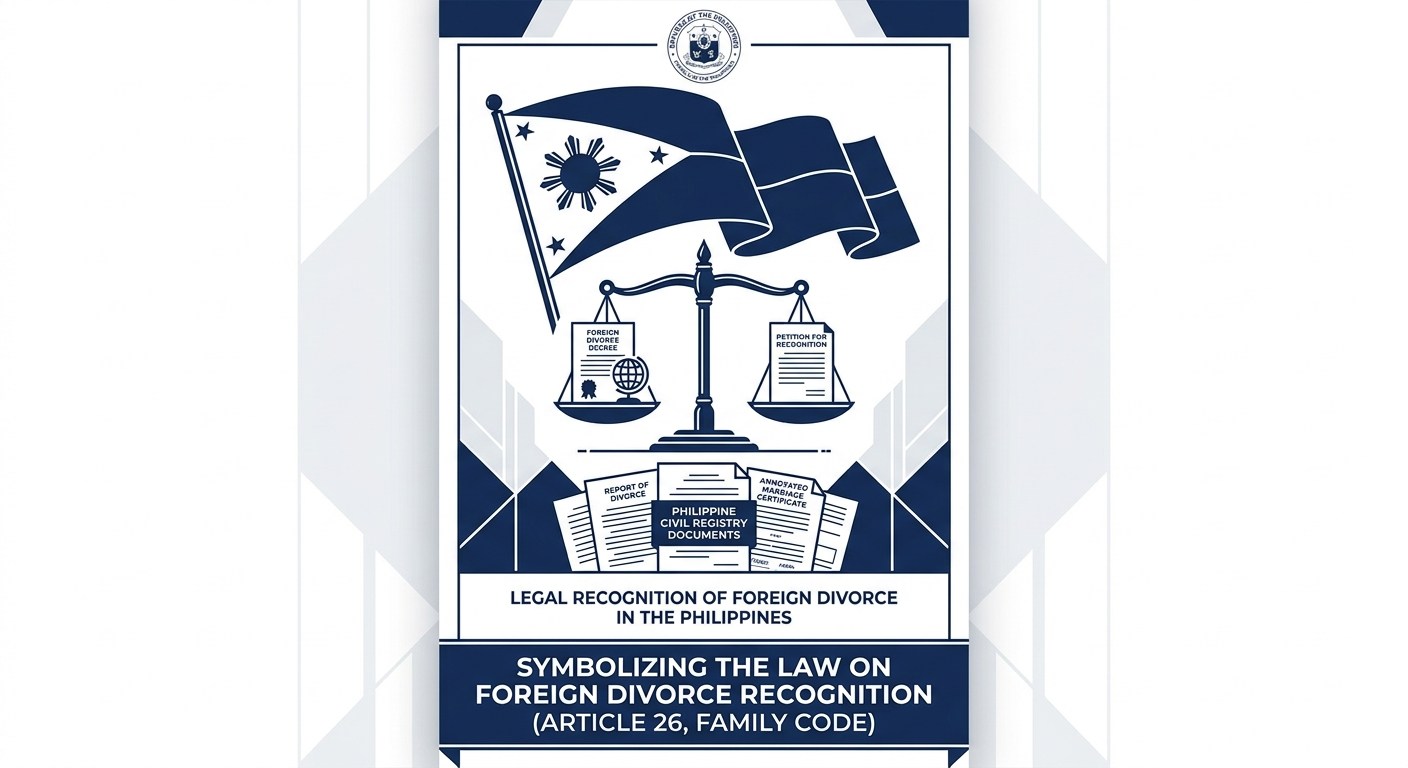
Foreign Divorce Recognition in the Philippines: A 2026 Legal Guide for Foreign Investors and Their Filipino Spouses
A legal guide to the judicial recognition of foreign divorce decrees in the Philippines under Article 26 of the Family Code — covering the landmark Republic v. Ng (2024) and Republic v. Manalo (2018) rulings, the evolving limping marriage doctrine, the step-by-step procedure before the Regional Trial Court, documentary authentication requirements, annotation in the civil registry, and the practical implications for foreign investors married to Filipino citizens.