How to Claim Tax Treaty Benefits in the Philippines as a Foreign Company

If your company earns income from the Philippines — dividends from a subsidiary, royalties from a licensing deal, or interest on a loan — you're likely subject to Philippine withholding tax. The standard rate for non-residents is 25% under the National Internal Revenue Code (NIRC).
But if your home country has a Double Taxation Agreement (DTA) with the Philippines, you may be entitled to significantly lower rates — sometimes as low as 10% or even 0%. The catch? Treaty relief is not automatic. You need to follow a specific process laid out by the Bureau of Internal Revenue (BIR).
Which Countries Have Tax Treaties with the Philippines?
The Philippines currently has DTAs with over 40 countries, including:
- United States, United Kingdom, Canada, Australia
- Japan, South Korea, China, Singapore, Thailand
- Germany, France, Netherlands, Switzerland, Spain
- India, Indonesia, Malaysia, Vietnam
- United Arab Emirates, Qatar, Kuwait
- New Zealand, Sweden, Norway, Denmark, Austria
The full list is maintained on the BIR's DTA page. Each treaty has its own rates, so the specific benefit depends on your country and the type of income.
What Rates Can You Expect?
Most Philippine DTAs reduce withholding tax on three main income types:
- Dividends — typically reduced to 10–15% (from 25%)
- Interest — typically reduced to 10–15%
- Royalties — typically reduced to 10–25%, depending on the treaty
Some treaties also cover capital gains, business profits, and service fees. For example, the US-Philippines treaty caps dividend withholding at 20% (or 15% for qualifying corporate shareholders holding at least 10% of voting stock).
The 5-Step Process Under RMO No. 14-2021
In 2021, the BIR issued Revenue Memorandum Order (RMO) No. 14-2021 to streamline treaty relief claims. Here's how it works:
Step 1: Prepare Your BIR Form 0901
The nonresident income earner must accomplish BIR Form No. 0901 (Application for Treaty Purposes). This form declares the type of income, the applicable treaty, and the preferential rate being claimed.
Step 2: Obtain a Tax Residency Certificate (TRC)
You need a Tax Residency Certificate issued by your home country's tax authority for the relevant period. For US companies, this is IRS Form 6166. For other countries, contact your local tax office. The TRC proves you are a tax resident of the treaty partner country.
Step 3: Apply the Treaty Rate at the Time of Payment
Under the current rules, the Philippine withholding agent (your local payer — subsidiary, licensee, or borrower) can apply the reduced treaty rate upfront at the time of payment, provided they have:
- Your completed BIR Form 0901
- Your valid TRC
- A copy of the relevant treaty provisions
This was a major improvement over the old system, which required advance approval before applying any reduced rate.
Step 4: File a Request for Confirmation
After applying the treaty rate, the withholding agent must file a Request for Confirmation with the BIR's International Tax Affairs Division (ITAD). Deadlines vary:
- Capital gains — by the last day of the 4th month after the close of the taxable year when the transaction was consummated
- Other income — by the last day of the 4th month after the close of the taxable year when income was paid or accrued
Missing this deadline can result in the BIR imposing the full 25% rate plus penalties.
Step 5: Receive the Certificate of Entitlement (COE)
If the BIR confirms the treaty rate was correctly applied, it issues a Certificate of Entitlement to Treaty Benefit (COE). If denied, the withholding agent must pay the deficiency tax plus surcharges and interest.
What If the Full 25% Was Already Withheld?
If your Philippine payer withheld at the regular 25% rate instead of the treaty rate, you can file a Tax Treaty Relief Application (TTRA) with ITAD to claim a refund of the excess. The TTRA can be filed any time after receipt of income, and must include:
- A letter-request explaining the claim
- BIR Form 0901
- Your TRC
- Proof of income payment and withholding tax paid
- A Special Power of Attorney if filed by a representative
Important: All documents executed outside the Philippines must be authenticated or apostilled in the foreign country before submission.
Common Mistakes Foreign Companies Make
- Assuming treaty relief is automatic — it requires active filing and documentation
- Not obtaining a TRC — the application will be denied without proof of treaty-country residency
- Missing the confirmation deadline — the BIR can retroactively impose the full 25% rate
- Failing to apostille foreign documents — unauthenticated documents are rejected
- Ignoring "beneficial ownership" requirements — shell companies or conduit arrangements may be denied treaty benefits under anti-treaty-shopping provisions
Why This Matters for Your Bottom Line
On a USD 1 million royalty payment, the difference between a 25% withholding rate and a 10% treaty rate is USD 150,000. For foreign companies with ongoing Philippine operations, proper treaty planning is not optional — it's essential.
A Philippine law firm experienced in international tax can help you structure the application, coordinate with your local withholding agent, and ensure ITAD compliance. Getting it right the first time saves months of processing and avoids costly deficiency assessments.
Need help claiming tax treaty benefits for your Philippine operations? Contact TTFC Law — we handle the BIR filings so you can focus on your business.
Related Articles

The Foreign Investor's Compliance Crossroads: Stockholder Inspection Rights, Data Privacy, and Merger Notification Thresholds Every Foreign Buyer Must Navigate in 2026
Three converging legal obligations — the Revised Corporation Code's stockholder inspection rights, the Data Privacy Act's constraints on personal data disclosure, and the Philippine Competition Commission's recalibrated merger notification thresholds — create a compliance labyrinth that no foreign investor acquiring a Philippine company can afford to navigate blindly. This guide unpacks each obligation, explains how they interact, and provides a practical roadmap for foreign buyers conducting due diligence and post-acquisition governance in the Philippines.

The Philippine Privacy Impact Assessment Revolution: What the 2026 Draft Circular Means for Foreign Companies
The NPC's August 2026 draft circular would replace the blanket Privacy Impact Assessment obligation that has governed Philippine data privacy compliance since 2017 with a risk-tiered framework. For foreign companies operating in or serving the Philippine market, the shift from a one-size-fits-all requirement to a threshold-based trigger system carries significant compliance and cost implications. This guide explains the eight mandatory PIA trigger categories, the new quantitative thresholds, what the draft circular means for AI systems and cross-border transfers, and the practical steps foreign companies must take now.
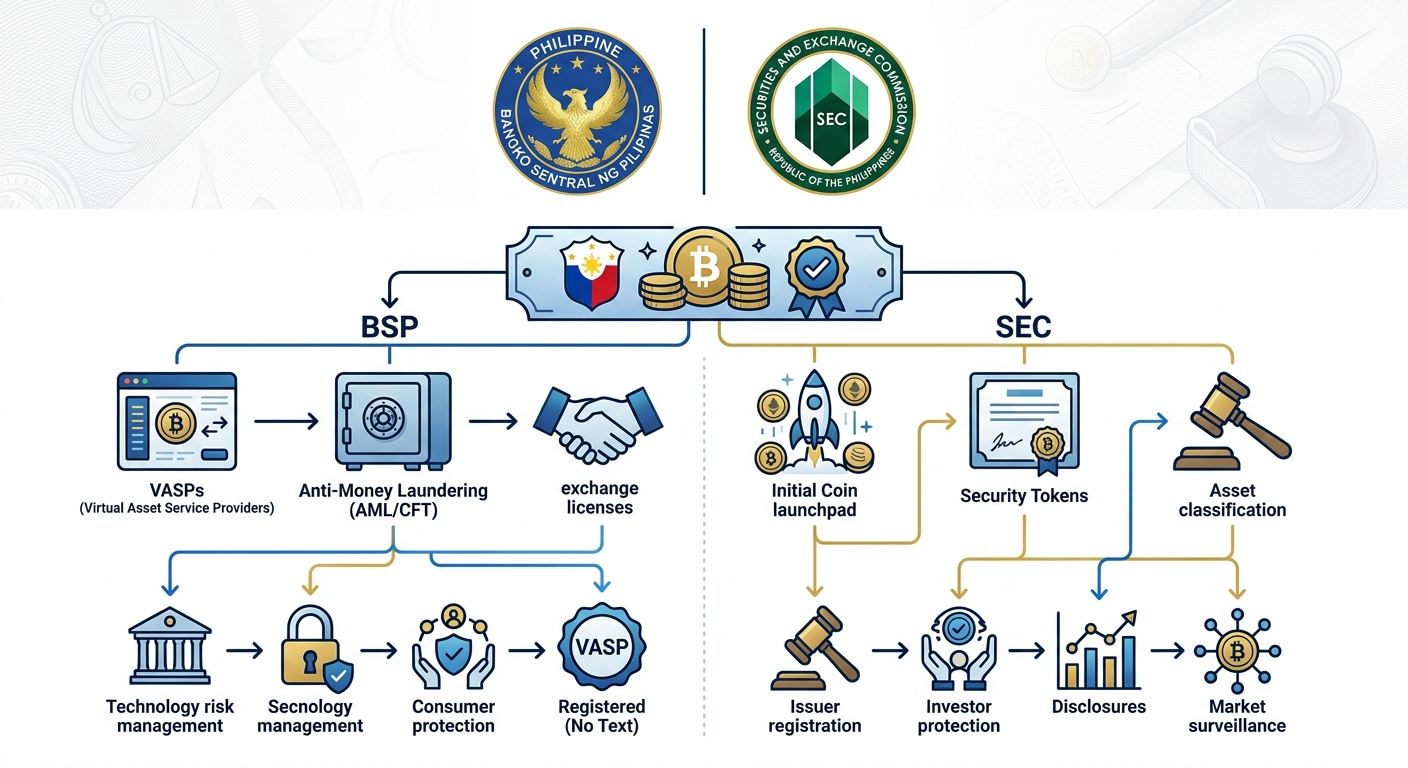
The Philippine Dual-Regulatory Framework for Cryptocurrency and Virtual Assets: A Comprehensive Guide for Foreign Investors in 2026
With the BSP's Circular No. 1108 and the SEC's CASP Rules (MC Nos. 04 and 05 of 2025) now both in force, foreign investors entering the Philippine virtual asset space face a bifurcated regulatory landscape that did not exist three years ago. This guide maps the jurisdictional boundaries between the Bangko Sentral ng Pilipinas and the Securities and Exchange Commission, explains the licensing pathways, capitalization requirements, AML/CTF obligations, the BSP's continued VASP license moratorium, and the practical steps a foreign investor must take to operate lawfully in the Philippines' digital asset market.