Can a Foreigner Inherit Property in the Philippines? 5 FAQs Answered

If your Filipino spouse, parent, or relative owns land in the Philippines, you have probably wondered: "Can I actually inherit that property even though I'm a foreigner?"
The short answer is yes — but only in specific circumstances. Here are the five most common questions we receive from foreign nationals about inheriting Philippine property, answered using the Constitution, the Civil Code, and the Tax Code.
1. Can a Foreigner Inherit Land in the Philippines?
Yes, but only through hereditary succession — never by purchase.
The 1987 Philippine Constitution, Article XII, Section 7 states:
"Save in cases of hereditary succession, no private lands shall be transferred or conveyed except to individuals, corporations, or associations qualified to acquire or hold lands of the public domain."
This means the constitutional ban on foreign land ownership has one express exception: inheritance. A foreign national can receive Philippine land as an heir — whether through intestate succession (no will) or as a compulsory heir under the Civil Code.
However, the Supreme Court has clarified that this exception does not extend to testamentary succession where the foreigner is merely a voluntary heir (i.e., someone named in a will who is not a compulsory heir). The reasoning: allowing any foreigner to receive land by will would make the constitutional ban meaningless.
2. What Is the Difference Between Intestate, Testate, and Compulsory Succession?
Understanding these terms is essential because how you inherit determines whether you can keep the land:
- Intestate succession — The deceased died without a valid will. Property passes to legal heirs by operation of law under the Civil Code of the Philippines (Book III). A foreign spouse or child who is a legal heir can inherit land this way.
- Testate succession — The deceased left a valid will. Compulsory heirs are entitled to their legitime (the reserved portion of the estate) regardless of the will's contents.
- Compulsory heirs — Under Article 887 of the Civil Code, compulsory heirs include legitimate children and descendants, legitimate parents and ascendants, the surviving spouse, and acknowledged illegitimate children. If you fall into one of these categories, you inherit by operation of law — and the constitutional exception applies.
Key takeaway: If you are a foreign national who is a compulsory heir (e.g., the surviving spouse or child of the deceased), you can inherit Philippine land. If you are merely named in a will as a friend or non-compulsory beneficiary, you likely cannot.
3. Can a Foreign Spouse Inherit Their Filipino Spouse's Land?
Yes. The surviving spouse is a compulsory heir under Article 887 of the Civil Code. When a Filipino property owner dies, their foreign surviving spouse is entitled to a share of the estate — including land — by operation of law.
The share depends on who else survives:
- Surviving spouse + legitimate children: The spouse receives a share equal to one child's legitime (Article 892).
- Surviving spouse + legitimate parents (no children): The spouse gets one-half, the parents get one-half of the estate (Article 893).
- Surviving spouse alone (no children, no parents): The spouse is entitled to one-half of the estate as legitime, plus the free portion (Articles 900–901).
This is one of the most common scenarios we handle at TTFC Law — a foreign husband or wife of a deceased Filipino seeking to settle the estate and transfer land titles.
4. What Taxes Does a Foreign Heir Pay?
Foreign heirs are subject to the same estate tax rules as Filipino heirs. Under the TRAIN Law (Republic Act No. 10963), which amended Section 84 of the National Internal Revenue Code:
- Estate tax rate: A flat 6% on the net estate exceeding ₱5,000,000 (the standard deduction).
- Filing deadline: The estate tax return must be filed and the tax paid within one (1) year from the decedent's death (extendible by the BIR upon request).
- Net estate computation: Gross estate minus allowable deductions — including funeral expenses (up to ₱200,000), medical expenses, claims against the estate, unpaid mortgages, the ₱5,000,000 standard deduction, and the family home deduction (up to ₱10,000,000).
For non-resident foreign decedents (a foreigner who owned property in the Philippines but lived abroad), only Philippine-situated property is included in the gross estate. This means bank accounts, shares in Philippine corporations, and real property located in the Philippines.
5. Once I Inherit the Land, Can I Keep It or Must I Sell?
The Constitution allows you to acquire the land through inheritance — but it does not explicitly guarantee that you can hold it indefinitely. In practice:
- You can hold the inherited land. There is no law or regulation requiring a foreign heir to dispose of inherited property within a fixed period.
- You cannot buy additional land. The hereditary succession exception is narrow — it only covers what you inherit, not future purchases.
- You can sell the land. A foreign heir may sell inherited property at any time, and the proceeds can be freely remitted abroad (subject to BSP regulations and proper tax clearance).
- You cannot use inheritance as a workaround. The Supreme Court has struck down arrangements where a foreigner funds a Filipino's purchase of land with the expectation of inheriting it later. This violates the constitutional intent.
What Should Foreign Heirs Do First?
If you are a foreign national who expects to inherit — or has already inherited — property in the Philippines, here are the practical next steps:
- Gather documents: Death certificate, marriage certificate (if surviving spouse), birth certificate (if child), and the property's Transfer Certificate of Title (TCT) or Condominium Certificate of Title (CCT).
- File the estate tax return with the BIR within one year of death.
- Settle the estate judicially or extrajudicially. If all heirs agree, an extrajudicial settlement published in a newspaper of general circulation may suffice.
- Transfer the title at the Register of Deeds to reflect the new owner(s).
- Consult a Philippine law firm experienced in foreign heir matters — the intersection of constitutional limits, tax rules, and property registration can be tricky.
TTFC Law regularly assists foreign spouses, dual citizens, and overseas heirs in settling Philippine estates. If you need guidance on inheritance, estate tax planning, or title transfers, reach out to our team.
Related Articles

The Philippine Privacy Impact Assessment Revolution: What the 2026 Draft Circular Means for Foreign Companies
The NPC's August 2026 draft circular would replace the blanket Privacy Impact Assessment obligation that has governed Philippine data privacy compliance since 2017 with a risk-tiered framework. For foreign companies operating in or serving the Philippine market, the shift from a one-size-fits-all requirement to a threshold-based trigger system carries significant compliance and cost implications. This guide explains the eight mandatory PIA trigger categories, the new quantitative thresholds, what the draft circular means for AI systems and cross-border transfers, and the practical steps foreign companies must take now.
The Philippine Dual-Regulatory Framework for Cryptocurrency and Virtual Assets: A Comprehensive Guide for Foreign Investors in 2026
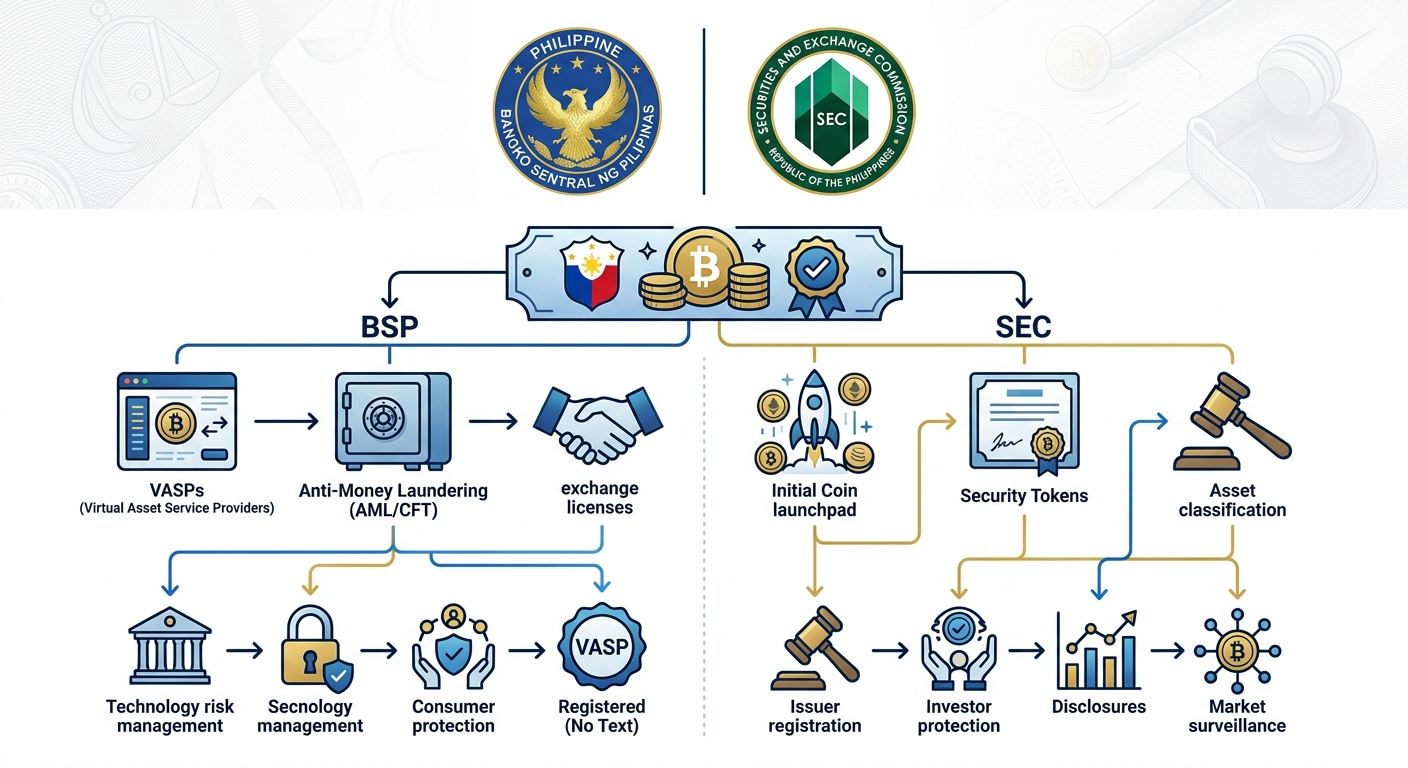
With the BSP's Circular No. 1108 and the SEC's CASP Rules (MC Nos. 04 and 05 of 2025) now both in force, foreign investors entering the Philippine virtual asset space face a bifurcated regulatory landscape that did not exist three years ago. This guide maps the jurisdictional boundaries between the Bangko Sentral ng Pilipinas and the Securities and Exchange Commission, explains the licensing pathways, capitalization requirements, AML/CTF obligations, the BSP's continued VASP license moratorium, and the practical steps a foreign investor must take to operate lawfully in the Philippines' digital asset market.
The Philippine E-Invoicing Mandate: A Comprehensive Compliance Guide for Foreign Companies in 2026
With the December 31, 2026 deadline for mandatory e-invoicing under BIR Revenue Regulations No. 11-2025 fast approaching, foreign companies operating in the Philippines face an urgent compliance obligation that cannot be deferred. This guide provides a complete analysis of who must comply, what constitutes a compliant electronic invoice, the step-by-step implementation process, tax deduction opportunities under the CREATE MORE Act, and the penalties for non-compliance — with every legal citation verified against primary sources.