Can a Foreigner Be a Sole Proprietor in the Philippines?

It's one of the most common questions we get from foreign clients: "Can I just register a sole proprietorship instead of incorporating a company?"
The short answer is yes — but with significant conditions that make it impractical for most foreigners. Here's what the law actually says.
The Legal Basis: RA 7042, as Amended
The Foreign Investments Act of 1991 (Republic Act No. 7042), as amended by Republic Act No. 11647 (2022), explicitly allows foreign nationals to register as sole proprietors. Section 5 of RA 7042 states that a non-Philippine national may, "upon registration with the Bureau of Trade Regulation and Consumer Protection (BTRCP) of the Department of Trade and Industry in the case of single proprietorships," do business in the Philippines.
So the legal door is open. The catch is the price of admission.
The USD 200,000 Capital Requirement
Under the FIA, enterprises with paid-in capital of less than USD 200,000 are reserved for Philippine nationals. This means a foreign sole proprietor must invest at least USD 200,000 (roughly PHP 11.4 million at current rates) as paid-in capital — a steep barrier for a one-person business.
This threshold applies to domestic market enterprises — businesses that sell primarily to the Philippine market. If the sole proprietorship exports at least 60% of its output, it may qualify as an export enterprise with different rules, but the DTI still requires compliance with registration and reporting obligations.
The Reduced USD 100,000 Threshold
RA 11647, signed into law on March 2, 2022, introduced a lower capital floor of USD 100,000 for foreign-owned enterprises (including sole proprietorships) that meet any of the following conditions:
- The enterprise involves advanced technology as certified by the Department of Science and Technology (DOST);
- The enterprise is endorsed as a startup or startup enabler under Republic Act No. 11337 (the Innovative Startup Act); or
- The enterprise employs a majority of Filipino workers, with not less than 15 direct Filipino employees.
Even at the reduced threshold, USD 100,000 is a substantial commitment for a sole proprietorship.
Additional Requirements
Beyond capital, a foreign sole proprietor must:
- Register with the DTI — Obtain a Business Name Certificate and a Certificate of Registration of Sole Proprietorship through the Business Name Registration System (BNRS).
- Not be on the Foreign Investment Negative List (FINL) — The business activity must be open to 100% foreign ownership. Activities on List A (constitutionally or legislatively restricted) and List B (defense, risk, or MSME-related restrictions) are off-limits or subject to equity caps.
- Secure local permits — Barangay clearance, mayor's or business permit, and BIR registration (TIN, Certificate of Registration, authority to print receipts).
- Hold a valid visa — A tourist visa does not authorize you to do business. You'll typically need a 9(G) work visa, a Special Investor's Resident Visa (SIRV), or another visa class that permits business activity.
Why Most Foreigners Incorporate Instead
In practice, the vast majority of foreign entrepreneurs in the Philippines opt for a One Person Corporation (OPC) or a standard domestic corporation rather than a sole proprietorship. Here's why:
- Limited liability. A sole proprietor is personally liable for all business debts. A corporation separates your personal assets from business liabilities.
- Same capital requirement. The USD 200,000 (or USD 100,000) minimum applies regardless of whether you register as a sole proprietor or incorporate — so you gain liability protection at no additional capital cost.
- Easier banking and contracts. Philippine banks and commercial partners are more accustomed to dealing with registered corporations than foreign sole proprietorships.
- Succession and transferability. A corporation has perpetual existence. A sole proprietorship dies with its owner.
The One Person Corporation, introduced under the Revised Corporation Code (RA 11232), is particularly attractive — it gives you the simplicity of a sole proprietorship with the legal protections of a corporate structure.
The Bottom Line
Can a foreigner be a sole proprietor in the Philippines? Legally, yes. Practically, it rarely makes sense. The capital requirements are identical to incorporating, but you take on unlimited personal liability and face a more unfamiliar registration process.
If you're a foreign national considering doing business in the Philippines, talk to a Philippine corporate lawyer before choosing your business structure. The right vehicle depends on your investment size, business activity, and long-term plans — and the wrong choice can be expensive to unwind.
Need guidance on the right business structure for your Philippine venture? Contact TTFC Law for a consultation.
Related Articles

The Philippine Privacy Impact Assessment Revolution: What the 2026 Draft Circular Means for Foreign Companies
The NPC's August 2026 draft circular would replace the blanket Privacy Impact Assessment obligation that has governed Philippine data privacy compliance since 2017 with a risk-tiered framework. For foreign companies operating in or serving the Philippine market, the shift from a one-size-fits-all requirement to a threshold-based trigger system carries significant compliance and cost implications. This guide explains the eight mandatory PIA trigger categories, the new quantitative thresholds, what the draft circular means for AI systems and cross-border transfers, and the practical steps foreign companies must take now.
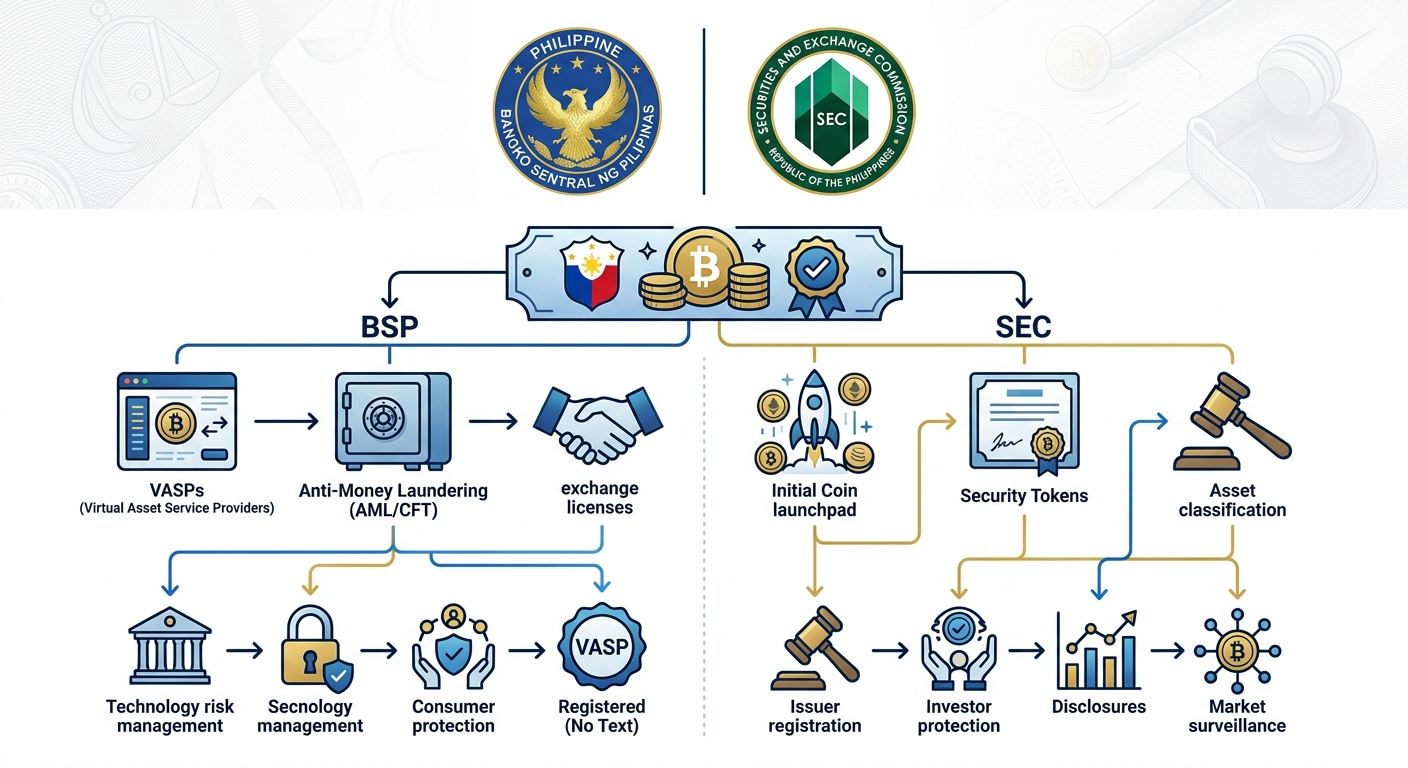
The Philippine Dual-Regulatory Framework for Cryptocurrency and Virtual Assets: A Comprehensive Guide for Foreign Investors in 2026
With the BSP's Circular No. 1108 and the SEC's CASP Rules (MC Nos. 04 and 05 of 2025) now both in force, foreign investors entering the Philippine virtual asset space face a bifurcated regulatory landscape that did not exist three years ago. This guide maps the jurisdictional boundaries between the Bangko Sentral ng Pilipinas and the Securities and Exchange Commission, explains the licensing pathways, capitalization requirements, AML/CTF obligations, the BSP's continued VASP license moratorium, and the practical steps a foreign investor must take to operate lawfully in the Philippines' digital asset market.
The Philippine E-Invoicing Mandate: A Comprehensive Compliance Guide for Foreign Companies in 2026
With the December 31, 2026 deadline for mandatory e-invoicing under BIR Revenue Regulations No. 11-2025 fast approaching, foreign companies operating in the Philippines face an urgent compliance obligation that cannot be deferred. This guide provides a complete analysis of who must comply, what constitutes a compliant electronic invoice, the step-by-step implementation process, tax deduction opportunities under the CREATE MORE Act, and the penalties for non-compliance — with every legal citation verified against primary sources.