How to Remit Profits Out of the Philippines as a Foreign Investor: A 5-Step Checklist

You've incorporated in the Philippines, built your business, and now your company is turning a profit. The next question: how do you actually get those earnings back to your home country?
The good news is that the Philippines follows a liberalized foreign exchange policy. Under the Foreign Investments Act of 1991 (Republic Act No. 7042, as amended by RA 11647), foreign investors are entitled to full and immediate repatriation of capital and remittance of dividends, profits, and earnings. But "entitled" and "hassle-free" are two different things. Without the right registrations, your bank may refuse to process the transfer.
Here's the five-step checklist every foreign investor should follow.
Step 1: Register Your Investment with the BSP
This is the step most foreign investors overlook — and it's the most important one.
When you first bring foreign currency into the Philippines to fund your business, that inward remittance should be registered with the Bangko Sentral ng Pilipinas (BSP). The registration is evidenced by a Bangko Sentral Registration Document (BSRD), which serves as your proof that the investment entered the country through legitimate banking channels.
Under BSP Circular No. 1192, Series of 2024 (amending the Manual of Regulations on Foreign Exchange Transactions), registration must be done through an Authorized Agent Bank (AAB). The key requirements are:
- Proof of inward remittance through the Philippine banking system
- SEC Certificate of Registration of the Philippine entity
- Articles of Incorporation showing the foreign investor's equity
- Conversion of the foreign currency to Philippine pesos through an AAB
Why it matters: Without a BSRD, you can still remit profits — but you cannot purchase foreign exchange from the Philippine banking system to do so. You would be limited to using foreign currency sourced from outside the banking system, which significantly complicates the process.
Step 2: Ensure Tax Compliance Before Remitting
The Bureau of Internal Revenue (BIR) must get its share before any money leaves. Under the National Internal Revenue Code (NIRC), as amended by the CREATE Act (Republic Act No. 11534), dividend payments to foreign investors are subject to final withholding tax:
- 25% — the general rate on dividends paid to non-resident foreign corporations (NIRC Section 28[B][5][b])
- 15% — the reduced rate, available if the foreign investor's home country either (a) does not impose income tax on dividends, or (b) allows a tax credit of at least 15% for taxes deemed paid in the Philippines (the "tax sparing" rule)
- Treaty rates — may be lower if a tax treaty exists between the Philippines and the investor's home country. For example, the Philippines-Japan tax treaty reduces the rate to 10% for qualifying corporate shareholders.
Before remitting, your Philippine company should:
- File and pay all applicable withholding taxes with the BIR
- Obtain a tax clearance certificate confirming that all tax obligations related to the dividend declaration have been settled
- Prepare audited financial statements confirming that retained earnings are available for distribution
Step 3: Secure a Board Resolution Declaring Dividends
Under the Revised Corporation Code (Republic Act No. 11232), dividends can only be declared out of unrestricted retained earnings — meaning profits that are not encumbered by legal restrictions, contractual obligations, or appropriations.
Your board of directors must pass a resolution that:
- Declares the dividend amount and the record date
- Identifies the payee (i.e., the foreign shareholder)
- Authorizes the corporate secretary or treasurer to process the remittance
This board resolution is a standard documentary requirement that your bank will ask for when processing the outward remittance.
Step 4: Process the Remittance Through an Authorized Bank
With the BSRD, tax clearance, board resolution, and audited financials in hand, you can now approach your Authorized Agent Bank to process the outward remittance.
Under the BSP's foreign exchange regulations (originally governed by BSP Circular No. 645, Series of 2009, as amended by Circular No. 1192), the AAB will require:
- The original or certified true copy of the BSRD
- Board resolution declaring dividends
- Audited financial statements
- Proof of tax payment (BIR Form 1601-FQ or equivalent)
- SEC Certificate of Filing of the General Information Sheet (GIS) showing ownership
The bank handles the actual purchase of foreign exchange and wire transfer. No prior BSP approval is needed — the process is bank-level, not central-bank-level.
Step 5: Keep Records for Future Remittances
This isn't a one-time exercise. If you plan to remit profits regularly (annually or quarterly), maintain an organized file of:
- All BSRDs and amendments
- Annual audited financial statements
- Board resolutions for each dividend declaration
- BIR filing confirmations and tax clearance certificates
- Bank confirmation receipts for each remittance
Good recordkeeping speeds up future remittances and protects you in the event of a BIR or BSP audit.
What About Branch Profits?
If you operate as a branch office rather than a subsidiary, the rules differ slightly. Branch profit remittances are subject to a 15% branch profit remittance tax under NIRC Section 28(A)(5), applied to profits effectively connected with the Philippine branch's operations. This tax is withheld before remittance — no separate dividend declaration is needed since a branch is not a separate legal entity.
Key Takeaway
The Philippines does not restrict profit repatriation — but it requires proper documentation at every stage. The single most important step is registering your investment with the BSP at the time of entry. If you missed this step, consult a Philippine law firm immediately, as retroactive registration may still be possible under certain conditions.
For foreign investors planning their entry or looking to structure their first profit remittance, having legal counsel coordinate with your bank and the BIR from the outset saves significant time and cost down the line.
This article is for informational purposes only and does not constitute legal advice. For guidance specific to your situation, contact TTFC Law.
Related Articles

The Philippine Privacy Impact Assessment Revolution: What the 2026 Draft Circular Means for Foreign Companies
The NPC's August 2026 draft circular would replace the blanket Privacy Impact Assessment obligation that has governed Philippine data privacy compliance since 2017 with a risk-tiered framework. For foreign companies operating in or serving the Philippine market, the shift from a one-size-fits-all requirement to a threshold-based trigger system carries significant compliance and cost implications. This guide explains the eight mandatory PIA trigger categories, the new quantitative thresholds, what the draft circular means for AI systems and cross-border transfers, and the practical steps foreign companies must take now.
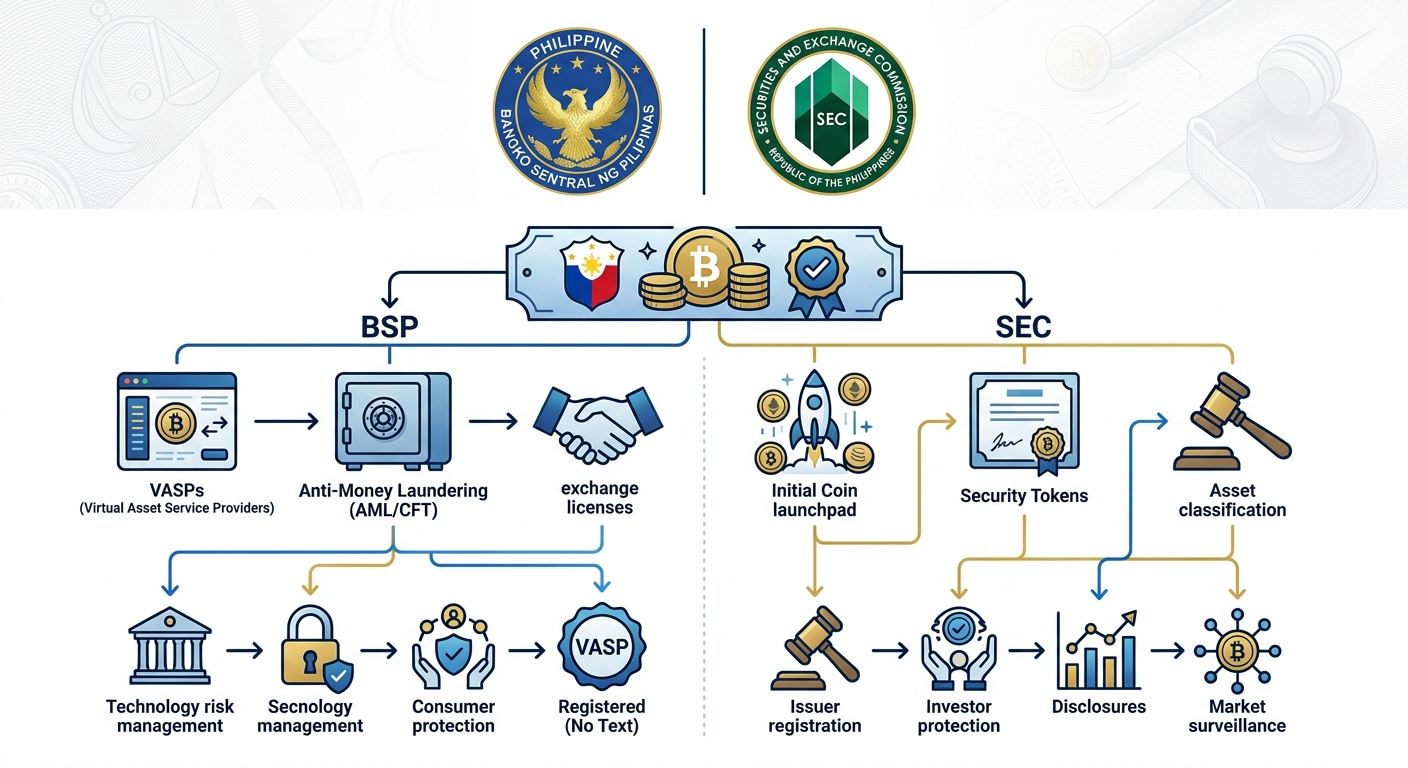
The Philippine Dual-Regulatory Framework for Cryptocurrency and Virtual Assets: A Comprehensive Guide for Foreign Investors in 2026
With the BSP's Circular No. 1108 and the SEC's CASP Rules (MC Nos. 04 and 05 of 2025) now both in force, foreign investors entering the Philippine virtual asset space face a bifurcated regulatory landscape that did not exist three years ago. This guide maps the jurisdictional boundaries between the Bangko Sentral ng Pilipinas and the Securities and Exchange Commission, explains the licensing pathways, capitalization requirements, AML/CTF obligations, the BSP's continued VASP license moratorium, and the practical steps a foreign investor must take to operate lawfully in the Philippines' digital asset market.
The Philippine E-Invoicing Mandate: A Comprehensive Compliance Guide for Foreign Companies in 2026
With the December 31, 2026 deadline for mandatory e-invoicing under BIR Revenue Regulations No. 11-2025 fast approaching, foreign companies operating in the Philippines face an urgent compliance obligation that cannot be deferred. This guide provides a complete analysis of who must comply, what constitutes a compliant electronic invoice, the step-by-step implementation process, tax deduction opportunities under the CREATE MORE Act, and the penalties for non-compliance — with every legal citation verified against primary sources.