The Foreign Corporation's Guide to Surviving a BIR Tax Audit in the Philippines: RMO 1-2026, Your Rights, and Practical Compliance Steps

Introduction: A New Era in Philippine Tax Administration
For foreign corporations doing business in the Philippines, few experiences generate more anxiety than the prospect of a BIR tax audit. The complexity of the Philippine tax system — with its layered withholding tax regimes, excise taxes, value-added tax obligations, and the ever-present risk of transfer pricing adjustments — means that a BIR examination can quickly become an expensive, resource-draining ordeal that distracts management from the business of actually doing business.
But 2026 marks a significant inflection point. In November 2025, the Bureau of Internal Revenue (BIR) took the unusual step of temporarily suspending all tax audits nationwide. The stated purpose: to give the BIR time to identify gaps in its audit procedures, revise its policies, and implement reforms that would increase efficiency, reduce subjectivity, and integrate digital systems more seamlessly into the audit process.
On January 27, 2026, the BIR announced the resumption of audit operations. The reforms were codified in two key issuances: Revenue Memorandum Order (RMO) No. 1-2026, which prescribes revised policies, controls, and procedures for tax audit and assessment, and Revenue Memorandum Circular (RMC) No. 8-2026, which formally lifted the audit suspension. The BIR also launched “REVIE,” a chatbot with a LOA Verifier feature, through RMC No. 5-2026, to help taxpayers authenticate Letters of Authority issued against them.
For foreign corporations — whether operating as subsidiaries, branch offices, representative offices, or regional operating headquarters — these changes are consequential. The BIR’s new audit framework introduces a single-instance audit model, system-assisted (rather than discretionary) selection of audit targets, and a consolidated approach to pending audits. Understanding these changes is not optional for foreign investors: it is essential risk management.
This guide provides a comprehensive, practical analysis of the new audit framework, your rights and obligations as a taxpayer during an audit, the specific compliance concerns that most commonly affect foreign corporations, and a step-by-step roadmap for surviving — and emerging from — a BIR audit with minimal damage.
Part I: The Legal Framework — Understanding the BIR’s Authority and Its Limits
1.1 The Statutory Basis for BIR Audit Authority
The BIR’s authority to conduct tax audits flows from the National Internal Revenue Code of 1997, as amended (the “Tax Code”). Under Sections 13 and 14 of the Tax Code, the BIR is empowered to examine books of accounts and other accounting records, including the books and records of corporations, to verify the correctness of tax returns filed and to discover unreported taxable income or overclaimed deductions.
For foreign corporations specifically, the BIR’s jurisdiction extends to:
- Resident foreign corporations: Those engaged in trade or business within the Philippines, which are taxed on worldwide income from Philippine sources. These include foreign corporations registered with the Securities and Exchange Commission (SEC) as subsidiaries, branch offices, or representative offices. Such corporations are subject to the same audit procedures as domestic corporations.
- Non-resident foreign corporations (NRFCs): Those not engaged in trade or business within the Philippines, which are taxed only on Philippine-source income. The BIR’s audit authority over NRFCs is more circumscribed but no less real, particularly regarding withholding tax compliance by Philippine payors.
1.2 The Statute of Limitations
Any discussion of BIR audit authority must begin with the statute of limitations, because it defines the outer boundary of the BIR’s power to assess additional taxes.
Under Section 203 of the Tax Code, the BIR generally has three (3) years from the last day prescribed by law for the filing of the return, or from the day the return was actually filed — whichever is later — within which to issue an assessment. For example, a corporate income tax return filed on April 15, 2026 (the deadline for calendar-year taxpayers) must be assessed by April 15, 2029.
There are critical exceptions to this three-year rule:
- Constructive vs. Fraudulent Returns: Where a return is filed but is fraudulent or false, the BIR may assess taxes within ten (10) years from the discovery of the fraud. Section 222 of the Tax Code expressly provides for this extended period when there is fraud or false return.
- Non-Filing: Where no return is filed, the BIR may assess taxes at any time. This is a risk for foreign corporations that fail to register with the BIR before commencing operations.
- Waiver of the Statute of Limitations: The BIR and the taxpayer may jointly agree in writing to extend the prescriptive period. However, such waivers must be executed before the original prescriptive period expires, and must specify the extended period agreed upon. A taxpayer’s mere passive acquiescence to an audit — or continued engagement with BIR examiners — does not constitute a valid waiver.
For foreign corporations, the practical implication is that records must be maintained for a minimum of ten (10) years from the taxable year, given the risk of fraud allegations. Some tax practitioners recommend retaining records for longer, particularly for transfer pricing documentation, given the complexity of intercompany transactions.
1.3 The BIR’s New Audit Architecture: RMO 1-2026 in Detail
The centerpiece of the BIR’s reform is RMO 1-2026, which introduced several structural changes to how audits are selected, authorized, and conducted.
The Single-Instance Audit Framework
Before RMO 1-2026, it was not uncommon for a taxpayer to receive multiple Letters of Authority (LOAs) from different BIR offices or units covering the same taxable year — one for income tax, another for VAT, a third for withholding taxes. This fragmented approach created enormous compliance burdens and, not infrequently, conflicting assessments.
RMO 1-2026 eliminates this by establishing a single-instance audit framework: a taxpayer will generally receive one electronic Letter of Authority (eLA) for a given taxable year covering all internal revenue taxes. Multiple eLAs covering the same taxpayer and the same taxable year are now strictly prohibited.
Exceptions to the Single-Instance Framework: The following remain outside the consolidated framework:
- One-time transactions (e.g., capital gains on a one-time sale of real property)
- Tax clearance requests
- Cancellation of business registration
- Cases involving fraud and irregularities
For foreign corporations — which often have complex, multi-tax-type obligations — the single-instance framework is generally favorable. It means one audit team reviews everything, reducing the risk of contradictory findings and eliminating the need to respond to multiple BIR teams simultaneously.
Consolidated Pending eLAs
Starting March 4, 2026, any existing multiple eLAs covering the same taxpayer and taxable year were automatically consolidated into one eLA, unless the taxpayer specifically opted out by filing a written request on or before February 16, 2026. The taxpayer and the revenue officers were given until April 30, 2026 to close consolidated audits. Beginning May 4, 2026, all unresolved cases were automatically consolidated regardless of assessment stage.
This automatic consolidation is particularly relevant for foreign corporations that were under audit prior to November 2025 and may have had multiple open eLAs. These entities should verify with their BIR counsel whether their cases were properly consolidated.
System-Assisted, Risk-Based Selection
One of the most significant reforms under RMO 1-2026 is the elimination of discretionary audit selection. Under the new framework, the selection of taxpayers for audit follows a risk-based, system-assisted approach using the Internal Revenue Integrated System (IRIS) — the BIR’s digital infrastructure.
Concretely:
- The BIR’s Information Systems Group (ISG) generates audit候选 lists based on criteria defined in Annex A of RMO 1-2026.
- These lists are anonymized before dissemination to regional offices — meaning BIR field examiners will not know, at the point of selection, which specific taxpayer is on the list.
- The list must receive approval from the Commissioner of Internal Revenue (CIR) before being sent to revenue regions and Large Taxpayer Offices (LTOs).
- An eLA can only be issued after completion of the system-assisted selection, centralized CIR approval, and anonymized assignment process.
Practical implication for foreign corporations: The days of arbitrary, discretionary selection are officially over. While this does not eliminate audit risk, it does mean that foreign corporations with clean compliance records and no red flags in IRIS are less likely to be selected. The BIR has also confirmed that taxpayer recommendations for audit may still be considered, but only if: (1) there is a written recommendation with justification from an appropriate approving authority; (2) the recommendation is validated against the approved criteria; and (3) the CIR approves.
The BIR has stated that full automation of the selection process is still in progress and that further guidelines will be issued on or before April 16, 2026.
Dissolution of Task Force Audits
RMO 1-2026 also dissolved the VAT Audit Sections and the Large Taxpayers VAT Audit Unit, with operations ceasing by May 15, 2026. Going forward, all tax audit and assessment authority rests with the appropriate regular offices of the BIR. This consolidation streamlines the chain of command and, in theory, makes it easier for taxpayers to identify who is handling their case.
Part II: The Audit Process — From LOA to Final Assessment
2.1 Receiving the Letter of Authority (LOA)
The audit begins with the issuance of an LOA to the taxpayer. Under RMO 1-2026 and RMC 5-2026, taxpayers can verify the authenticity of any LOA using the “LOA Verifier” feature in the REVIE chatbot, accessible through the BIR website. This is an important protection against fraudulent LOAs — a real concern in the Philippine tax landscape where bogus “BIR examiners” occasionally attempt to extort taxpayers.
Upon receipt of a valid LOA, the foreign corporation should:
- Immediately notify its tax counsel and external auditors. Time is of the essence in preparing for a BIR audit.
- Verify the scope of the LOA. The LOA should specify the taxable years covered, the types of taxes under examination, and the issuing BIR office.
- Request the audit program. Under current BIR rules, the examining officer must furnish the taxpayer with a copy of the audit program, which outlines the specific items to be examined.
2.2 The Audit Proper
During the audit, BIR examiners will typically review:
- Annual Income Tax Returns (AITRs) and supporting financial statements
- VAT returns and the VAT register
- Withholding tax returns (Forms 1601C, 1601E, 1604-CF, etc.) and the underlying withholding certificates
- Proof of withholding tax remittances (BIR Forms 2306 and 2307)
- Related-party transaction records and transfer pricing documentation
- Deduction schedules and supporting documents
- Application for refund or tax credit, if any
For foreign corporations, the most commonly contested areas in an audit are:
- Transfer pricing adjustments: Where intercompany transactions — such as management fees, royalty payments, interest on intercompany loans, or cost-sharing arrangements — are not conducted at arm’s length.
- Withholding tax deficiencies: Failure to withhold the correct percentage on payments to NRFCs, failure to file Forms 2306 and 2307, or failure to remit withheld taxes on time.
- Deducibility of expenses: The BIR’s perennial scrutiny of deductions claimed by foreign corporations, particularly head office expenses allocated to the Philippine entity.
- PEZA or BOI incentive compliance: Where the foreign corporation operates within a PEZA zone or holds BOI registrations, the conditions for availing tax incentives are subject to ongoing compliance verification.
2.3 BIR Form 1709 and Transfer Pricing Documentation
Foreign corporations with related-party transactions should pay particular attention to BIR Form No. 1709 (Information Return on Transactions with Related Party) and the transfer pricing documentation requirements under Revenue Regulations (RR) No. 03-2025, which took effect on January 17, 2025.
Under BIR regulations, a taxpayer must file BIR Form 1709 if:
- It is required to file an Annual Income Tax Return (AITR);
- It has transactions with a domestic or foreign related party during the taxable year; and
- It falls into one of these categories:
- Large taxpayers
- Taxpayers enjoying tax incentives
- Taxpayers reporting net operating losses (NOL) for the current taxable year and the two immediately preceding years
- A related party that transacts with any of the above
Materiality thresholds for transfer pricing documentation apply as follows:
- Annual gross revenue exceeding PHP 150 million AND total related-party transactions exceeding PHP 90 million within the taxable year
- Sale of tangible goods involving the same related party exceeding PHP 60 million within the taxable year
- Service transactions, interest payments, utilization of intangible goods, or other related-party transactions involving the same related party exceeding PHP 15 million within the taxable year
The arm’s-length principle — requiring that related-party transactions be conducted under conditions consistent with those between independent parties in comparable circumstances — is enforced through BIR’s Revenue Audit Memorandum Order on transfer pricing. Taxpayers must maintain contemporaneous transfer pricing documentation that can withstand BIR scrutiny during an audit.
Part III: Your Rights During a BIR Audit
3.1 The Right to Be Informed
A taxpayer has the right to be informed of the nature and scope of the audit. The LOA and the audit program should provide this. Any request for documents or information by BIR examiners must be reasonable and relevant to the taxes under examination.
3.2 The Right Against Self-Incrimination
Under the 1987 Constitution, no person shall be compelled to be a witness against himself or herself. This right, while primarily criminal in nature, has been invoked in tax proceedings to limit the use of compelled testimony in subsequent criminal prosecutions for tax evasion. Foreign corporations — as juridical persons — do not enjoy this right in the same manner as individuals, but management should be cautious about the statements made to BIR examiners.
3.3 The Right to Due Process in Assessment
The Tax Code imposes a specific procedure for deficiency assessments that the BIR must follow. This is a non-negotiable requirement:
- The BIR must issue a Notice for Informal Conference (NIRC Section 228), giving the taxpayer an opportunity to present its case before any assessment is finalized.
- If the BIR issues a Formal Letter of Demand (FLD) with a Assessment Notice, the taxpayer has thirty (30) days from receipt within which to protest the assessment in writing.
- The BIR then has sixty (60) days from receipt of the protest to act on it. If no action is taken, the protest is deemed denied.
- If the protest is denied (or deemed denied), the taxpayer may appeal to the Court of Tax Appeals (CTA) within thirty (30) days.
This deficiency assessment process applies to all taxes — income tax, VAT, withholding taxes, and excise taxes alike. For foreign corporations, the timeline is the same. The CTA has jurisdiction over cases involving the legality or validity of any assessment issued by the BIR.
3.4 The Right to Request a Bill of Particulars
A taxpayer may request a more specific statement of the BIR’s findings, including a detailed explanation of how the deficiency tax was computed. The BIR is required to respond to such requests.
Part IV: Practical Compliance Roadmap for Foreign Corporations
4.1 Before the Audit: Proactive Preparation
The best time to prepare for a BIR audit is before one arrives. Foreign corporations should implement the following practices:
a) Maintain Contemporaneous Transfer Pricing Documentation Under RR No. 03-2025, transfer pricing documentation must be in existence at the time the intercompany arrangements are developed or implemented. Post-hoc documentation prepared in response to an audit notice is far less credible than documentation prepared contemporaneously. Multinational groups should establish a transfer pricing policy, document intercompany agreements, and keep arm’s-length benchmarking studies current.
b) Ensure Withholding Tax Compliance Withholding tax errors are among the most common sources of BIR assessments for foreign corporations. Establish clear internal procedures for:
- Withholding the correct percentage on all applicable payments
- Issuing BIR Forms 2306 and 2307 (Certificate of Final Tax Withheld and Certificate of Creditable Tax Withheld at Source) to the appropriate recipients
- Remitting withheld taxes on or before the 10th day of the month following the withholding
- Maintaining a complete withholding tax register
c) File All Required Returns Electronically Under RMC 20-2026, all AITRs for Calendar Year 2025 — including those with no tax due — must be filed electronically through eFPS, eBIRForms, or an accredited Tax Software Provider (TSP). Manual filing is permitted only where the BIR has issued a specific advisory allowing it. Foreign corporations should ensure their electronic filing systems are accredited and functioning correctly.
d) Reconcile Intercompany Accounts Regularly Foreign corporations with intercompany transactions should conduct quarterly or semi-annual reconciliation of intercompany accounts. Unreconciled differences invite scrutiny, particularly when they result in timing differences in income or expense recognition.
4.2 During the Audit: Managing the Process
When a LOA is received:
a) Engage BIR counsel immediately. Tax audits are not DIY matters. The complexity of the issues — transfer pricing, withholding tax, deductibility of head office expenses — requires experienced tax counsel.
b) Conduct an internal pre-audit. Before responding to BIR requests, conduct a thorough internal review of the areas the LOA covers. Identify potential exposure points and prepare a documentation package to support the positions taken on the tax returns.
c) Manage document requests carefully. BIR examiners will request voluminous documents. Respond promptly but in an organized manner. Produce documents in the order requested, with a cover letter indexing each production. Keep copies of everything submitted.
d) Attend the Informal Conference prepared. The informal conference is the taxpayer’s opportunity to present its case before a deficiency assessment is issued. Come prepared with: (i) a position paper summarizing the legal and factual arguments; (ii) supporting documents; and (iii) a proposed resolution.
e) Consider a partial payment. If the taxpayer believes there is genuine exposure on certain items, making a partial payment of the tax assessed before the issuance of a Formal Letter of Demand can demonstrate good faith and, in some cases, reduce exposure for penalties and interest.
4.3 After the Audit: Assessment, Protest, and Appeal
If a Formal Letter of Demand (FLD) and Assessment Notice are issued:
a) File a Protest within 30 days. The protest must be in writing and must specify: (i) the date of the assessment; (ii) the taxpayer’s arguments and supporting evidence; and (iii) any applicable legal defenses. A protest filed after the 30-day period is untimely and renders the assessment final and unappealable.
b) Protest all items, even if only partially contested. An assessment is presumptive correct. If the taxpayer fails to protest an item, that item becomes final. It is generally advisable to protest all items, even those the taxpayer believes may be sustained, to preserve the right to contest them at the CTA.
c) Explore settlement options. The BIR offers several settlement mechanisms: (i) the Tax Amnesty on Delinquencies under RA 11213 (the “Tax Amnesty Law”); (ii) the Inventory Reporting and Compliance Incentive (IRCI); and (iii) the BIR’s compromise and abatement programs. Foreign corporations facing large assessments should explore all available options.
d) Appeal to the Court of Tax Appeals if necessary. If the protest is denied or deemed denied, the taxpayer has 30 days to appeal to the CTA. The CTA has two divisions: the CTA en Banc (which hears appeals from the divisions) and the Supreme Court (which hears appeals from the en Banc on pure questions of law).
Part V: Common Pitfalls for Foreign Corporations
5.1 Head Office Expense Allocations
Foreign corporations with Philippine subsidiaries frequently receive allocated head office expenses — management fees, shared services fees, IT support costs, and similar charges. The BIR scrutinizes these allocations rigorously, asking whether: (i) the expenses are actually incurred for the Philippine entity’s benefit; (ii) the allocation methodology is reasonable; and (iii) the total amount is arm’s length. Without robust supporting documentation, these allocations are prime targets for disallowance.
5.2 Royalties and Intellectual Property Payments
Where a Philippine subsidiary pays royalties to a foreign parent for the use of trademarks, patents, or other intellectual property, the BIR will examine whether the royalty rate is consistent with arm’s-length standards and whether the underlying IP transfer is properly documented. Failure to register IP license agreements with the BIR’s International Tax Affairs Division (ITAD) can also create complications.
5.3 PEZA and BOI Incentive Conditions
Foreign corporations operating inside PEZA economic zones or holding BOI registrations enjoy specific tax incentives — typically in the form of exemption from income tax or reduced rates. However, these incentives are conditional on ongoing compliance with the PEZA or BOI rules. Failure to maintain the required documentation, file the required reports, or meet the conditions of registration can result in withdrawal of incentives and retroactive assessment of all taxes.
5.4 PEZA-registered entities operating outside PEZA zones
A common trap for foreign investors: a PEZA-registered entity that conducts operations outside its registered zone (e.g., a call center registered in a PEZA zone but conducting sales or marketing activities outside the zone) risks losing its incentives entirely for that non-compliant activity. The BIR and PEZA coordinate on this, and the exposure can be substantial.
Conclusion: Navigating the New Audit Reality
The BIR’s post-2025 audit reforms represent the most significant structural change to Philippine tax administration in years. The shift from discretionary to system-assisted, risk-based audit selection; the consolidation of multiple eLAs into a single audit; and the integration of digital tools like REVIE and IRIS reflect a BIR that is modernizing, professionalizing, and — critically — targeting its resources more efficiently.
For foreign corporations, this new reality carries both opportunity and risk. On the one hand, clean compliance history is now more protective than ever — a well-run foreign corporation with no red flags in the IRIS system is less likely to be selected for audit. On the other hand, when an audit does occur, it will be more comprehensive (covering all tax types), more data-driven (drawing on IRIS analytics), and more systematically managed (with centralized CIR approval).
The practical imperative is clear: invest in compliance infrastructure now. Retain experienced Philippine tax counsel, maintain contemporaneous documentation of all material tax positions, keep transfer pricing studies current, and ensure that withholding tax obligations are managed with the same rigor as direct tax compliance.
A BIR audit does not have to be a catastrophe. With proper preparation, a methodical response, and a clear understanding of the taxpayer’s rights and obligations, a foreign corporation can navigate even a complex multi-issue examination, resolve legitimate disputes through the proper channels, and emerge with its tax position clarified and its compliance posture strengthened.
This article is for general informational purposes only and does not constitute legal advice. Foreign corporations operating in the Philippines should consult qualified Philippine tax counsel for advice specific to their circumstances.
Related Articles

The Foreign Investor's Compliance Crossroads: Stockholder Inspection Rights, Data Privacy, and Merger Notification Thresholds Every Foreign Buyer Must Navigate in 2026
Three converging legal obligations — the Revised Corporation Code's stockholder inspection rights, the Data Privacy Act's constraints on personal data disclosure, and the Philippine Competition Commission's recalibrated merger notification thresholds — create a compliance labyrinth that no foreign investor acquiring a Philippine company can afford to navigate blindly. This guide unpacks each obligation, explains how they interact, and provides a practical roadmap for foreign buyers conducting due diligence and post-acquisition governance in the Philippines.

The Philippine Privacy Impact Assessment Revolution: What the 2026 Draft Circular Means for Foreign Companies
The NPC's August 2026 draft circular would replace the blanket Privacy Impact Assessment obligation that has governed Philippine data privacy compliance since 2017 with a risk-tiered framework. For foreign companies operating in or serving the Philippine market, the shift from a one-size-fits-all requirement to a threshold-based trigger system carries significant compliance and cost implications. This guide explains the eight mandatory PIA trigger categories, the new quantitative thresholds, what the draft circular means for AI systems and cross-border transfers, and the practical steps foreign companies must take now.
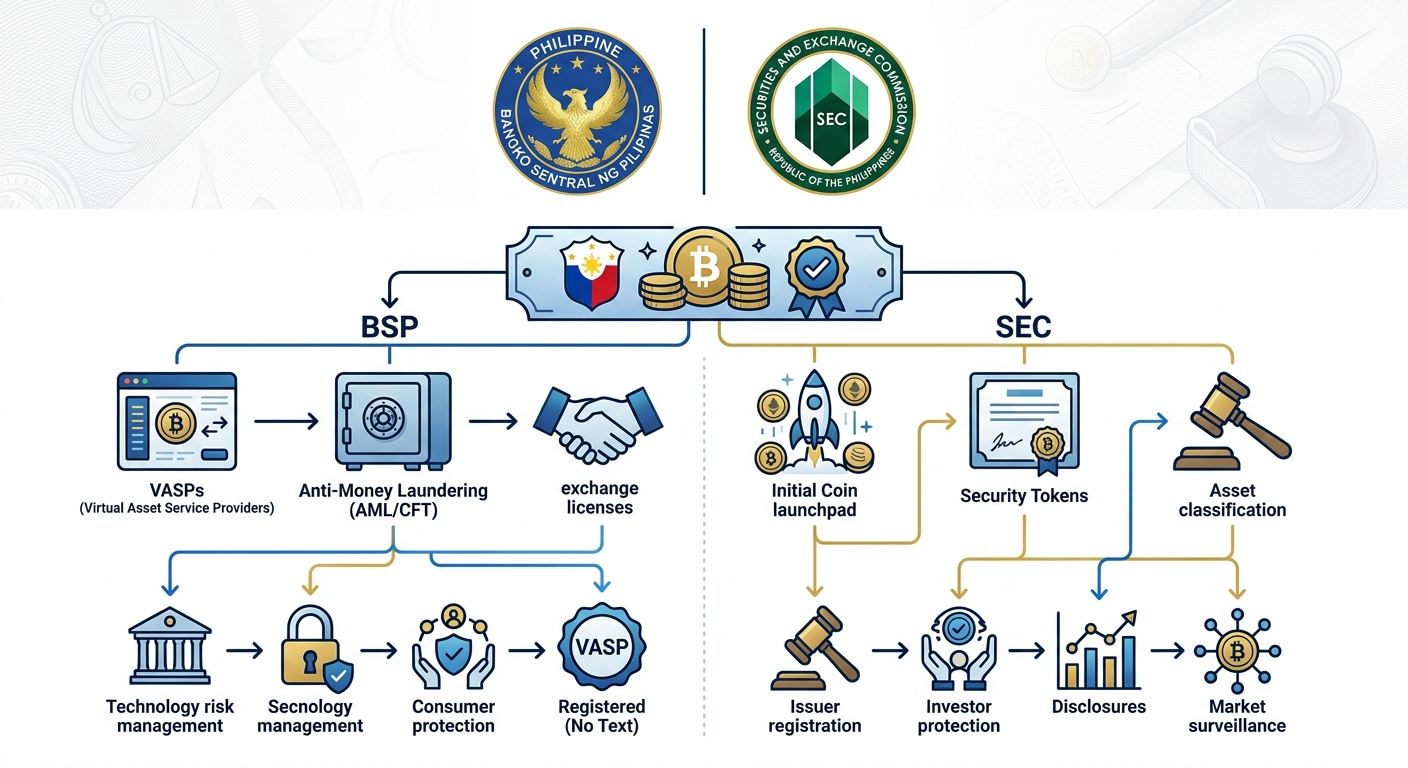
The Philippine Dual-Regulatory Framework for Cryptocurrency and Virtual Assets: A Comprehensive Guide for Foreign Investors in 2026
With the BSP's Circular No. 1108 and the SEC's CASP Rules (MC Nos. 04 and 05 of 2025) now both in force, foreign investors entering the Philippine virtual asset space face a bifurcated regulatory landscape that did not exist three years ago. This guide maps the jurisdictional boundaries between the Bangko Sentral ng Pilipinas and the Securities and Exchange Commission, explains the licensing pathways, capitalization requirements, AML/CTF obligations, the BSP's continued VASP license moratorium, and the practical steps a foreign investor must take to operate lawfully in the Philippines' digital asset market.