The Foreign Franchisor's Legal Roadmap to the Philippines: A 2026 Comprehensive Guide
Introduction: Why the Philippines Is a Foreign Franchisor’s Priority Market
The Philippines consistently ranks among the fastest-growing franchise markets in Southeast Asia. The country’s 110 million population — with a median age of 25.5 years, a literacy rate exceeding 98%, and a rapidly expanding middle class — creates an ideal environment for proven brand concepts in food and beverage, retail, education, wellness, and services. Foreign franchisors from the United States, Japan, South Korea, and Europe have taken notice: international franchise brands now operate across every major Philippine city, from Quezon City and Manila to Cebu, Davao, and Clark.
Yet the Philippines’ legal framework for foreign participation in franchise systems is not a single statute — it is a layered system of corporation law, intellectual property law, tax law, labor law, competition law, and sectoral regulations that foreign franchisors must navigate simultaneously. The consequences of getting it wrong are severe: a foreign company that “does business” in the Philippines without proper SEC licensing violates the Revised Corporation Code (Republic Act No. 11232) and may be subject to involuntary dissolution. A franchisor that fails to register its trademarks with the Intellectual Property Office of the Philippines (IPOPHL) under the Intellectual Property Code (Republic Act No. 8293) exposes its brand to piracy and loses the ability to enforce infringement claims in Philippine courts. And a franchisor that remits royalties to a foreign parent company without proper BIR withholding tax compliance faces penalties, surcharges, and potential criminal prosecution.
This guide provides a comprehensive, lawyer-grade roadmap for foreign franchisors seeking to establish a lawful and sustainable franchise presence in the Philippines in 2026.
Part I: Understanding the Philippine Legal Framework for Franchising
1.1 There Is No Single “Franchise Act” — and Why That Matters
Unlike the United States, which has the Federal Trade Commission’s Franchise Rule (16 C.F.R. Part 436) mandating detailed pre-sale disclosure through a Franchise Disclosure Document, the Philippines does not have a single statute governing business-format franchising end-to-end. Instead, Philippine franchising is governed by a patchwork of statutes, administrative orders, and self-regulatory norms:
- The Civil Code of the Philippines — general contract law governing the franchise agreement itself (consent, cause, object, vices of consent, good faith in performance)
- Republic Act No. 8293 — The Intellectual Property Code of the Philippines — governing trademark registration, trade secret protection, and copyright in training materials and operations manuals
- Republic Act No. 11232 — The Revised Corporation Code of the Philippines — governing the formation, registration, and governance of the Philippine corporate entity through which the franchise operates
- Republic Act No. 10667 — The Philippine Competition Act — governing vertical restraints in franchise agreements and exclusive distribution arrangements
- Republic Act No. 8762, as amended by Republic Act No. 11595 — The Retail Trade Liberalization Act — governing foreign equity and paid-up capital requirements where the franchise involves retail operations
- The National Internal Revenue Code (Tax Code), as amended — governing income tax, VAT, and withholding tax on royalties and franchise fees
- DOLE Department Order No. 146, Series of 2015 (DO 146-15) — governing the Alien Employment Permit (AEP) for foreign personnel seconded to the Philippine franchise operation
- Republic Act No. 10173 — The Data Privacy Act of 2012 — governing the collection, processing, and cross-border transfer of customer and employee personal data through the franchise system
- Republic Act No. 7394 — The Consumer Act of the Philippines — governing product safety, warranties, and deceptive sales practices relevant to franchise retail operations
Foreign franchisors must understand that the absence of a unified franchise statute does not mean franchising is unregulated — it means every aspect of the franchise relationship is separately regulated under the applicable statute, and non-compliance with any one layer creates legal exposure.
1.2 What Constitutes a “Franchise” Under Philippine Law
Philippine courts and regulators look to the substance of the arrangement rather than the label attached to it. A business-format franchise in the Philippine context typically combines:
- An intellectual property license — the right to use the franchisor’s trademarks, trade dress, proprietary recipes, and operational systems
- A business system — operations manuals, training programs, supply chain standards, quality control protocols
- Fee arrangements — an initial franchise fee, continuing royalty (typically a percentage of gross sales), and sometimes marketing fund contributions and technology fees
- Support and controls — site selection standards, design and fit-out specifications, mandatory audits, reporting requirements
- Exclusivity — territorial rights (exclusive or non-exclusive), minimum development commitments, and restrictions on competitive activities
A distribution or dealership agreement that grants a local entity the right to use a foreign brand’s trademark, know-how, and operational system may be treated as a franchise in legal disputes — even if the parties labelled it something else. Foreign franchisors should plan their contractual architecture with this in mind.
Part II: Trademark Registration With IPOPHL — Non-Negotiable Step One
2.1 Why Trademarks Must Be Registered in the Philippines Before Anything Else
Before a foreign franchisor signs a single franchise agreement, registers a Philippine entity, or opens a single outlet, it must register its trademarks with the Intellectual Property Office of the Philippines (IPOPHL) under Republic Act No. 8293 (the Intellectual Property Code).
The reason is fundamental: Philippine trademark law is a registration-based system. Under Section 122 of RA 8293, “[t]he rights in a mark shall be acquired through registration made validly in accordance with the provisions of this law.” A foreign franchisor that operates in the Philippines without registering its trademarks first will find that it cannot effectively enforce infringement claims against Philippine counterfeiters, pirates, or bad-faith trademark squatters — because the burden of proof in infringement cases falls on the registered trademark owner.
More practically: a Philippine franchisee will be reluctant to invest significant capital in a brand that has no local trademark protection. Franchisees understand intellectual property risk, and a franchisor that has not taken the basic step of IPOPHL registration signals that it has not done its Philippine homework.
2.2 Filing Requirements Under RA 8293, Section 124
Under Section 124 of RA 8293, a trademark application must be filed with IPOPHL and must include:
- The name and address of the applicant
- A representation (drawing) of the trademark sought to be registered
- A list of the goods or services for which registration is sought, grouped and identified by their respective Nice Classification categories
- The basis for filing (use-based or intention-to-use)
The Nice Classification system categorizes goods and services into 45 classes — 34 for goods and 11 for services. A foreign food and beverage franchisor, for example, would typically file in Class 43 (restaurant and catering services) and possibly Class 29-33 for specific food and beverage products sold under the brand. An education franchise franchisor would file in Class 41 (education and training services). A retail brand franchise would file across multiple classes depending on the product categories sold.
2.3 The Foreign Applicant Requirement
A foreign franchisor can file a trademark application directly with IPOPHL as a foreign applicant, but it must designate a Filipino resident agent or attorney for purposes of the application process. This is a mandatory requirement under IPOPHL’s rules. Most foreign franchisors engage Philippine IP counsel to handle the filing, examination, publication, and opposition process.
2.4 Timeline and Costs
The typical timeline for IPOPHL trademark registration is four to eight months from filing to registration, assuming no opposition is filed during the publication period. Key steps include:
- Filing and formal examination (1-2 months)
- Publication in the IPOPHL Gazette (2 months for opposition period)
- Substantive examination (2-4 months)
- Allowance and issuance of registration certificate
The official filing fee per class is relatively modest (approximately PHP 1,500-3,000 depending on the type of applicant and number of classes), but the larger cost is professional fees for trademark counsel who manage the process.
2.5 Recording the Franchise License Agreement
Once a franchise agreement is signed with a Philippine franchisee, the franchisor should consider recording the trademark license agreement with IPOPHL. While recording is not legally required for the license to be valid between the parties, it creates a public record of the license that can be useful in infringement enforcement proceedings and in demonstrating the franchisor’s good faith to Philippine regulatory authorities.
Part III: Choosing the Right Philippine Entity Structure
3.1 The SEC Licensing Requirement — “Doing Business” in the Philippines
The most consequential legal question for any foreign franchisor is whether its activities in the Philippines require it to obtain a license from the Securities and Exchange Commission (SEC) under Republic Act No. 11232 (the Revised Corporation Code).
Section 142 of RA 11232 defines a foreign corporation as “a corporation organized under foreign laws.” Section 143 provides that a foreign corporation that “does business” in the Philippines without a license shall not be permitted to maintain any action in any court in the Philippines until it has obtained such license. More significantly, Section 144 provides that such unlicensed foreign corporation shall be precluded from collecting or receiving any sum in pesos or in foreign currency on any judgment obtained in its favor in any court in the Philippines.
The SEC has interpreted “doing business” to include activities such as:
- Maintaining a local office or place of business in the Philippines
- Hiring employees, agents, or representatives in the Philippines who habitually conclude contracts on behalf of the foreign corporation
- Having a Philippine-based server or digital infrastructure used for commercial transactions with Philippine customers
- Habitually selling goods, services, or franchises to Philippine residents on a repeated basis
A foreign franchisor that enters into a franchise agreement with a Philippine franchisee, and that franchise agreement involves the franchisor actively supporting, training, auditing, and collecting royalties from the Philippine franchisee, will almost certainly be found to be “doing business” in the Philippines and will require SEC licensing.
3.2 Entity Structure Options
Option A: Philippine Subsidiary Corporation (Domestic Corporation)
The most common and recommended structure for a foreign franchisor establishing a direct presence in the Philippines is to incorporate a Philippine subsidiary corporation under RA 11232, which is treated as a domestic corporation regardless of foreign ownership. This subsidiary:
- Has a distinct legal personality from the foreign parent
- Can be 100% foreign-owned (subject to the restrictions noted below)
- Can be structured as a One Person Corporation (OPC) under RA 11232 if the franchisor prefers simplicity
- Is subject to Philippine corporate income tax on its net income
- Can engage in all activities necessary to support the franchise system in the Philippines
The subsidiary approach is particularly attractive for franchisors that want to directly operate pilot outlets, employ local staff, and actively manage the franchise development process.
Option B: Branch Office
A foreign franchisor can establish a branch office in the Philippines by obtaining an SEC license under SEC Form F-103 and contributing the required minimum capital (USD 200,000 for most industries, or USD 100,000 for exporters and technology-based enterprises). A branch office is not a separate legal entity from the foreign parent — the foreign parent is directly liable for the branch’s obligations. This structure is less common for franchise operations because of the unlimited liability exposure.
Option C: Representative Office
A representative office (SEC Form F-104) is a less-than-full-presence option — it can engage only in activities that are preparatory or auxiliary to the foreign corporation’s main business (e.g., market research, liaison, product promotion). It cannot earn income in the Philippines, cannot conclude contracts on behalf of the foreign parent, and cannot support an active franchise operation. For most franchise purposes, this is not a viable structure.
Option D: Master Franchise or Area Developer Structure
Many foreign franchisors avoid direct Philippine incorporation by granting a master franchise to an established Philippine entity (the “master franchisee”), which then sub-franchises individual unit franchisees. This structure:
- Allows the foreign franchisor to avoid the “doing business” requirement (because the master franchisee is a Philippine entity, not a foreign one)
- Shifts operational responsibility for franchise development, training, and compliance to the master franchisee
- Requires careful drafting of the master franchise agreement to preserve the franchisor’s brand standards, IP rights, and quality control obligations
The master franchise structure is particularly common for foreign franchisors entering the Philippines for the first time, as it reduces regulatory exposure and leverages the local expertise of the master franchisee. However, it requires the foreign franchisor to give up a significant degree of direct control over the Philippine market.
3.3 Retail Trade Liberalization Act — RA 8762, as amended by RA 11595
Where the franchise system involves retail operations (selling goods or services directly to consumers), the foreign franchisor must also consider Republic Act No. 8762, as amended by Republic Act No. 11595 (the Retail Trade Liberalization Act, or RTLA).
RA 11595, which took effect in April 2022, significantly liberalized foreign participation in retail trade by:
- Deleting the requirement that foreign retailers must have a paid-up capital of at least USD 2,500,000
- Allowing foreign-owned enterprises to engage in retail trade if they meet a substantially lower minimum paid-up capital threshold
- Permitting foreign-owned partnerships, associations, and corporations to engage in retail trade under the amended framework
Foreign franchisors planning to own and operate retail franchise outlets directly (rather than through a franchisee) must comply with the RTLA’s capital and registration requirements. Franchisors that grant franchises to Philippine entities that own and operate retail outlets are generally outside the scope of RTLA licensing requirements — but this depends on whether the franchise arrangement is considered a “retail enterprise” or merely a “franchise” of a brand.
Part IV: Tax Obligations for Foreign Franchisors
4.1 Corporate Income Tax
A Philippine subsidiary corporation (domestic corporation) is subject to corporate income tax on its worldwide net income at the rates prescribed under the Tax Code, as amended by the Corporate Recovery and Tax Incentives for Enterprises to Maximize Opportunities for Reinvestment and Sustained Transformations (CREATE MORE) Act (Republic Act No. 12066).
Under RA 12066, domestic corporations are subject to a flat 25% corporate income tax (CIT) on net taxable income. Small domestic corporations with net taxable income not exceeding PHP 5,000,000 and with total assets not exceeding PHP 100,000,000 (excluding land) may qualify for a reduced 20% CIT rate.
Foreign franchisors operating through a Philippine branch office are subject to the 25% tax on Philippine-source income only, with the foreign parent liable for tax on income attributable to its Philippine branch operations.
4.2 Withholding Tax on Royalties — The Critical Issue for Foreign Franchisors
The tax issue that most frequently surprises foreign franchisors is the withholding tax on royalties paid by Philippine franchisees to the foreign franchisor.
Under Section 28(A)(3) of the Tax Code, royalties and other payments received by a non-resident foreign corporation (NRFC) from Philippine sources are subject to a 25% final withholding tax on the gross amount of such payments. “Royalties” in this context broadly includes payments for the use of, or the right to use, patents, trademarks, copyrights, secret processes, formulas, goodwill, and other intangible property — which squarely captures franchise royalty payments.
Practical implication: When a Philippine franchisee pays royalties to a foreign franchisor, the franchisee (as the withholding agent) must withhold 25% of the gross royalty payment and remit it to the BIR. The foreign franchisor receives only the net amount (75% of the gross). The withheld 25% is a final tax — the foreign franchisor does not need to file a Philippine income tax return if its only Philippine income is royalties subject to this withholding treatment.
4.3 Tax Treaty Relief
The 25% withholding tax rate may be reduced under an applicable bilateral tax treaty if the foreign franchisor’s country of incorporation has a tax treaty with the Philippines that covers royalties and the franchisor can demonstrate it qualifies as a treaty beneficiary.
The Philippines has tax treaties with several countries, including Japan, South Korea, the United States (treaty in force), the United Kingdom, Germany, France, Canada, Australia, Netherlands, Singapore, and others. Treaty royalty rates are often reduced to 10% or 15% of the gross amount.
To claim treaty benefits, the foreign franchisor must:
- Obtain a Certificate of Tax Residency from the tax authority of its home country
- Submit the certificate to the Philippine franchisee or withholding agent
- Ensure the royalty payments are for payments that qualify as royalties under the applicable treaty
- Comply with any substance requirements under the treaty (anti-abuse provisions in modern treaties require the foreign entity to have genuine economic substance in the treaty country)
Failure to properly document treaty eligibility before the first royalty payment results in the 25% standard rate being applied and potentially significant disputes when attempting to claim a refund later.
4.4 VAT on Franchise Fees and Royalties
Franchise fees and royalty payments for services rendered in the Philippines are generally subject to 12% Value Added Tax (VAT) under the Tax Code, if the franchisor is VAT-registered in the Philippines or if the payments exceed the VAT threshold. Where the foreign franchisor is not VAT-registered in the Philippines (because it has no direct business presence), the Philippine franchisee typically does not withhold VAT but instead ensures that the total fee arrangement accounts for the VAT treatment.
4.5 Transfer Pricing
Where the foreign franchisor and the Philippine franchise entity are related parties (e.g., the Philippine entity is a subsidiary of the foreign parent, or both are controlled by the same ultimate parent), all intercompany transactions — including royalties, management fees, and supply arrangements — must be conducted at arm’s-length prices under Section 50 of the Tax Code and the BIR’s Transfer Pricing Regulations. The BIR has the authority to adjust non-arm’s-length intercompany prices and allocate income between related parties to reflect economic substance rather than form.
Part V: Registering Franchise Agreements With the DTI
5.1 The MSME Franchise Registry Under the DTI’s Administrative Order
Foreign franchisors with Philippine franchisees that qualify as micro, small, or medium enterprises (MSMEs) must register their franchise agreements with the Department of Trade and Industry (DTI) pursuant to an Executive Order establishing the MSME Franchise Registry.
Under the DTI’s framework, franchisors are required to:
- Register the franchise agreement with the DTI’s MSME Franchise Registry
- Execute an undertaking that all future franchise agreements with MSME franchisees shall incorporate the minimum terms and conditions prescribed by the DTI
- Ensure that the franchise disclosure document (even though not legally mandated under Philippine law) is provided to prospective MSME franchisees
While the DTI registry requirement applies specifically to MSME franchisees, it represents an important compliance obligation for foreign franchisors that work with smaller Philippine franchisees — which is common for franchisors using a multi-unit or area developer model.
5.2 The Absence of a Statutory FDD Requirement — And Why Best Practice Fills the Gap
Unlike the United States under the FTC Franchise Rule, the Philippines does not have a statute mandating a Franchise Disclosure Document (FDD) with specific itemized disclosures provided to prospective franchisees before the signing of a franchise agreement. This regulatory gap does not mean that foreign franchisors should skip disclosure — it means that the franchise agreement itself must be carefully drafted to address all material terms, and best practice dictates providing a disclosure document that covers:
- The franchisor’s corporate identity and financial condition
- The intellectual property being licensed
- All fees (initial, continuing, and hidden)
- Territorial rights and exclusivity terms
- The franchisor’s obligations to provide training, support, and supplies
- Conditions for renewal, transfer, and termination
- The franchisee’s post-termination obligations
The Philippine Franchise Association (PFA) has adopted a Self-Regulatory Code of Franchising that sets disclosure standards for its members. Foreign franchisors seeking to operate credibly in the Philippine market should align their disclosure practices with PFA standards even when not legally required to do so.
Part VI: Bringing Foreign Personnel to the Philippines
6.1 The Alien Employment Permit (AEP) — DOLE Department Order No. 146, Series of 2015
Foreign franchisors that establish a Philippine subsidiary or branch office and wish to station foreign personnel (e.g., a country manager, operations director, or training specialist) in the Philippines must ensure that each foreign national obtains an Alien Employment Permit (AEP) from the Department of Labor and Employment (DOLE) pursuant to DOLE Department Order No. 146, Series of 2015 (DO 146-15).
Section 1 of DO 146-15 states that “[a]ll foreign nationals who intend to engage in gainful employment in the Philippines shall apply for an Alien Employment Permit.” The AEP is issued only after the DOLE determines that the foreign national’s employment is not prejudicial to Philippine labor market conditions — meaning there is no Filipino citizen who is competent, able, and willing to perform the services for which the foreign national is sought.
Key requirements for AEP issuance include:
- A job offer or employment contract from the Philippine employer
- Evidence that the position requires specialized skills, advanced training, or managerial expertise not readily available from Philippine nationals
- The foreign national’s passport, visa, curriculum vitae, and academic/professional credentials
- The employer’s business permits and organizational documents
The AEP is typically valid for the period of the employment contract, up to a maximum of one year, and is renewable. The foreign national must also secure a 9(g) Pre-Arranged Employment Visa from the Bureau of Immigration (BI) as the primary immigration status enabling lawful employment in the Philippines.
6.2 The 9(g) Visa as the Primary Employment Immigration Status
The 9(g) Pre-Arranged Employment Visa, issued by the Bureau of Immigration under the Commonwealth Act No. 613 (the Philippine Immigration Act), is the standard work visa for foreign nationals employed by a Philippine-registered entity. The 9(g) visa:
- Allows multiple travel in and out of the Philippines during its validity period
- Covers the foreign national and their dependents (spouse and minor children)
- Requires employer sponsorship (the Philippine entity files the petition)
- Is convertible (the foreign national can change employers if the new employer files a new petition)
Foreign personnel of a Philippine subsidiary or branch office must have both a valid AEP from DOLE and a 9(g) visa from the BI before commencing any work in the Philippines. Working without either document exposes both the foreign national and the Philippine employer to significant penalties, including deportation and fines.
Part VII: Philippine Competition Law Compliance
7.1 Republic Act No. 10667 — The Philippine Competition Act
The Philippine Competition Act (Republic Act No. 10667) prohibits anti-competitive agreements, abuse of dominant position, and anti-competitive mergers and acquisitions. For foreign franchisors, the most relevant provisions are those governing vertical agreements between the franchisor and its franchisees.
Section 14 of RA 10667 provides a safe harbor for certain vertical agreements, including:
“(1) Permissible franchising, licensing, exclusive merchandising or exclusive distributorship agreements such as those which give each party the right to unilaterally terminate the agreement; or”
This safe harbor means that standard franchise agreement provisions — including territorial exclusivity grants, minimum resale price maintenance (when framed as recommended prices), exclusive sourcing requirements, and non-compete clauses — are generally permissible under the Philippine Competition Act, provided they do not cross into abuse of dominant position or hard-core cartel conduct (price-fixing, market allocation).
Important caveat: The safe harbor applies to agreements that give each party the unilateral right to terminate. Franchise agreements with long lock-in periods without termination rights for the franchisee may fall outside the safe harbor and be assessed under a full rule-of-reason analysis by the Philippine Competition Commission (PCC).
7.2 PCC Notification for Franchise Portfolio Acquisitions
Where a foreign franchisor acquires an existing Philippine master franchise portfolio — whether through an acquisition of the master franchisee company or its franchisee network — the transaction may trigger PCC mandatory notification thresholds under RA 10667 and its IRR. The PCC has jurisdiction over transactions where the aggregate annual revenue or value of the Philippine assets of the acquired entities exceed PHP 1 billion in the preceding year, or where the value of the transaction exceeds PHP 6 billion. Foreign franchisors considering acquisitions of Philippine franchise operations must conduct a PCC threshold analysis before closing.
Part VIII: Joint Employer Risk and Labor Compliance
8.1 The “Joint Employer” Risk in Franchise Operations
A significant and often underappreciated risk for foreign franchisors operating through franchisees (rather than directly owned units) is the risk of being treated as a joint employer of the franchisee’s employees under Philippine labor law.
Philippine labor law (Article 106 of the Labor Code, as amended) establishes that “there is deemed to be a labor-only contracting arrangement” where the contractor does not have substantial capital or does not exercise the functions of a proper employer. If a franchisor’s field operations personnel are found to be directly hiring, scheduling, supervising, or disciplining the employees of its franchisees — rather than merely enforcing brand standards — Philippine courts and labor tribunals may find that the franchisor is a joint employer with joint and several liability for labor obligations including minimum wage, overtime, Social Security System (SSS) contributions, PhilHealth contributions, Home Development Mutual Fund (HDMF/Pag-IBIG) contributions, and 13th-month pay.
The practical mitigation steps for foreign franchisors are:
- Maintain clear boundaries between brand standards enforcement (the “what”) and day-to-day HR management (the “how”), which must remain with the franchisee as the direct employer
- Include strong employer language in franchise agreements that affirmatively states the franchisee is the sole employer of its personnel, responsible for all labor law compliance
- Train field representatives on the distinction between brand audits (observing and reporting) and employee supervision (directing and controlling)
- Document all brand standards enforcement activities to demonstrate they are quality control, not HR management
8.2 Compliance Obligations for Directly Employed Staff
Where a foreign franchisor’s Philippine subsidiary directly employs staff (e.g., for a pilot flagship store or for franchise development and support functions), the employer must comply with the full stack of Philippine labor law requirements:
- Registration with the DOLE as an employer
- BIR registration and issuance of Tax Identification Numbers (TINs) for all employees
- SSS registration and monthly contribution remittance
- PhilHealth registration and monthly contribution remittance
- HDMF (Pag-IBIG) registration and monthly contribution remittance
- DOLE occupational safety and health (OSH) standards compliance
- Compliance with the Data Privacy Act (RA 10173) for employee personal data processing
The Labor Code also mandates that employers provide a 13th-month pay benefit (not less than 1/12 of the total basic salary earned in a calendar year), and comply with employee leave provisions under the Expanded Breastfeeding Promotion Act (RA 10028), the Solo Parents Welfare Act (RA 8972), and other special leave laws.
Part IX: The Practical Roadmap — Step-by-Step Implementation
Phase 1: Pre-Entry Preparation (Months 1-3)
Step 1: Register Core Trademarks With IPOPHL File trademark applications in all relevant Nice classes with IPOPHL under RA 8293. Engage Philippine IP counsel to manage the filing, examination, publication, and registration process. Simultaneously, conduct a trademark clearance search to identify and address any conflicts before filing.
Step 2: Develop Philippine-Tuned Franchise Documentation Prepare or adapt the franchise agreement, operations manual, training curriculum, and franchise disclosure document for the Philippine market. Ensure the franchise agreement addresses:
- Governing law (Philippine law is recommended for Philippine franchise operations)
- Dispute resolution (arbitration under the PDCRCI or ICC Rules is common for commercial disputes)
- Philippine-specific compliance obligations (AEP requirements, BIR withholding, DTI registration)
- Currency and payment mechanics for royalty remittances
- De-branding and post-termination obligations
Step 3: Conduct Entity and Tax Structure Planning Determine the optimal entity structure (subsidiary vs. master franchise) based on the franchisor’s desired level of control, capital commitment, and risk appetite. Model the withholding tax treatment of royalty flows, evaluate applicable tax treaty rates, and establish the transfer pricing methodology for any related-party transactions.
Phase 2: Philippine Legal Establishment (Months 3-6)
Step 4: Incorporate the Philippine Subsidiary (if applicable) File the articles of incorporation and bylaws with the SEC via the eSPARC online platform. The minimum authorized capital for a foreign-owned corporation is USD 200,000 unless the industry qualifies for a lower threshold under the CREATE MORE Act (RA 12066). At least 25% of the authorized capital must be subscribed and paid in upon incorporation.
Step 5: Obtain SEC License (if applicable) If the foreign franchisor is establishing a branch office rather than a subsidiary, file SEC Form F-103 (Application for License to Do Business in the Philippines) with the SEC, accompanied by the required supporting documents including the foreign corporation’s charter documents, board resolution authorizing the branch, and proof of inward remittance of the minimum capital.
Step 6: Register With the BIR Register the Philippine entity with the Bureau of Internal Revenue (BIR) within 30 days of SEC registration. Obtain the entity’s Tax Identification Number (TIN), register for applicable taxes (corporate income tax, VAT if applicable), and register all employees for withholding tax purposes.
Step 7: Secure Business Permits and LGU Registrations Obtain the mayor’s permit (business license) from the local government unit (LGU) where the Philippine entity’s principal office is located, along with barangay clearance and other required LGU-specific permits.
Phase 3: Operational Launch and Compliance (Month 6 Onward)
Step 8: Register Franchise Agreements With the DTI If the franchisee qualifies as an MSME, register the franchise agreement with the DTI’s MSME Franchise Registry. Execute the required undertaking to incorporate DTI-prescribed minimum terms in all future MSME franchise agreements.
Step 9: Obtain Alien Employment Permits for Foreign Personnel Apply for AEPs for all foreign nationals who will be employed by the Philippine entity under DO 146-15. File 9(g) visa petitions with the Bureau of Immigration for each qualifying foreign employee.
Step 10: Implement Ongoing Compliance Systems Establish systems for:
- Quarterly BIR withholding tax remittance on royalties paid to the foreign franchisor
- Annual corporate income tax filing
- SSS, PhilHealth, and HDMF monthly contribution remittance for all employees
- Annual franchise agreement review and DTI registry renewal
- IPOPHL trademark renewal (every 10 years)
- PCC transaction monitoring for any acquisitions of Philippine franchise portfolios
- Data Privacy Act compliance for customer data processing through POS systems and loyalty programs
Conclusion: The Foreign Franchisor’s Philippine Advantage
The Philippines offers foreign franchisors an exceptional combination of market size, English-speaking consumer base, growing middle class, and geographic proximity to key Asian markets. But the country’s layered legal system — spanning corporation law, intellectual property law, tax law, labor law, competition law, and sectoral regulation — demands that foreign franchisors approach market entry with the same rigor they would apply in any major jurisdiction.
The foundational principles are clear:
- Register trademarks first — before any franchise agreement, before any market activity, before any disclosure to potential franchisees
- Obtain proper SEC licensing if the franchisor will have a direct operational presence in the Philippines
- Model the tax treatment of every royalty and fee flow before signing the first franchise agreement — the 25% withholding tax, potential treaty reductions, and VAT implications all affect the economics of the deal
- Comply with labor law from day one — the AEP and 9(g) visa requirements are non-negotiable for foreign personnel
- Treat franchise disclosure as a business necessity, even if not yet a statutory mandate in the Philippines
- Maintain the brand control/integrated employer distinction to avoid joint employer liability
The foreign franchisor who builds these compliance foundations properly will find in the Philippines not just a market — but a scalable, long-term franchise platform that can become one of the most valuable assets in its international portfolio.
This article is for general informational purposes only and does not constitute legal advice. The laws and regulations discussed are subject to change. Foreign franchisors seeking to establish franchise operations in the Philippines should consult with qualified Philippine legal counsel before taking any action.
Related Articles

The Philippine Privacy Impact Assessment Revolution: What the 2026 Draft Circular Means for Foreign Companies
The NPC's August 2026 draft circular would replace the blanket Privacy Impact Assessment obligation that has governed Philippine data privacy compliance since 2017 with a risk-tiered framework. For foreign companies operating in or serving the Philippine market, the shift from a one-size-fits-all requirement to a threshold-based trigger system carries significant compliance and cost implications. This guide explains the eight mandatory PIA trigger categories, the new quantitative thresholds, what the draft circular means for AI systems and cross-border transfers, and the practical steps foreign companies must take now.
The Philippine Dual-Regulatory Framework for Cryptocurrency and Virtual Assets: A Comprehensive Guide for Foreign Investors in 2026
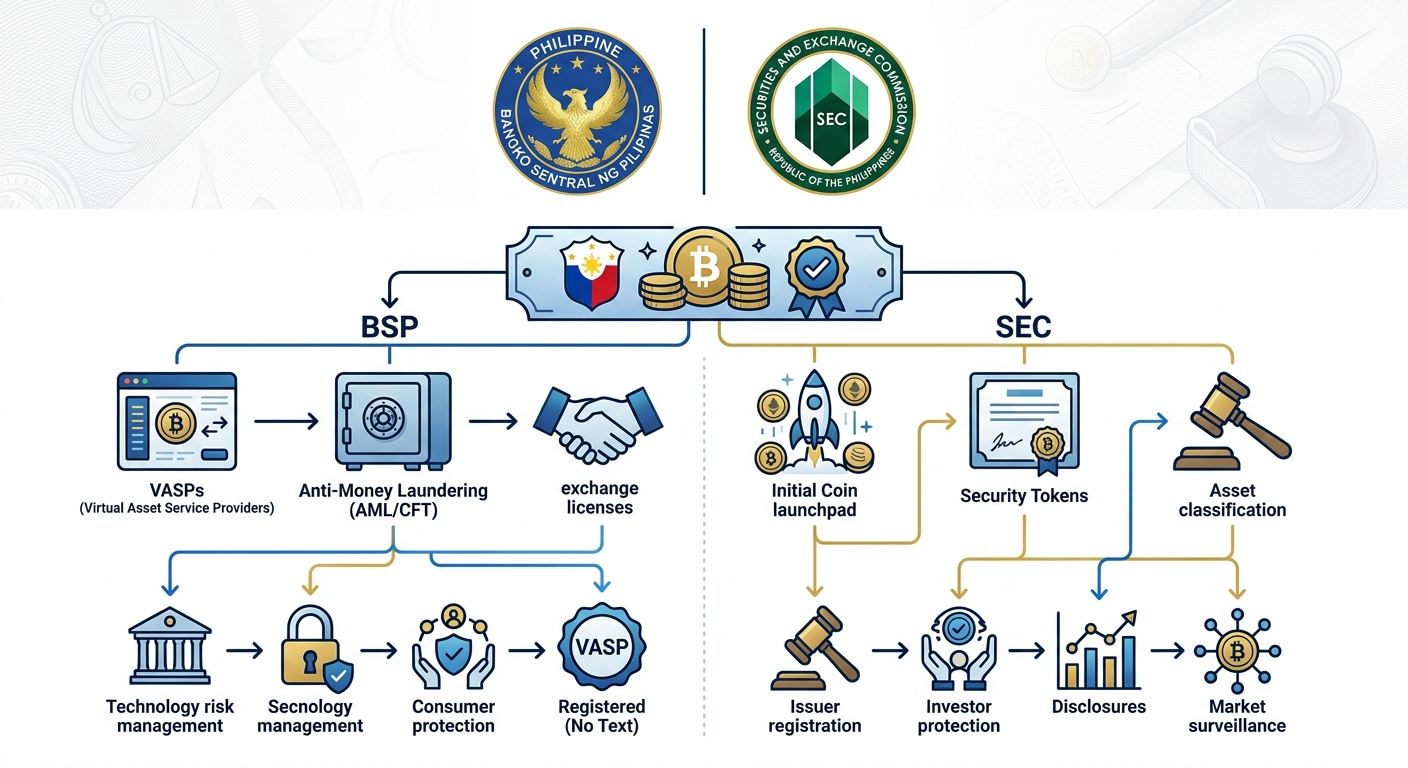
With the BSP's Circular No. 1108 and the SEC's CASP Rules (MC Nos. 04 and 05 of 2025) now both in force, foreign investors entering the Philippine virtual asset space face a bifurcated regulatory landscape that did not exist three years ago. This guide maps the jurisdictional boundaries between the Bangko Sentral ng Pilipinas and the Securities and Exchange Commission, explains the licensing pathways, capitalization requirements, AML/CTF obligations, the BSP's continued VASP license moratorium, and the practical steps a foreign investor must take to operate lawfully in the Philippines' digital asset market.

The Philippine E-Invoicing Mandate: A Comprehensive Compliance Guide for Foreign Companies in 2026
With the December 31, 2026 deadline for mandatory e-invoicing under BIR Revenue Regulations No. 11-2025 fast approaching, foreign companies operating in the Philippines face an urgent compliance obligation that cannot be deferred. This guide provides a complete analysis of who must comply, what constitutes a compliant electronic invoice, the step-by-step implementation process, tax deduction opportunities under the CREATE MORE Act, and the penalties for non-compliance — with every legal citation verified against primary sources.