Philippine Startup Visa for Foreign Founders: 6 Questions About RA 11337 Answered

The Philippines has made a deliberate push to attract foreign entrepreneurs. In 2019, Congress passed Republic Act No. 11337, the Innovative Startup Act, which — among other things — created a dedicated visa category for foreign startup founders, employees, and investors. If you're a foreign national considering launching an innovative business in the Philippines, here are six questions you should be asking.
1. What Exactly Is the Startup Visa?
Under Section 13 of RA 11337, the Department of Foreign Affairs (DFA) is mandated to create three types of startup visas:
- Startup Owner Visa — for prospective or current foreign owners of a startup or startup enabler registered in the Philippines
- Startup Employee Visa — for foreign employees of a registered startup or startup enabler
- Startup Investor Visa — for prospective or current foreign investors in a registered startup or startup enabler
Each visa has an initial validity of five (5) years and may be renewed for an additional three (3) years. They are multiple-entry, meaning holders can travel freely in and out of the Philippines without needing to reapply each time.
There's also a multiple-entry interim startup visa, valid for six months to one year, which is issued free of charge to prospective startup owners, investors, or enablers upon endorsement by the appropriate host agency.
2. Do I Still Need an Alien Employment Permit (AEP)?
No. One of the most significant benefits of the startup visa is the exemption from the Alien Employment Permit (AEP) requirement. Under normal circumstances, any foreigner working in the Philippines must secure an AEP from the Department of Labor and Employment (DOLE) under Article 40 of the Labor Code of the Philippines. This process can take weeks and involves demonstrating that no qualified Filipino is available for the position.
Section 13 of RA 11337 explicitly states that "bearers of the visa shall be exempt from securing an Alien Employment Permit (AEP) issued by the Department of Labor and Employment." This removes a major bureaucratic hurdle for foreign founders and their foreign team members.
3. What Qualifies as a "Startup" Under the Law?
The definition is broad but innovation-focused. Under Section 3(g) of RA 11337, a startup is "any person or registered entity in the Philippines which aims to develop an innovative product, process, or business model."
The law defines "innovative" across three categories:
- Innovative product — a good or service that is new or significantly improved in its technical specifications, components, software, user-friendliness, or functional characteristics
- Innovative process — a new or significantly improved production or delivery method
- Innovative business model — a new organizational method in business practices, workplace organization, or external relations
This means you don't necessarily need to be a tech company. A foreign founder introducing a novel supply chain model, a new service delivery platform, or an improved manufacturing process could potentially qualify — as long as the innovation element is demonstrable.
4. Does the Startup Act Reduce the Minimum Capital Requirement for Foreigners?
Yes — indirectly. Under the Foreign Investments Act of 1991 (RA 7042, as amended by RA 11647), a 100% foreign-owned domestic market enterprise generally needs a minimum paid-up capital of US$200,000. However, the amended FIA provides a reduced threshold of US$100,000 for enterprises that, among other qualifying conditions, involve "startups or startup enablers as defined under Republic Act No. 11337."
This halved capital requirement can make a meaningful difference for foreign founders bootstrapping a new venture. Note, however, that the 60-40 foreign equity restrictions under the Philippine Constitution and the Foreign Investment Negative List (FINL) still apply to nationalized or partly nationalized industries. The Startup Act does not override constitutional ownership limits — it reduces the financial barrier to entry for qualifying businesses in sectors open to full foreign ownership.
5. How Do I Actually Apply?
To access the benefits under RA 11337, including the startup visa, you must go through a host agency. The three lead agencies are:
- DOST (Department of Science and Technology) — for science and R&D-driven startups
- DTI (Department of Trade and Industry) — for trade and business innovation
- DICT (Department of Information and Communications Technology) — for ICT-focused ventures
The general process is:
- Register your startup with the SEC (for corporations or partnerships) or DTI (for sole proprietorships)
- Apply to a host agency for endorsement under the Philippine Startup Development Program — you'll need a business plan demonstrating the innovative nature of your product, process, or model
- Undergo evaluation by a Steering Committee that assesses innovation value, scalability, and job creation potential
- Receive endorsement — once approved, the host agency endorses your startup visa application to the DFA and Bureau of Immigration
The DTI has also established Startup BOSS (Business One-Stop Shop), an online and physical platform designed to streamline registration, tax compliance, and local permit applications for qualified startups.
6. What Other Benefits Can Foreign Founders Access?
Beyond the visa and reduced capital requirements, RA 11337 offers several additional benefits that foreign founders can access through their host agency:
- Registration subsidies — full or partial subsidy for business permits and certificates (Section 7(a))
- Facility access — subsidized use of government co-working spaces, office facilities, and equipment (Section 7(c)-(d))
- Grants-in-aid (GIA) — funding for research, development, training, and expansion (Section 7(e))
- Startup Venture Fund (SVF) — a government matching fund co-managed by the DTI and the National Development Company that matches private investor contributions in Philippine-based startups (Section 12)
- PEZA Startup Ecozones — the law directs PEZA, in coordination with DTI, DOST, and DICT, to create special economic zones tailored for startups, potentially giving qualified startups access to PEZA incentives like income tax holidays and duty-free importation (Section 9)
Foreign startup founders may also be eligible for the APEC Business Travel Card through their Filipino co-founders or executives, facilitating faster travel across APEC member economies.
The Bottom Line
The Philippine Startup Act represents a genuine legislative effort to attract foreign innovation. The combination of a dedicated visa, reduced capital requirements, AEP exemptions, and access to government grants makes the Philippines more competitive as a startup destination in Southeast Asia. However, foreign founders should still be aware of constitutional ownership limits in restricted industries and should seek legal counsel to structure their ventures correctly from the outset.
Need help registering a startup or applying for a startup visa in the Philippines? Our team at TTFC Law can guide you through the process — from SEC registration and host agency endorsement to visa application and compliance. Get in touch with us today.
Related Articles

The Philippine Privacy Impact Assessment Revolution: What the 2026 Draft Circular Means for Foreign Companies
The NPC's August 2026 draft circular would replace the blanket Privacy Impact Assessment obligation that has governed Philippine data privacy compliance since 2017 with a risk-tiered framework. For foreign companies operating in or serving the Philippine market, the shift from a one-size-fits-all requirement to a threshold-based trigger system carries significant compliance and cost implications. This guide explains the eight mandatory PIA trigger categories, the new quantitative thresholds, what the draft circular means for AI systems and cross-border transfers, and the practical steps foreign companies must take now.
The Philippine Dual-Regulatory Framework for Cryptocurrency and Virtual Assets: A Comprehensive Guide for Foreign Investors in 2026
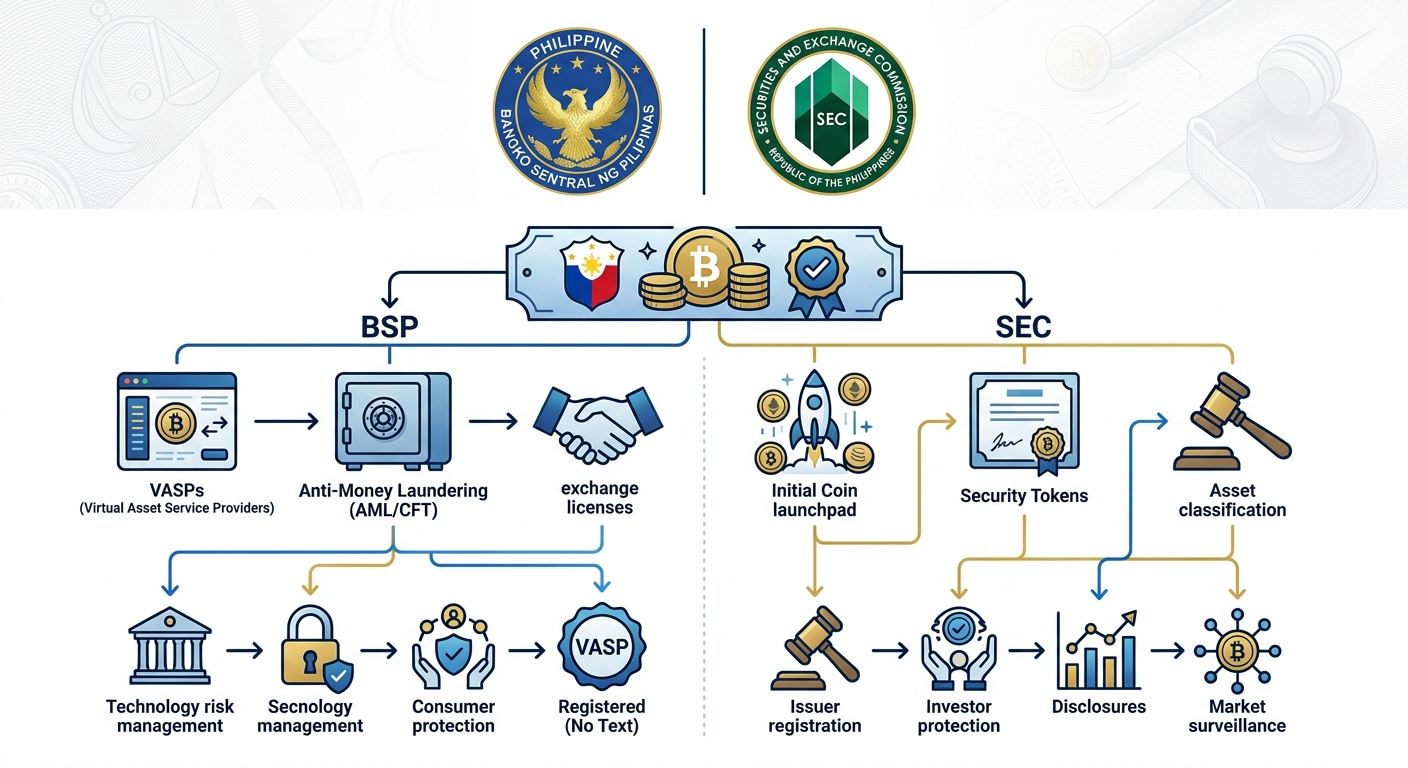
With the BSP's Circular No. 1108 and the SEC's CASP Rules (MC Nos. 04 and 05 of 2025) now both in force, foreign investors entering the Philippine virtual asset space face a bifurcated regulatory landscape that did not exist three years ago. This guide maps the jurisdictional boundaries between the Bangko Sentral ng Pilipinas and the Securities and Exchange Commission, explains the licensing pathways, capitalization requirements, AML/CTF obligations, the BSP's continued VASP license moratorium, and the practical steps a foreign investor must take to operate lawfully in the Philippines' digital asset market.
The Philippine E-Invoicing Mandate: A Comprehensive Compliance Guide for Foreign Companies in 2026
With the December 31, 2026 deadline for mandatory e-invoicing under BIR Revenue Regulations No. 11-2025 fast approaching, foreign companies operating in the Philippines face an urgent compliance obligation that cannot be deferred. This guide provides a complete analysis of who must comply, what constitutes a compliant electronic invoice, the step-by-step implementation process, tax deduction opportunities under the CREATE MORE Act, and the penalties for non-compliance — with every legal citation verified against primary sources.