Money Services Business Licensing in the Philippines: A Complete Guide for Fintech Companies

The Philippines has emerged as one of Southeast Asia's most dynamic fintech markets. With a population of over 110 million and significant unbanked segments, fintech companies see tremendous opportunity. However, operating a money services business requires proper licensing from the Bangko Sentral ng Pilipinas (BSP). This guide covers the regulatory framework under the M-Regulations (BSP Circular No. 1206) and provides a roadmap for obtaining the necessary licenses.
What is a Money Services Business (MSB)?
Note: MSB licensing is distinct from the Merchant Acquisition License (MAL), which is required for Operators of Payment Systems engaging in merchant onboarding and payment processing. If your business model involves helping merchants accept payments (like payment gateways), you need an MAL. If your business involves money transfers, e-wallets, cryptocurrency, or currency exchange, you need an MSB license as described below.
Under BSP regulations, a Money Services Business is defined as a non-banking entity engaged in one or more of the following activities:
- Remittance services
- Money changing
- Foreign exchange dealings
The M-Regulations, which took effect in December 2024, consolidate all rules governing MSBs, repealing previous provisions in Sections 901-N and 902-N of the Manual of Regulations for Non-bank Financial Institutions (MORNBFI).
Types of Money Services Businesses
MSBs are classified into two main categories:
1. Remittance and Transfer Companies (RTCs)
RTCs include the following subcategories:
- Remittance Agents (RAs): Companies that facilitate domestic and international money transfers
- Remittance Platform Providers (RPPs): Technology platforms enabling remittance transactions
- E-Money Issuers (EMIs): Companies that issue electronic money and operate e-wallets
- Virtual Asset Service Providers (VASPs): Companies dealing in cryptocurrency and virtual assets
2. Money Changers (MCs) / Foreign Exchange Dealers (FXDs)
Entities engaged in buying and selling foreign currencies.
BSP License Classifications and Requirements
The BSP classifies MSBs into different types based on their operations, each with specific capital requirements, registration fees, and annual fees:
| Type | Classification | Min. Capital | Reg. Fee | Annual Fee |
|---|---|---|---|---|
| A | Large-Scale Remittance Agent (monthly transactions ≥ PHP 75M) | PHP 50M | PHP 100,000 | PHP 100,000 |
| B | Small-Scale Remittance Agent (monthly transactions < PHP 75M) | < PHP 50M | PHP 20,000 | PHP 20,000 |
| C | E-Money Issuer (Large Scale) | PHP 200M | PHP 100,000 | PHP 300,000+ |
| C | E-Money Issuer (Small Scale) | PHP 100M | PHP 100,000 | PHP 300,000+ |
| D | Remittance Platform Provider | PHP 10M | PHP 100,000 | PHP 100,000 |
| E | Large-Scale Money Changer/FX Dealer (monthly transactions ≥ PHP 50M) | PHP 10M | PHP 100,000 | PHP 100,000 |
| F | Small-Scale Money Changer/FX Dealer (monthly transactions < PHP 50M) | < PHP 10M | PHP 20,000 | PHP 20,000 |
| - | VASP (Custodial) | PHP 50M | PHP 100,000 | PHP 100,000 |
| - | VASP (Non-custodial) | PHP 10M | PHP 20,000 | PHP 20,000 |
E-Money Issuer (EMI) License
E-Money Issuers are authorized to convert cash into electronic money that can be stored in digital wallets. This is the license required for operating e-wallet services like GCash or Maya.
Key Requirements:
- Minimum Capital: PHP 100 million (small scale) to PHP 200 million (large scale)
- Liquidity Reserve: 1:1 ratio—EMIs must maintain reserves equal to all outstanding e-money liabilities
- Segregated Funds: Customer funds must be separated from operational funds
Current Status:
The BSP lifted the moratorium on new EMI-NBFI applications in late 2024. New applicants may now apply for EMI licenses, though the approval process remains rigorous.
Virtual Asset Service Provider (VASP) License
VASPs are companies involved in cryptocurrency and virtual asset transactions, including:
- Exchange between virtual assets and fiat currencies
- Exchange between one or more forms of virtual assets
- Transfer of virtual assets
- Safekeeping and administration of virtual assets (custodial services)
Capital Requirements:
- Custodial VASP: PHP 50 million minimum
- Non-custodial VASP: PHP 10 million minimum
Important Notice - VASP Moratorium:
The BSP continues to maintain a moratorium on new VASP licenses until September 2025. However, existing BSP-supervised financial institutions may still apply to expand their operations to include VASP services.
Registration Process Overview
The BSP registration process consists of three stages:
Stage 1: Preliminary Assessment (20 working days for RTCs/MCs/FXDs; 13 working days for VASPs)
Required documents include:
- Letter of Application signed by authorized officer
- Proof of SEC/DTI registration
- Comprehensive Business Plan
- List of owners, directors, and key officers
- Compliance with fitness and propriety requirements (personal data forms, NBI clearance)
- Proof of financial capacity
- Certification that funds are not from unlawful activities
- Proof of AML training attendance
- Provisional AMLC registration
- Non-refundable filing fee payment
Stage 2: SEC Registration (7 working days)
After Stage 1 approval, you must:
- Obtain BSP Letter of No Objection
- Register your Articles of Incorporation with the SEC indicating MSB purpose
Stage 3: Certificate of Authority Issuance (13-20 working days)
Final requirements include:
- Notarized Application for Authority to Establish and Operate
- Certified true copy of registered AOI/By-laws
- Business license from local government
- Notarized Deed of Undertaking
- Updated proof of financial capacity
- Payment of licensing and metal plate fees
Total processing time: Approximately 40-47 working days for standard MSBs; longer for VASPs due to additional verification requirements.
AMLC Registration Requirement
All MSBs are classified as "covered persons" under the Anti-Money Laundering Act. Before commencing operations, you must:
- Register with the Anti-Money Laundering Council (AMLC)
- Obtain the AMLC Certificate of Registration
- Implement KYC (Know Your Customer) procedures
- File Suspicious Transaction Reports (STRs) as required
- Comply with the Philippine Travel Rule for cross-border transactions
Multiple Licenses: When You Need More Than One
An entity receives only the specific MSB license for which it applies. If your business model involves multiple money services activities, you need separate licenses for each.
Example: A fintech app that allows users to:
- Buy and sell cryptocurrency
- Hold e-money in an e-wallet
- Send money domestically and overseas
- Exchange foreign currencies
This company would need VASP, EMI, RA, and MC/FX licenses respectively.
Reference: Licenses Held by Major Philippine Fintech Companies
Major fintech players in the Philippines typically hold multiple licenses:
- E-wallet providers often combine EMI and RA licenses
- Crypto exchanges may hold VASP, EMI, and Operator of Payment System (OPS) licenses
- Comprehensive fintech platforms may hold 4-5 different BSP licenses
Electronic Payment and Financial Services (EPFS) License
In addition to the basic MSB license, companies may apply for an advanced EPFS license. This license authorizes end-users to initiate and receive payments or access financial information through electronic devices, enabling more sophisticated financial services.
Compliance Obligations
Once licensed, MSBs must maintain ongoing compliance with:
- Capital adequacy: Maintain minimum capital requirements at all times
- Liquidity requirements: EMIs must maintain 1:1 reserves
- AML/CFT compliance: Continuous monitoring and reporting obligations
- Consumer protection: Clear disclosure of fees, complaint handling mechanisms
- IT risk management: Per BSP Circular No. 1213 (May 2025) for advanced electronic payment services
- Annual renewal: Payment of annual service fees
- Reportorial requirements: Regular submissions to BSP
Foreign Companies: Entry Requirements
Foreign fintech companies seeking to enter the Philippine market must:
- Establish a branch or subsidiary through SEC registration
- Meet secondary licensing requirements with SEC and/or BSP
- Comply with local AML requirements
- Satisfy minimum capital requirements (foreign investment rules may apply)
Timeline and Commencement of Operations
Upon successful registration, BSP issues a Certificate of Registration (COR). Important note: Operations must commence within three (3) months of COR issuance, or the certificate will be cancelled.
Key Takeaways
- Define your scope clearly: Different activities require different licenses. Map out your intended services before applying.
- Plan for significant capital: Minimum capital requirements range from PHP 10 million to PHP 200 million depending on license type.
- Budget for ongoing fees: Annual service fees and compliance costs are substantial.
- Start with AML compliance: AMLC registration and AML training are prerequisites for BSP application.
- Allow adequate time: The full licensing process typically takes 3-6 months minimum.
- Consider current moratoria: VASP moratorium remains in effect until September 2025.
The Philippine fintech regulatory landscape continues to evolve as the BSP balances innovation with financial stability and consumer protection. Companies entering this space should engage experienced legal counsel to navigate the regulatory requirements and ensure successful licensing.
Related Articles

The Philippine Privacy Impact Assessment Revolution: What the 2026 Draft Circular Means for Foreign Companies
The NPC's August 2026 draft circular would replace the blanket Privacy Impact Assessment obligation that has governed Philippine data privacy compliance since 2017 with a risk-tiered framework. For foreign companies operating in or serving the Philippine market, the shift from a one-size-fits-all requirement to a threshold-based trigger system carries significant compliance and cost implications. This guide explains the eight mandatory PIA trigger categories, the new quantitative thresholds, what the draft circular means for AI systems and cross-border transfers, and the practical steps foreign companies must take now.
The Philippine Dual-Regulatory Framework for Cryptocurrency and Virtual Assets: A Comprehensive Guide for Foreign Investors in 2026
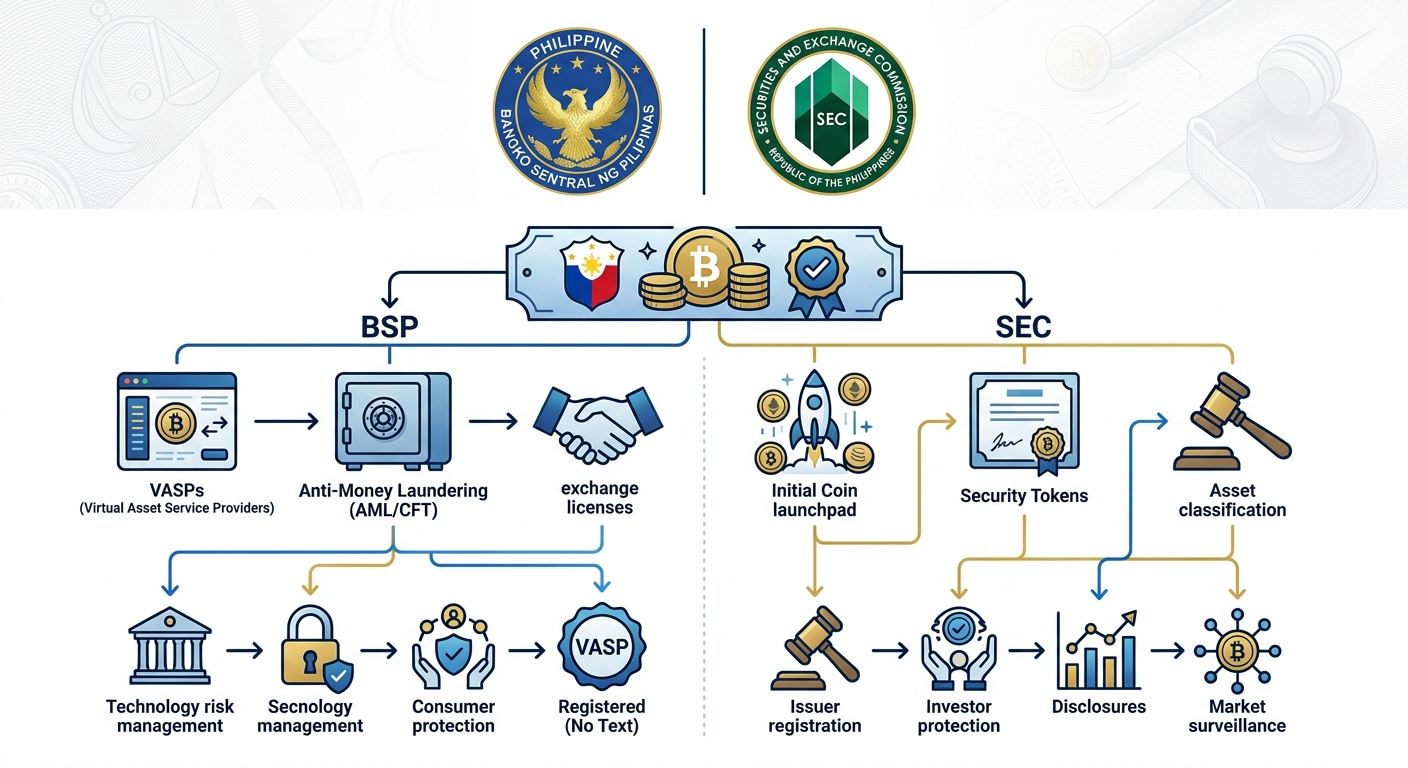
With the BSP's Circular No. 1108 and the SEC's CASP Rules (MC Nos. 04 and 05 of 2025) now both in force, foreign investors entering the Philippine virtual asset space face a bifurcated regulatory landscape that did not exist three years ago. This guide maps the jurisdictional boundaries between the Bangko Sentral ng Pilipinas and the Securities and Exchange Commission, explains the licensing pathways, capitalization requirements, AML/CTF obligations, the BSP's continued VASP license moratorium, and the practical steps a foreign investor must take to operate lawfully in the Philippines' digital asset market.
The Philippine E-Invoicing Mandate: A Comprehensive Compliance Guide for Foreign Companies in 2026
With the December 31, 2026 deadline for mandatory e-invoicing under BIR Revenue Regulations No. 11-2025 fast approaching, foreign companies operating in the Philippines face an urgent compliance obligation that cannot be deferred. This guide provides a complete analysis of who must comply, what constitutes a compliant electronic invoice, the step-by-step implementation process, tax deduction opportunities under the CREATE MORE Act, and the penalties for non-compliance — with every legal citation verified against primary sources.