The 2026 Strategic Investment Priority Plan and the PPP Code: A Foreign Investor's Comprehensive Guide to Philippine Infrastructure Investment Incentives

For foreign investors with an appetite for infrastructure development in Southeast Asia's most dynamic emerging market, the Philippines in 2026 presents a regulatory landscape that is simultaneously more sophisticated and more incentivized than at any prior point in the country's post-colonial history. Two legislative and policy instruments — Republic Act No. 11966, the PPP Code of the Philippines, and the 2026 Strategic Investment Priority Plan (SIPP) — have together created a structured, transparent pathway for private sector participation in public infrastructure that was previously dominated by ad hoc government procurement and limited foreign investor access.
This article is written for foreign investors — whether sovereign wealth funds, infrastructure private equity managers, multinational construction and engineering firms, or foreign corporations evaluating Philippine market entry through an infrastructure investment thesis. It assumes the reader has a foundational understanding of Philippine corporate law and foreign investment regulations, and seeks a lawyer-grade analysis of the legal architecture, incentive benefits, and practical steps for structuring a compliant Philippine infrastructure investment.
1. The Legal Framework: Two Pillars of Philippine Infrastructure Investment
1.1 Republic Act No. 11966 — The PPP Code of the Philippines
Republic Act No. 11966, otherwise known as the Public-Private Partnership Code of the Philippines, was signed into law in 2023, replacing the previous patchwork of PPP regulations that had governed the sector since the Build-Operate-Transfer Law (Republic Act No. 6957, as amended by RA 7718). The PPP Code represents a generational overhaul of the legal framework governing public infrastructure procurement through private participation, and its implications for foreign investors are substantial.
The PPP Code defines a public-private partnership as a contract between a government contracting agency and a private entity whereby the private entity performs, manages, and finances public infrastructure projects and related services, assuming substantial financial, technical, and operational risk in the project's implementation. The Code establishes several PPP modalities, including:
- Build-Operate-Transfer (BOT) — the private partner builds and operates the project, then transfers it to the government after a specified period;
- Build-Own-Operate (BOO) — the private partner retains ownership of the asset throughout the concession period;
- Build-Lease-Transfer (BLT) — the private partner builds the project, leases it to the government, then transfers it;
- Build-Transfer-Operate (BTO) — the private partner builds and transfers the asset to the government, then operates it under a lease or service contract;
- Contract-Operate-Manage (COM) — the private partner operates and manages an existing government asset under a management contract;
- Rehabilitate-Own-Operate (ROO) — the private partner rehabilitates an existing asset, owns it, and operates it.
Critically for foreign investors, the PPP Code introduced a formal framework for unsolicited proposals — project concepts submitted by private entities to government agencies without a prior public tender. Under the Code's IRR, unsolicited proposals must undergo a Swiss Challenge procedure, wherein the government invites other parties to match or improve the proposal, providing foreign investors with a structured mechanism to proactively propose infrastructure projects rather than waiting for government-initiated tenders.
The PPP Code also established the Project Development and Monitoring Facility (PDMF) within the PPP Center, which provides grant funding for the development of PPP project concept notes, feasibility studies, and transaction advisory services — reducing the upfront cost burden for foreign investors conducting project due diligence in the Philippines.
1.2 The CREATE MORE Act (RA 12066) and the SIPP
The Corporate Recovery and Tax Incentives for Enterprises to Maximize Opportunities for Reinvigorating the Economy (CREATE MORE) Act, Republic Act No. 12066, signed in 2024, replaced the previous CREATE Act (RA 11534) as the governing statute for fiscal incentives granted to registered business enterprises (RBEs) in the Philippines. The CREATE MORE Act introduced a broader, more flexible incentive architecture, with incentives calibrated to investment location, sector priority, employment generation, and technology intensity.
Under Section 292 of the National Internal Revenue Code (NIRC) of 1997, as amended by the CREATE Act and further refined by the CREATE MORE Act, the Board of Investments (BOI), in consultation with the Fiscal Incentives Review Board (FIRB), investment promotion agencies (IPAs), other government agencies administering tax incentives, and the private sector, formulates the SIPP for Presidential approval. The SIPP is the definitive list of economic activities, sectors, and investment areas that are eligible for fiscal incentives under the CREATE MORE Act.
The Fiscal Incentives Review Board (FIRB), chaired by the Finance Secretary, is the central coordinating body for all tax incentive grants. Under the CREATE MORE Act, the FIRB or the relevant IPA shall grant appropriate tax incentives to RBEs only to the extent of their approved registered project or activity under the SIPP — meaning there is no entitlement to incentives outside the SIPP framework.
2. The 2026 SIPP: Structure, Tiers, and Key Changes from the 2022 SIPP
2.1 Overview and Legal Basis
The 2026 SIPP was approved by President Ferdinand R. Marcos Jr. through Memorandum Order No. 47, signed by Executive Secretary Ralph Recto on May 21, 2026, and published in the Official Gazette on June 2, 2026. It takes effect fifteen (15) days after its Official Gazette publication, in accordance with the NIRC. The SIPP serves as the Philippines' investment roadmap through 2028.
The 2026 SIPP was developed by the BOI in close coordination with the FIRB, IPAs, national government agencies, and the private sector. The FIRB, through FIRB Resolution No. 015-25 dated December 15, 2025, adopted the proposed 2026 SIPP and recommended its approval to the President through the BOI. Subsequently, the BOI, through Board Resolution No. 10-03 dated April 10, 2026, approved the submission of the proposed SIPP, incorporating refinements adopted by the FIRB.
While the 2026 SIPP retains the overall intent and framework of the 2022 SIPP, it reflects a deliberate recalibration of the government's investment strategy — shifting from post-pandemic recovery (the focus of the 2022 SIPP) toward a forward-looking agenda centered on innovation, clean energy, digital infrastructure, and structural economic transformation.
2.2 The Three-Tier Framework
The 2026 SIPP maintains the three-tier policy framework established under the 2022 SIPP, organizing priority activities into three tiers based on strategic importance and development impact. Each tier corresponds to different incentive levels and priority treatment.
Tier I — Modern Basic Needs, Sustainability, and Climate-Related Projects
Tier I activities form the foundation of the 2026 SIPP and encompass projects that address fundamental economic needs and sustainability objectives. These include:
- Agriculture, fishery, and forestry — including agribusiness processing, cold chain infrastructure, and export-oriented production;
- Manufacturing — including halal, kosher, and organic-related activities;
- Services — covering logistics, supply chain management, and business process outsourcing;
- Health care and disaster risk reduction management services — including hospital infrastructure, mobile healthcare units, and climate resilience systems;
- Infrastructure and logistics — roads, bridges, ports, airports, rail, and urban transport systems;
- Energy — particularly renewable energy generation and distribution;
- Sustainability-driven industries — industrial and hazardous waste treatment, bulk water treatment and supply, wastewater treatment, and environment or climate change-related projects such as carbon capture, waste-to-value, circular economy projects, and forest management for carbon credits.
Tier I represents the broadest category and is the most accessible entry point for foreign investors seeking to participate in Philippine infrastructure. It encompasses both traditional infrastructure (roads, ports) and emerging sustainability infrastructure (waste-to-energy, water treatment).
Tier II — Strategic Industries
Tier II covers industries that address strategic value-chain gaps and national security or food security objectives. These include:
- Defense-related service activities — logistics, maintenance, and support services for defense capabilities;
- Industrial value chain gap activities — investments in intermediate goods, components, and materials that reduce import dependence;
- Food security-related activities — agricultural input production, post-harvest facilities, and food processing infrastructure;
- Critical mineral processing — refining and processing of nickel, cobalt, copper, and other minerals for industrial and energy applications;
- Electric vehicle infrastructure — charging stations, battery swapping facilities, and EV assembly;
- Sustainable aviation fuel — production and distribution infrastructure;
- Desalination — water security infrastructure for island and coastal communities.
Foreign investors in Tier II activities benefit from the government's explicit recognition of these sectors as strategically important, which typically translates to more favorable incentive treatment and expedited regulatory processing.
Tier III — Frontier Technologies and Future Industries
Tier III represents the most forward-looking category in the 2026 SIPP, explicitly targeting industries that will define the next decade of global economic competition:
- Artificial intelligence (AI) — AI development, deployment, and integration infrastructure;
- Quantum computing — hardware, software, and application development;
- Cybersecurity — security operations centers, threat intelligence platforms, and critical infrastructure protection;
- Hydrogen and nuclear energy — next-generation clean energy research, development, and deployment;
- Advanced research and development (R&D) — university-industry R&D partnerships, technology transfer, and innovation hubs;
- Data center infrastructure — hyperscale and edge data centers supporting the digital economy.
Tier III is the most significant departure from the 2022 SIPP, which did not explicitly recognize AI, quantum computing, or cybersecurity as priority investment activities. The explicit inclusion of these sectors in the 2026 SIPP signals the government's intent to position the Philippines as a destination for high-technology foreign direct investment, not merely a labor arbitrage market.
2.3 Additional SIPP Categories
Beyond the three-tier framework, the 2026 SIPP includes several additional categories that are directly relevant to foreign investors:
- Export activities — recognized as covered by special laws, including activities that qualify under the CREATE MORE Act's export incentive framework;
- Special law-mandated activities — including projects under the PPP Code (RA 11966), the Expanded Producer Responsibility Act (RA 11898), and the Salt Industry Development Act (RA 11984);
- BARMM priority activities — the Bangsamoro Autonomous Region in Muslim Mindanao has been allocated specific priority investment areas, including halal enterprises (halal, kosher, and organic production), halal tourism, and Shari'ah-compliant investments — of particular interest to foreign investors from Middle Eastern jurisdictions;
- Coal mining and production — a notable addition to the 2026 SIPP not present in the 2022 version, reflecting the government's pragmatic approach to energy transition planning.
3. RA 11966 and the 2026 SIPP: How They Work Together
A critical insight for foreign investors is that the PPP Code and the 2026 SIPP are not parallel frameworks — they are complementary and reinforcing. The 2026 SIPP explicitly identifies PPP Code projects as activities covered by special laws, meaning that a foreign investor pursuing a PPP infrastructure project in a SIPP-listed sector may be eligible for both PPP regulatory framework benefits and CREATE MORE Act fiscal incentives.
For example, a foreign investor seeking to develop a renewable energy microgrid in an off-grid Philippine province could:
- Structure the project as a PPP under RA 11966 (BOT or BOO modality), engaging the National Grid Corporation or the relevant local government unit as the government contracting agency;
- Simultaneously register the project as an RBE under the 2026 SIPP (Tier I — energy, sustainability-driven), qualifying for CREATE MORE Act incentives including income tax holidays, reduced withholding tax rates, and VAT exemptions on imported capital equipment.
This dual-track approach — PPP contractual framework plus SIPP incentive registration — represents the most commercially attractive structure available to foreign infrastructure investors in the Philippines in 2026.
4. Tax Incentives Under the CREATE MORE Act for SIPP-Registered Projects
4.1 Incentive Duration: 14 to 27 Years
Under the CREATE MORE Act, projects that are qualified within the 2026 SIPP can receive tax incentives for a period ranging from 14 to 27 years, depending on two key variables:
- Location — projects in less developed areas (including BARMM, rural provinces, and special economic zones) receive longer incentive periods;
- Tier classification — Tier III frontier technology projects and strategically important Tier II projects receive longer incentive periods than standard Tier I activities.
This represents a meaningful expansion from the original CREATE Act, which provided maximum incentive periods of 10 to 17 years. The extended incentive periods under the CREATE MORE Act reflect the government's recognition that infrastructure projects — particularly in clean energy, digital infrastructure, and advanced manufacturing — require longer investment horizons to achieve commercial viability.
4.2 Types of Tax Incentives Available
The CREATE MORE Act provides a menu of fiscal incentives that RBEs may receive, calibrated to the nature and location of the registered project. For SIPP-registered infrastructure projects, the most commercially significant incentives include:
- Income Tax Holiday (ITH) — exemption from corporate income tax for a defined period, ranging from 3 to 7 years depending on project tier and location;
- Enhanced Deduction (ED) — after the ITH period, RBEs may opt for a special deduction rate of 50% to 100% of the normal deduction, effectively reducing taxable income for an extended period;
- Reduced Withholding Tax on Dividends — reduced withholding tax rate on dividends remitted to foreign parent companies, subject to conditions;
- VAT Exemption on Importations — exemption from VAT on imported capital equipment, raw materials, and inputs required for the registered project;
- VAT Zero-Rating on Local Purchases — local purchases of goods and services for use in the registered project may be zero-rated for VAT purposes;
- Exemption from Real Property Tax — in certain zones and for certain project types, exemption from real property tax on project assets;
- Exemption from Customs Duties — on imported equipment and materials not locally available.
For enterprises registered with the Philippine Economic Zone Authority (PEZA) and operating within PEZA economic zones — particularly those in export manufacturing, renewable energy, logistics, technology infrastructure, and advanced industrial activities — the 2026 SIPP framework is particularly favorable, as PEZA zones are treated as preferential locations under the CREATE MORE Act's location-based incentive tiers.
4.3 FIRB Oversight and Compliance
All tax incentives granted under the CREATE MORE Act are subject to FIRB oversight. RBEs must maintain compliance with the terms of their registration, including:
- Achievement of committed investment amounts and employment targets;
- Submission of annual reports and financial statements to the relevant IPA and FIRB;
- Maintenance of the registered project's activities within the SIPP-listed categories;
- Adherence to any performance standards specified in the Certificate of Registration.
The FIRB has the authority to revoke or modify incentives for non-compliant RBEs. Foreign investors should ensure that their Philippine legal and finance teams maintain robust compliance monitoring systems from the date of registration.
5. Foreign Ownership Considerations in PPP and SIPP Projects
5.1 The General Rule: 100% Foreign Ownership Is Presumptively Available
Under the Foreign Investment Act of 1991 (RA 7042), as amended by RA 11647, sectors not appearing on the Foreign Investment Negative List are open to 100% foreign ownership. The vast majority of SIPP-listed activities — including renewable energy, digital infrastructure, data centers, logistics, and advanced manufacturing — are not on the 13th Foreign Investment Negative List (promulgated under Executive Order No. 113, effective May 2, 2026), meaning foreign investors may hold 100% equity in these projects without restriction.
Renewable energy projects deserve particular mention: the Renewable Energy Act of 2008 (RA 9513) removed equity caps for renewable energy investments, and the 13th RFINL has confirmed that solar, wind, hydro, and ocean energy projects may be 100% foreign-owned. This makes renewable energy PPP projects among the most accessible infrastructure investment vehicles for foreign investors in the Philippines.
5.2 Sector-Specific Restrictions That May Still Apply
Despite the general liberalization, foreign investors must conduct a sector-specific analysis before assuming full ownership. Key restrictions that remain in force include:
- Land ownership — under Article XII, Section 7 of the 1987 Constitution and Commonwealth Act No. 141, as amended, foreign nationals cannot own freehold land in the Philippines. However, under the 99-Year Lease Law (RA 12252), foreign investors may enter into lease agreements for periods of up to 50 years, renewable for another 50 years — providing effective long-term land access without ownership;
- Public utilities — under the Public Service Act of 1936 as amended by RA 11659, public utilities (defined as those providing services to the public at regulated rates) remain subject to the 40% foreign equity cap unless the foreign investor's home country grants reciprocal rights to Philippine nationals;
- Mass media — under Article XVI, Section 11 of the 1987 Constitution, mass media entities must be 100% Filipino-owned;
- Certain defense-related activities — some Tier II defense services activities may be subject to nationality requirements or require prior government approval.
The Anti-Dummy Law (Commonwealth Act No. 108, as amended by PD 715) applies to all PPP and SIPP projects. Foreign investors must ensure that their ownership structures reflect genuine economic participation and that any Filipino co-investors hold real, substantive equity stakes — not nominee arrangements that could expose the foreign investor to criminal liability under the Anti-Dummy Law.
5.3 The HARBOR Beneficial Ownership Registry
Foreign investors should be aware that the SEC HARBOR beneficial ownership registry — operational since January 30, 2026, under SEC Memorandum Circular No. 15, Series of 2025 — requires corporations to disclose their ultimate beneficial owners, defined as natural persons who own or control at least 5% of the corporation's shares or voting rights, or who exercise effective control over the corporation through other means. This registry materially increases transparency requirements for foreign-owned Philippine corporations and increases the risk profile of nominee arrangements.
6. Practical Roadmap for Foreign Investors
Step 1: Sector and Ownership Pre-Analysis
Before committing capital, foreign investors should conduct a structured pre-analysis of their target sector against the 13th RFINL, the 2026 SIPP, and any applicable special laws. Key questions: Is the target activity listed in the 2026 SIPP? Does it fall in a restricted sector on the FINL? What PPP modality best fits the commercial thesis? Is 100% foreign ownership available, or is a Filipino co-investor required?
Step 2: Entity Structuring and SEC Registration
Most foreign infrastructure investors will establish a Philippine corporation (either a subsidiary or a branch office, depending on liability and capital considerations) registered with the Securities and Exchange Commission (SEC). The subsidiary route — a Philippine corporation with foreign shareholders — is generally preferred for infrastructure projects because it limits liability to the Philippine entity and allows 100% foreign ownership in unrestricted sectors.
For PPP projects specifically, the private partner must be a juridical entity — either a Philippine corporation or a foreign corporation with a Philippine branch or representative office. The PPP Center's IRR requires that private partners demonstrate technical capability, financial capacity, and relevant experience in comparable projects.
Step 3: IPA Registration and SIPP Qualification
Once the corporate entity is established, the foreign investor should apply for registration with the relevant IPA — typically the BOI for most activities, PEZA for ecozone-located projects, or the Subic Bay Metropolitan Authority (SBMA), Clark Development Corporation (CDC), or other IPAs for projects in their respective zones. The IPA will evaluate the project against the 2026 SIPP criteria and, if approved, issue a Certificate of Registration that qualifies the project for CREATE MORE Act incentives.
The FIRB's involvement is required for certain incentive packages, particularly those involving enhanced deductions or extended ITH periods. The BOI, through its Investment Policy and Planning Service, is currently finalizing the General Policies (GP) and Specific Guidelines (SG) for the 2026 SIPP, expected to be published within the third quarter of 2026. In the interim, the 2022 SIPP GP and SG remain in effect.
Step 4: PPP Procurement Process
For projects structured as PPPs under RA 11966, the private partner must participate in the government procurement process:
- Solicited proposals — the government agency initiates the procurement, and the foreign investor submits a bid in response to the Invitation for Bids;
- Unsolicited proposals — the foreign investor submits a Project Concept Note (PCN) to the government agency, which undergoes a Swiss Challenge evaluation. The PPP Center provides PDMF-funded support for PCN development;
- PPP Agreement — once selected, the private partner executes a PPP Agreement with the government contracting agency, specifying the modality (BOT, BOO, BLT, etc.), concession period, tariff or fee structure, performance obligations, and risk allocation.
Step 5: BIR Registration and Local Permit Compliance
Following SEC registration and IPA registration, the RBE must register with the Bureau of Internal Revenue (BIR) to obtain a Tax Identification Number (TIN) and, where applicable, VAT registration. For SIPP-registered projects, the BIR will annotate the RBE's file to reflect the applicable incentive package. Local government unit (LGU) permits — including business permits, building permits, and environmental compliance certificates — must be obtained in coordination with the relevant IPA, which is mandated under the Ease of Doing Business and Efficient Government Service Delivery Act of 2018 (RA 11032) to streamline the permitting process.
Step 6: Ongoing Compliance and Reporting
Throughout the project lifecycle, the RBE must maintain compliance with FIRB and IPA reporting requirements, submit annual audited financial statements, and notify the IPA of any material changes to the project scope, investment amount, or ownership structure. Failure to maintain compliance may result in incentive revocation and additional tax assessments.
7. Key Risks and Compliance Considerations for Foreign Investors
7.1 Anti-Dummy Law Exposure
The Anti-Dummy Law remains one of the most significant legal risks for foreign investors in Philippine infrastructure projects. Even where full foreign ownership is legally available, enforcement agencies may scrutinize arrangements where a Filipino minority shareholder appears to act at the direction of the foreign majority — whether through side letters, voting agreements, or informal understandings. Foreign investors should ensure that any Filipino co-investors are genuine, independent parties with real economic stakes and decision-making authority.
7.2 Regulatory Uncertainty During Transition
The 2026 SIPP's implementing guidelines (GP and SG) are still being finalized and are expected to be published in Q3 2026. Foreign investors relying on specific incentive packages should build regulatory risk into their financial models and seek a formal ruling from the FIRB or relevant IPA before committing to investment decisions based on incentive assumptions.
7.3 Currency and Repatriation Risk
Infrastructure projects in the Philippines typically generate revenues in Philippine pesos, while foreign investors often have foreign currency-denominated debt or return expectations. The BIR's withholding tax treatment of dividend repatriation — and any applicable tax treaty benefits under the National Internal Revenue Code — should be factored into the investment structure from the outset.
7.4 Land Access and Usufructuary Rights
Under the PPP Code, government contracting agencies may grant Development and Usufructuary Rights (DUR) over public land to private partners, allowing the private partner to develop, build, and monetize improvements without owning the underlying land. Foreign investors should carefully structure their land access arrangements to ensure they do not inadvertently trigger land ownership restrictions. The BIR's characterization of usufruct fees — whether as rental income subject to VAT or as a non-taxable pass-through — is an evolving area of tax law that should be reviewed with Philippine tax counsel.
8. Conclusion
The Philippines in 2026 presents a materially more structured and incentivized environment for foreign infrastructure investment than existed even three years prior. The PPP Code (RA 11966) has consolidated and modernized the legal framework for private participation in public infrastructure, while the 2026 SIPP — approved by Presidential Memorandum Order No. 47 on May 21, 2026, and effective from June 17, 2026 — has sharpened the government's investment priorities and expanded the menu of activities eligible for CREATE MORE Act fiscal incentives.
For foreign investors, the strategic implication is clear: the Philippine government is actively seeking private capital — including foreign capital — for infrastructure development across a wide spectrum of sectors, from traditional roads and ports to AI data centers and renewable energy microgrids. The combination of 100% foreign ownership availability in most SIPP sectors, 14-to-27-year tax incentive periods, and a formal PPP procurement framework makes the Philippines one of the more attractive infrastructure investment destinations in Southeast Asia in 2026.
However, the opportunity comes with compliance obligations that should not be underestimated. Foreign investors who approach the Philippine market with a clear understanding of the SIPP framework, the PPP Code's procurement mechanics, the FIRB's oversight role, and the Anti-Dummy Law's constraints — and who engage experienced Philippine legal counsel from the earliest stages of project conception — will be best positioned to structure compliant, commercially viable infrastructure investments in the Philippines.
This article is intended for informational purposes only and does not constitute legal advice. Foreign investors should consult qualified Philippine legal counsel before making any investment decisions. All legal citations have been verified against official sources including lawphil.net, the Official Gazette (officialgazette.gov.ph), and sec.gov.ph. This article was published on June 15, 2026; readers should verify that no subsequent legislative or regulatory changes have affected the analysis herein.
Related Articles

The Philippine Privacy Impact Assessment Revolution: What the 2026 Draft Circular Means for Foreign Companies
The NPC's August 2026 draft circular would replace the blanket Privacy Impact Assessment obligation that has governed Philippine data privacy compliance since 2017 with a risk-tiered framework. For foreign companies operating in or serving the Philippine market, the shift from a one-size-fits-all requirement to a threshold-based trigger system carries significant compliance and cost implications. This guide explains the eight mandatory PIA trigger categories, the new quantitative thresholds, what the draft circular means for AI systems and cross-border transfers, and the practical steps foreign companies must take now.
The Philippine Dual-Regulatory Framework for Cryptocurrency and Virtual Assets: A Comprehensive Guide for Foreign Investors in 2026
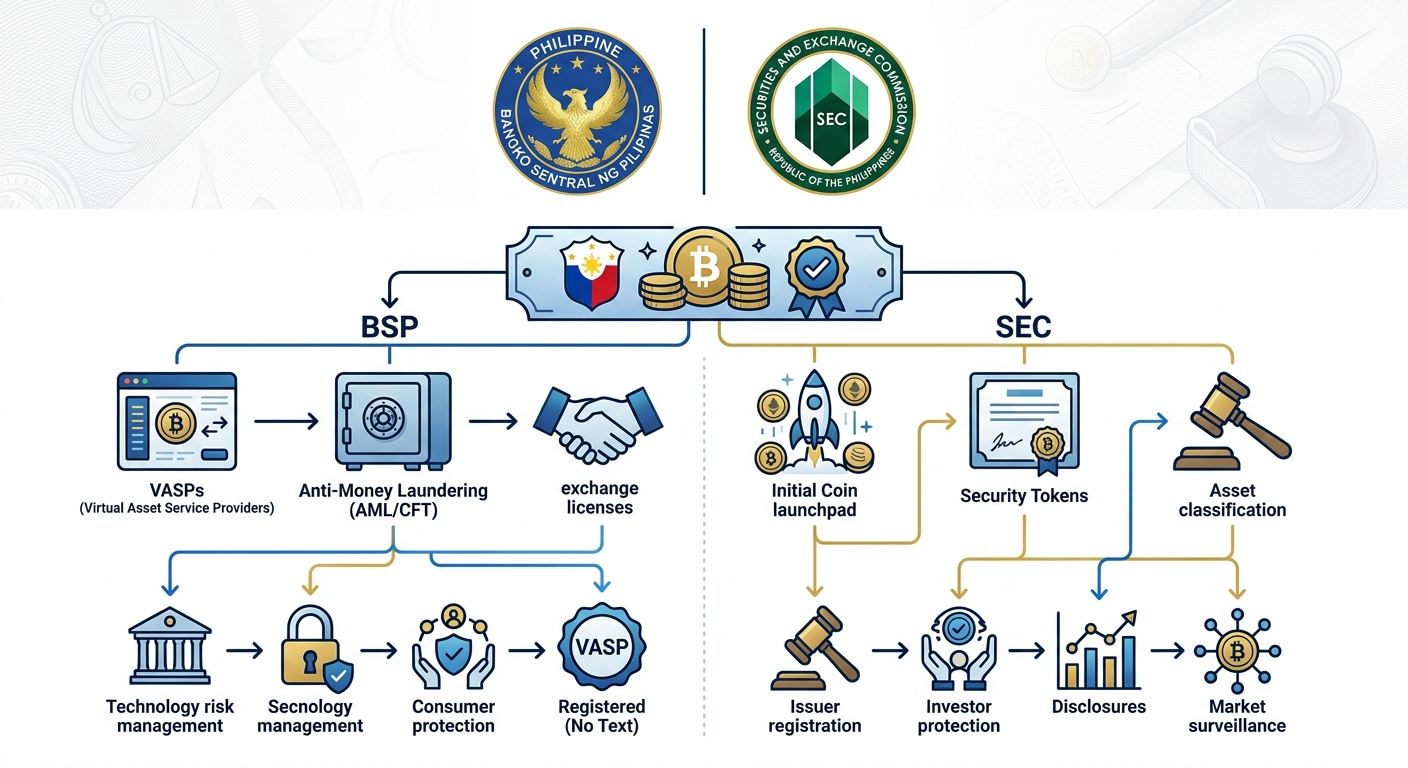
With the BSP's Circular No. 1108 and the SEC's CASP Rules (MC Nos. 04 and 05 of 2025) now both in force, foreign investors entering the Philippine virtual asset space face a bifurcated regulatory landscape that did not exist three years ago. This guide maps the jurisdictional boundaries between the Bangko Sentral ng Pilipinas and the Securities and Exchange Commission, explains the licensing pathways, capitalization requirements, AML/CTF obligations, the BSP's continued VASP license moratorium, and the practical steps a foreign investor must take to operate lawfully in the Philippines' digital asset market.
The Philippine E-Invoicing Mandate: A Comprehensive Compliance Guide for Foreign Companies in 2026
With the December 31, 2026 deadline for mandatory e-invoicing under BIR Revenue Regulations No. 11-2025 fast approaching, foreign companies operating in the Philippines face an urgent compliance obligation that cannot be deferred. This guide provides a complete analysis of who must comply, what constitutes a compliant electronic invoice, the step-by-step implementation process, tax deduction opportunities under the CREATE MORE Act, and the penalties for non-compliance — with every legal citation verified against primary sources.