Branch Office vs. Representative Office vs. ROHQ: Which Structure Should Your Foreign Company Use in the Philippines?

When a foreign corporation decides to establish a presence in the Philippines without incorporating a local subsidiary, it typically has three options: a branch office, a representative office, or a regional operating headquarters (ROHQ). Each structure serves a different strategic purpose — and choosing the wrong one can mean paying more taxes, facing unnecessary restrictions, or falling short of compliance requirements.
Here's a side-by-side comparison to help foreign companies make the right call.
1. Branch Office: Full Operations, Full Taxation
A branch office is an extension of the foreign parent company. It is not a separate legal entity — it operates under the parent's name and the parent bears full liability for its obligations.
What It Can Do
A branch office has the broadest powers among the three structures. It can conduct revenue-generating activities in the Philippines, enter into contracts, hire employees, and transact business with local customers — all in the parent company's name.
Legal Basis
Branch offices are governed by Title XVI of the Revised Corporation Code (Republic Act No. 11232), which requires foreign corporations to obtain a license from the SEC before "transacting business" in the Philippines. The Foreign Investments Act (RA 7042, as amended by RA 11647) sets the capital thresholds.
Capital Requirement
A minimum of USD 200,000 in assigned capital. This may be reduced to USD 100,000 if the branch involves advanced technology or employs at least 50 direct employees, per RA 11647.
Tax Treatment
Branch offices are subject to the regular corporate income tax (RCIT) of 25% on net taxable income from Philippine sources. Additionally, profit remittances to the head office are subject to a 15% branch profit remittance tax under Section 28(A)(5) of the Tax Code, unless reduced by an applicable tax treaty.
Best For
Foreign companies that want to actively do business in the Philippines — selling goods, providing services, or executing contracts locally — without setting up a separate corporate entity.
2. Representative Office: Presence Without Revenue
A representative office is the lightest-touch option. It allows a foreign company to have a physical presence in the Philippines, but it cannot earn income or engage in commercial transactions.
What It Can Do
A representative office is limited to information dissemination, promotion, and quality control of the parent company's products or services. It can liaise with local clients or partners but cannot enter into revenue-generating contracts, accept purchase orders, or issue invoices.
Legal Basis
Representative offices are also registered with the SEC under the Revised Corporation Code (RA 11232). The SEC treats them as non-income-generating entities that serve a coordination or liaison function.
Capital Requirement
The parent company must remit at least USD 30,000 per year to cover the representative office's operating expenses. There is no minimum assigned capital requirement since the office does not generate local income.
Tax Treatment
Because a representative office cannot derive income in the Philippines, it is generally not subject to income tax. However, it must still register with the BIR and comply with withholding tax obligations on compensation paid to its employees and on other applicable transactions.
Best For
Foreign companies that want to test the Philippine market, build relationships, or maintain a liaison presence — without committing to full-scale operations.
3. ROHQ: Regional Services Hub
A regional operating headquarters (ROHQ) occupies a middle ground. It can earn income, but only by providing qualifying services to its own affiliates, subsidiaries, or branches — not to unrelated third parties.
What It Can Do
An ROHQ may perform qualifying services such as general administration, business planning, sourcing, financial advisory, marketing, human resources management, logistics, and R&D for its related entities in the Asia-Pacific region. It cannot serve external clients or sell goods domestically.
Legal Basis
Republic Act No. 8756 governs the establishment, licensing, and incentives of both regional headquarters (RHQs) and ROHQs. Only multinational corporations with affiliates, subsidiaries, or branches in the Asia-Pacific region can set up an ROHQ.
Capital Requirement
The parent company must remit at least USD 200,000 per year to cover the ROHQ's operating expenses.
Tax Treatment (Post-CREATE)
This is where things have changed significantly. Before 2022, ROHQs enjoyed a preferential 10% income tax rate. However, the CREATE Act (RA 11534) abolished that preferential rate effective January 1, 2022. ROHQs are now subject to the regular 25% corporate income tax.
The subsequent CREATE MORE Act (RA 12066, signed November 2024) did not restore the preferential ROHQ rate. However, it introduced enhanced incentives for Registered Business Enterprises (RBEs) — including a reduced 20% CIT under the Enhanced Deductions Regime (EDR) and expanded deductions. ROHQs cannot directly register as RBEs, but a multinational may set up a separate BOI- or PEZA-registered entity alongside its ROHQ to capture these benefits.
Best For
Multinational corporations that need a centralized services hub in the Philippines to support their Asia-Pacific operations — particularly those already managing regional affiliates from Manila.
Quick Comparison
| Feature | Branch Office | Representative Office | ROHQ |
|---|---|---|---|
| Can earn income? | Yes — unrestricted | No | Yes — affiliates only |
| Minimum capital | USD 200,000 assigned | USD 30,000/year remittance | USD 200,000/year remittance |
| Income tax rate | 25% RCIT + 15% BPRT | Exempt (no income) | 25% RCIT |
| Governing law | RA 11232 + RA 7042 | RA 11232 | RA 8756 |
| Client restrictions | None — can serve anyone | Liaison only | Affiliates/subsidiaries only |
| SEC registration | Required | Required | Required |
Don't Forget the Fourth Option: A Domestic Subsidiary
Many foreign companies ultimately find that incorporating a domestic subsidiary — a Philippine corporation with foreign equity — offers more flexibility than any of the three structures above. A subsidiary is a separate legal entity, which means it shields the parent from direct liability. It can also register with the BOI or PEZA to access CREATE MORE incentives, something that branch offices, representative offices, and ROHQs cannot do directly.
The trade-off? Foreign equity caps under the Foreign Investment Negative List (FINL) may apply depending on the industry. Check our guide to the FINL for details.
The Bottom Line
There is no one-size-fits-all answer. The right structure depends on what your company actually needs to do in the Philippines:
- Selling to Philippine customers? → Branch office or domestic subsidiary
- Just scouting the market? → Representative office
- Centralizing regional back-office services? → ROHQ
- Want maximum flexibility and incentive access? → Domestic subsidiary registered as an RBE
Each option carries different registration, compliance, and tax obligations — getting it right from the start saves significant time and money down the road.
Need help choosing the right structure for your foreign company's Philippine operations? Contact TTFC Law for a consultation tailored to your business objectives.
Related Articles

The Philippine Privacy Impact Assessment Revolution: What the 2026 Draft Circular Means for Foreign Companies
The NPC's August 2026 draft circular would replace the blanket Privacy Impact Assessment obligation that has governed Philippine data privacy compliance since 2017 with a risk-tiered framework. For foreign companies operating in or serving the Philippine market, the shift from a one-size-fits-all requirement to a threshold-based trigger system carries significant compliance and cost implications. This guide explains the eight mandatory PIA trigger categories, the new quantitative thresholds, what the draft circular means for AI systems and cross-border transfers, and the practical steps foreign companies must take now.
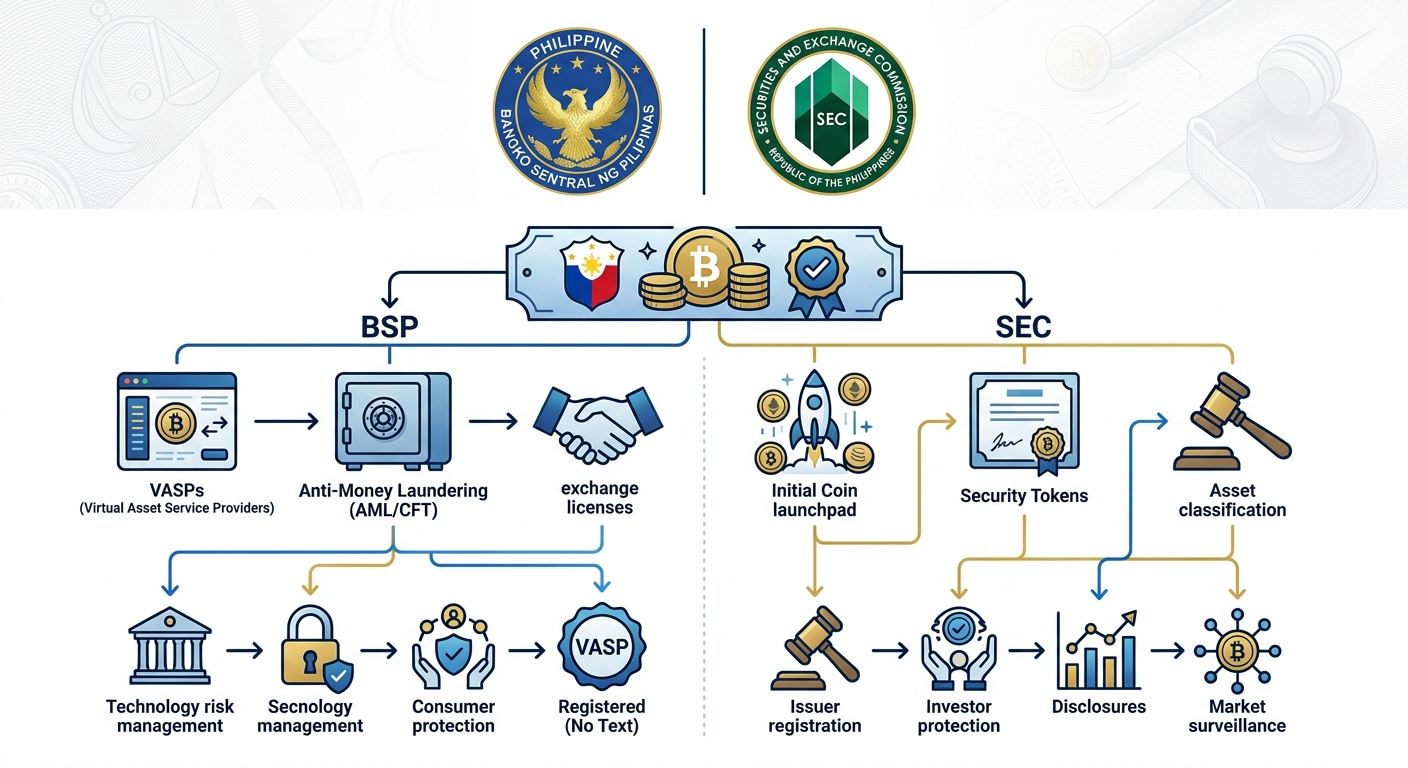
The Philippine Dual-Regulatory Framework for Cryptocurrency and Virtual Assets: A Comprehensive Guide for Foreign Investors in 2026
With the BSP's Circular No. 1108 and the SEC's CASP Rules (MC Nos. 04 and 05 of 2025) now both in force, foreign investors entering the Philippine virtual asset space face a bifurcated regulatory landscape that did not exist three years ago. This guide maps the jurisdictional boundaries between the Bangko Sentral ng Pilipinas and the Securities and Exchange Commission, explains the licensing pathways, capitalization requirements, AML/CTF obligations, the BSP's continued VASP license moratorium, and the practical steps a foreign investor must take to operate lawfully in the Philippines' digital asset market.
The Philippine E-Invoicing Mandate: A Comprehensive Compliance Guide for Foreign Companies in 2026
With the December 31, 2026 deadline for mandatory e-invoicing under BIR Revenue Regulations No. 11-2025 fast approaching, foreign companies operating in the Philippines face an urgent compliance obligation that cannot be deferred. This guide provides a complete analysis of who must comply, what constitutes a compliant electronic invoice, the step-by-step implementation process, tax deduction opportunities under the CREATE MORE Act, and the penalties for non-compliance — with every legal citation verified against primary sources.