Foreign Divorce Recognition in the Philippines: A 2026 Legal Guide for Foreign Investors and Their Filipino Spouses
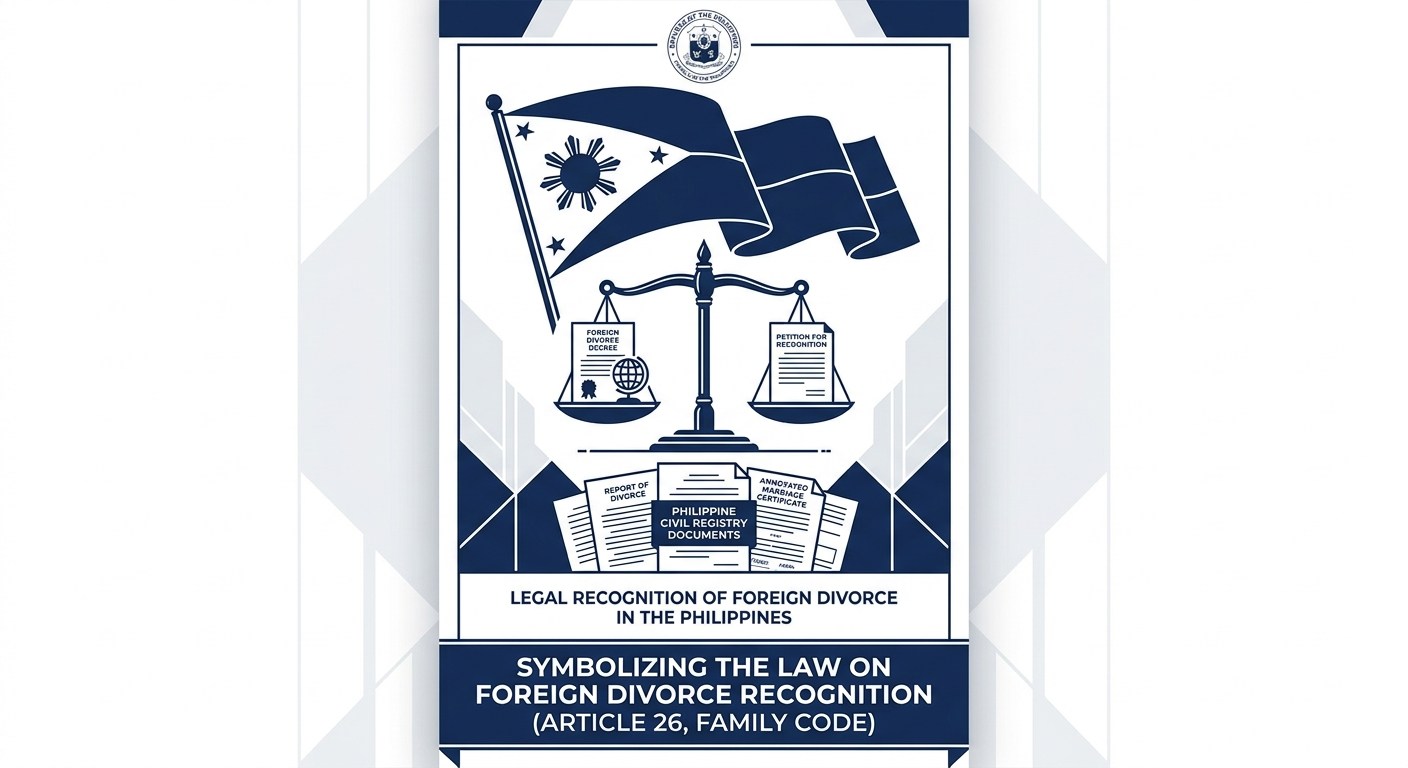
For foreign nationals who have married Filipino citizens, the question of whether a divorce obtained abroad can dissolve a Philippine-recognized marriage is not merely an academic exercise — it is a issue that directly determines their legal capacity to remarry, their civil status under Philippine law, and in certain cases, their ability to structure long-term residency or investment arrangements in the Philippines. The Philippine Supreme Court's recent decisions in Republic v. Ng (G.R. No. 249238, February 27, 2024) and the ongoing oral arguments on the "limping marriage" doctrine have significantly expanded the framework for recognizing foreign divorces, bringing the Philippines closer to a more internationally responsive approach to private international law.
This article provides foreign investors and their Philippine counsel with a comprehensive, lawyer-grade analysis of the current state of foreign divorce recognition in the Philippines — grounded in the Family Code, verified Supreme Court jurisprudence, and the procedural rules governing civil registry annotation. Every citation has been verified against official lawphil.net and judiciary.gov.ph sources.
1. The Problem: Why a Foreign Divorce Does Not Automatically Dissolve a Philippine Marriage
The Philippines remains one of the few countries in the world where absolute divorce is not available to Filipino citizens for marriages celebrated under Philippine law. This has not changed in 2026. What has changed — through the iterative development of Supreme Court jurisprudence — is the extent to which foreign divorces obtained abroad can be given legal effect in the Philippines.
The foundational problem is this: a foreign national obtains a divorce in their country of citizenship. That divorce is final and absolute under the law of that country. But because Philippine law does not recognize absolute divorce between Filipino citizens — and because the marriage was celebrated under Philippine law — the Filipino spouse remains legally married in the Philippines. This creates what practitioners call a "limping marriage": a union that is valid in one jurisdiction but dissolved in another. The foreign spouse is free to remarry in their own country. The Filipino spouse is not.
Article 26, Paragraph 2 of the Family Code of the Philippines provides the statutory remedy. But it does so in qualified terms — and the scope of what qualifies has been the subject of sustained Supreme Court deliberation.
2. The Legal Framework: Article 26, Paragraph 2 of the Family Code
The primary legal basis for foreign divorce recognition in the Philippines is Article 26, Paragraph 2 of the Family Code of the Philippines (Executive Order No. 209, as amended), which provides in full:
"Where a marriage between a Filipino citizen and a foreigner is validly celebrated and a divorce is thereafter validly obtained abroad by the alien spouse capacitating him or her to remarry, the Filipino spouse shall likewise have capacity to remarry under Philippine law."
The legislature's intent is evident: to prevent the absurd situation where a Filipino spouse remains bound by a marriage that has already been validly dissolved by the law of the foreign country — leaving that Filipino legally unable to remarry while their former spouse is already free to do so in their own jurisdiction. The provision reflects a principled recognition that private international law cannot operate in a vacuum when Philippine citizens' civil status is stake.
The qualifying elements under Article 26(2) are:
- Mixed marriage: The marriage must have been between a Filipino citizen and a foreign national at the time of its celebration.
- Valid foreign divorce: The divorce must have been validly obtained abroad — through judicial, administrative, or by mutual agreement — and must have resulted in the complete dissolution of the marriage.
- Capacitation to remarry: The divorce must have capacitated the alien spouse to remarry under the law of the country that granted it.
None of these elements require that the foreign divorce be decreed by a court. As the Supreme Court clarified in Republic v. Ng, it is the validity of the divorce under foreign law — not the type of process through which it was obtained — that is controlling under Article 26(2).
3. The Landmark Jurisprudence: Republic v. Manalo (2018) and Republic v. Ng (2024)
Republic v. Manalo, G.R. No. 221029 (April 24, 2018)
The Supreme Court's decision in Republic v. Manalo is the cornerstone of the modern foreign divorce recognition doctrine. The case arose from the marriage of Marelyn Tanedo Manalo, a Filipino citizen, to Yoshino Minoro, a Japanese national. Marelyn filed for and obtained a divorce in Japan. She subsequently sought to have her marriage entry canceled in the Philippine civil registry. The Regional Trial Court denied the petition, holding that under Article 15 of the Civil Code, Philippine law does not allow Filipinos to file for divorce. The Court of Appeals reversed, and the case reached the Supreme Court.
The Manalo Court's holding was landmark: Article 26, Paragraph 2 does not require that the alien spouse be the one who initiated the divorce proceedings. The provision also applies when the Filipino spouse initiated or jointly obtained the divorce abroad. To hold otherwise, the Court reasoned, would create an absurd situation that the provision was specifically designed to prevent — leaving a Filipino spouse bound by a marriage that the foreign spouse has already dissolved under the foreign spouse's own law.
The Court further held that this interpretation does not violate the equal protection clause, as it serves the legitimate state interest of preventing a Filipino citizen from being unjustly shackled to a marriage that no longer exists in the jurisdiction of the foreign spouse. The case was remanded to the trial court for Marelyn to present proof of the Japanese law on divorce — a crucial procedural requirement that must be satisfied in every case seeking judicial recognition.
Republic v. Ng, G.R. No. 249238 (February 27, 2024)
The Republic v. Ng decision went a step further, directly confronting the question of whether a foreign divorce obtained by mutual agreement — rather than through adversarial judicial proceedings — could be recognized under Article 26(2) of the Family Code.
The case involved Ruby Cuevas Ng, a Filipino citizen married to Akihiro Sono, a Japanese national, in Quezon City in 2004. The couple obtained a "divorce by mutual agreement" in Japan. Ruby subsequently filed a petition for judicial recognition of the foreign divorce and a declaration of capacity to remarry before the Regional Trial Court. The RTC granted the petition. The Republic of the Philippines challenged this before the Supreme Court, arguing that a divorce to be recognized in the Philippines must be decreed by a court of competent jurisdiction — and that a divorce by mutual agreement should not qualify.
The Supreme Court, speaking through Justice Leonen, denied the Republic's petition. The ruling confirmed three critical propositions:
- Article 26(2) does not distinguish between types of proceedings: The plain text of the provision requires only that the divorce be "validly obtained abroad." It does not require that the divorce be decreed by a judicial proceeding. Whether the divorce was obtained through adversarial judicial proceedings, administrative processes, or mutual agreement is legally immaterial, as long as it is valid under the foreign law.
- "Agreement" is not the same as "collusion": The Court rejected the argument that a divorce by mutual agreement is a device designed to circumvent Philippine law. A divorce by mutual agreement, if valid under the foreign spouse's national law, reflects a genuine legal dissolution of the marriage in that jurisdiction — not a scheme to evade Philippine public policy.
- The purpose of Article 26(2) is corrective: The provision exists to correct the anomalous situation where the Filipino spouse remains married under Philippine law while the foreign spouse is already free to remarry under their own law. Read in this light, the provision should be interpreted expansively to serve its corrective purpose — not restrictively to deny its benefits.
However, the Ng Court also restated the non-negotiable procedural requirement: the party seeking recognition must adequately prove both the fact of the divorce and the foreign law allowing it. In Ng's case, the Court found that she had failed to present a sufficiently authenticated copy of the Japanese law on divorce and remanded the case for further proceedings on this discrete point.
The Ng decision, decided on February 27, 2024, and published in the official Supreme Court reports, is now the controlling doctrine on this issue. It reinforces and extends Manalo, making it clear that the procedural pathway through which a foreign divorce is obtained is irrelevant — what matters is its validity under the law of the foreign jurisdiction.
4. The Limping Marriage Problem: The Ongoing Supreme Court Proceedings in 2026
Perhaps the most significant development in foreign divorce recognition law in 2026 is theongoing Supreme Court proceedings addressing the problem of "limping marriages" — unions valid in one country but nullified in another, particularly when a Filipino citizen who obtained a divorce abroad later reacquires Philippine citizenship or holds dual citizenship.
The Supreme Court has been actively hearing oral arguments on this issue since at least April 2026, with family law scholars and private international law experts appearing as amicus curiae. The case at bar involves a Filipino petitioner who obtained a divorce in the United States while holding a green card, later became an American citizen, and subsequently reacquired his Filipino citizenship. The central legal question is whether Article 26(2) of the Family Code — which speaks of a marriage "between a Filipino citizen and a foreigner" — applies to a Filipino who was, at the time of the divorce, no longer exclusively a Filipino citizen.
The competing arguments before the Court are as follows:
- The expansivist argument: Professors and legal scholars argue that recognizing foreign divorces obtained by persons who later reacquire Filipino citizenship would promote stability in civil statuses and prevent the absurd result where a person is divorced under American law, free to remarry in the United States, but unable to do so in the Philippines purely because of a subsequent reacquisition of citizenship that occurred after the divorce.
- The textualist argument: Solicitor General Darlene Berberabe, representing the Republic, has urged the Court to dismiss the petition, arguing that Article 26(2) does not apply when both spouses were Filipino citizens at the time the divorce was filed — invoking the nationality principle. Under this reading, the provision was designed to address mixed marriages involving a foreign spouse at the time of the divorce, not marriages between two Filipinos that later acquire foreign citizenship.
- The legislative fix argument: Both sides have acknowledged that Congress, not the Court, is the appropriate forum to comprehensively address the limping marriage problem through legislation — whether by amending the Family Code directly or by enacting standalone divorce legislation. The reality, however, is that as of May 2026, no such legislation has been enacted.
The Court has not yet promulgated a decision on this matter. Practitioners and foreign investors should monitor these proceedings closely, as a ruling in favor of recognizing divorces obtained by Filipinos who have reacquired citizenship would represent the most significant expansion of Article 26(2) doctrine since Manalo.
5. RA 9048 and Civil Registry Correction: What It Covers and What It Does Not
A common misconception among foreign investors and their Filipino spouses is that Republic Act No. 9048, the Clerical Error Law, can be used to address changes in civil status arising from foreign divorce. It cannot.
Republic Act No. 9048, enacted on March 22, 2001, and subsequently amended by Republic Act No. 10172 on August 15, 2012, provides an administrative remedy for correcting minor clerical or typographical errors in civil registry documents. The errors covered include misspellings in names, erroneous day or month of birth entries (but not year, under RA 10172), wrong sex entries (where it is clearly a clerical mistake), place of birth, and parents' information. The administrative process is filed before the City or Municipal Civil Registrar, or the nearest Philippine Consulate for those residing abroad.
What RA 9048 does not cover is any correction that requires the determination of a substantive civil status change — including the annotation of a foreign divorce or a declaration of capacity to remarry following a foreign divorce. Those require a separate, judicial petition.
After a Regional Trial Court has issued a decision recognizing a foreign divorce, theannotating the civil registry documents to reflect the changed civil status can be done through a petition under Rule 108 of the Rules of Court for Cancellation or Correction of Entries in the Civil Registry — often filed jointly with the Petition for Judicial Recognition of Foreign Divorce in the same RTC proceedings.
6. The Complete Procedure: Filing for Judicial Recognition Before the Regional Trial Court
Foreign divorce recognition in the Philippines is not automatic. It requires a judicial petition filed before the appropriate Regional Trial Court (RTC). The following is the complete step-by-step procedure, with reference to applicable rules and timelines.
Step 1: Consultation and Documentary Preparation
The first and most critical phase is the gathering of all necessary documents. Incomplete documentation is the single most common reason for delayed or denied petitions. The required documents include:
- For the marriage record: A PSA-issued copy of the Philippine Marriage Certificate (if celebrated in the Philippines) or a Report of Marriage from the Philippine Foreign Post (if celebrated abroad) — both for primary purposes.
- For the divorce: The official divorce decree, judgment, or order — in the form of a certified true copy issued by the foreign court or administrative body that granted the divorce. The document must establish the finality of the divorce (i.e., that it is not subject to appeal or reversal).
- For the foreign divorce law: A certified copy of the statute or legal provision of the foreign country that allowed the divorce and that grants the foreign spouse capacity to remarry. This can be an official publication, a government-issued certified copy, or a certified translation from an authorized translator. This is the most commonly overlooked requirement and the most common ground for dismissal — as demonstrated in Republic v. Ng.
- For citizenship: Passports or citizenship certificates (naturalization papers, reacquisition orders, or equivalent documents) for both spouses at the time of the divorce — particularly to establish the foreign spouse's nationality as of the date of the divorce.
- Supporting documents: The petitioner's affidavit, the children's birth certificates (if any), custody agreements, and property settlement agreements from the divorce proceedings — all strengthening the petitioner's evidentiary position.
Step 2: Authentication of Foreign Documents
All foreign documents — the divorce decree and the foreign divorce law — must be authenticated before they can be admitted in Philippine courts:
- For countries party to the Hague Apostille Convention: The documents should carry an Apostille certificate from the Competent Authority of the issuing country. The Philippines acceded to the Hague Apostille Convention (Apostille Convention) in 2024, meaning that foreign documents from member states no longer require the traditional "red ribbon" consular authentication from a Philippine Embassy or Consulate.
- For countries not party to the Apostille Convention: Documents require "red ribbon" consular authentication — first authenticated by the foreign Ministry of Foreign Affairs, then by the Philippine Embassy or Consulate in that country.
- For documents in foreign languages: A certified translation by a competent translator — or by a court-accredited interpreter — must accompany the original documents.
Step 3: Filing the Petition
A verified Petition for Judicial Recognition of Foreign Divorce is prepared, signed by counsel, and sworn to by the petitioner. It is filed — together with all supporting documents and the corresponding docket fees — with the Regional Trial Court that has jurisdiction over either:
- The place where the marriage was recorded in the civil registry; or
- The place where the petitioner currently resides.
The petition must be captioned with the full names of both spouses, the case number, and the nature of the petition. If the petitioner is abroad, a Special Power of Attorney (SPA) must be executed, notarized, and authenticated (apostilled or consularized) to authorize a Philippine-based representative to file the petition, appear in court, and act on the petitioner's behalf throughout the proceedings.
Step 4: Court Proceedings and the Role of the Solicitor General
Upon filing, the RTC clerk of court will docket the case and assign it to a presiding judge. The following sequences then occur:
- Issuance of summons: The court issues summons to the former foreign spouse, directing them to file a responsive pleading within a reglementary period. If the former spouse is abroad and cannot be personally served, substituted service through publication in a newspaper of general circulation may be authorized by the court.
- SolGen notification: Under the rules of procedure for foreign judgment recognition cases, a copy of the petition is served upon the Office of the Solicitor General (OSG), which represents the Republic of the Philippines. The OSG may choose to intervene to contest the recognition of the foreign divorce — as it did in both Republic v. Manalo and Republic v. Ng.
- Publication: Where required by the court or applicable rules, a notice of the filing must be published in a newspaper of general circulation to notify any interested parties.
- Pre-trial and hearings: The court conducts pre-trial to determine the issues, identify the documents to be marked, and set the dates for presentation of evidence. The petitioner is then given the opportunity to present testimonial and documentary evidence establishing all elements required under Article 26(2).
- Presentation of evidence on foreign law: The petitioner must present the foreign divorce decree and the foreign divorce law as evidence — proving their authenticity, their provision for the dissolution of marriage, and their grant of remarriage capacity to the foreign spouse. Philippine courts do not take judicial notice of foreign laws and must be persuaded through admissible evidence. This is the evidentiary cornerstone of every successful petition.
Step 5: RTC Decision
After all evidence has been submitted and the parties have filed their respective memoranda, the RTC issues its decision either granting or denying the petition. If granted, the decision declares that the foreign divorce is recognized under Article 26(2) of the Family Code and that the Filipino spouse has the capacity to remarry under Philippine law.
Absent an appeal, the decision becomes final and executory fifteen (15) days from receipt by all parties — or later if the OSG was served on a later date (in which case the reglementary period runs from the date of actual receipt).
7. Civil Registry Annotation: From Court Decision to Annotated Marriage Certificate
The RTC decision recognizing the foreign divorce, once final, does not automatically update the civil registry. A separate but consequential step is the annotation of the recognized divorce on the marriage certificate — which is what makes the change in civil status legally effective and visible in all official government records.
Step 6: Registration of the Court Decision with the Local Civil Registry
The final and executory RTC decision, together with the Certificate of Finality and Entry of Judgment, is filed with the Local Civil Registry (LCR) where the marriage was originally registered. If the marriage was registered in Manila, the filing is with the Office of the Civil Registrar-General (OCRG) in Manila. The LCR then transmits the documents to the Philippine Statistics Authority (PSA) for annotation.
Step 7: PSA Annotation and Retrieval of the Annotated Marriage Certificate
The PSA annotates the recognized foreign divorce on the marriage certificate record, noting the date of the RTC decision and its docket number. The Filipino spouse — now legally capacitated to remarry — can then obtain an updated PSA marriage certificate bearing the annotation, which serves as conclusive proof of their changed civil status for all subsequent transactions, including remarriage, property transactions, or passport applications.
Timeline and Cost Summary
| Phase | Estimated Duration | Key Cost Items |
|---|---|---|
| Document gathering and authentication (Philippines + abroad) | 2–4 months | Apostille fees, consular authentication, translation costs |
| Filing and pre-trial proceedings (RTC) | 3–6 months | Filing fees, legal fees, OSG representation |
| Trial and decision | 4–12 months | Hearing fees, expert witness costs (if foreign law expert needed) |
| Finality period (15 days + OSG period) | 1–2 months | Court-certified copies, entry of judgment fees |
| Civil registry annotation (LCR + PSA) | 1–3 months | Civil registry fees per RA 10354 |
| Total estimated timeline | 6 months to 2+ years | Total costs vary significantly based on location of parties, complexity of foreign documents |
8. Practical Implications for Foreign Investors
For foreign investors whose investment or residency strategy involves marriage to a Filipino citizen, the recognition of foreign divorce has several practical implications beyond civil status:
Remarriage and Matrimonial Property Regime Changes
Once a foreign divorce is judicially recognized, the Filipino spouse regains the legal capacity to remarry. This changes their property relations under the Absolute Community of Property or Conjugal Partnership of Gains regime applicable to their previous marriage. A subsequent remarriage will give rise to a new property regime from the date of remarriage — which affects inheritance rights, property acquisitions, and any ongoing real estate transactions under the name of the Filipino spouse.
Residency Structuring and Long-Term Visa Applications
The SRRV (Special Resident Retiree's Visa) and SIRV (Special Investor's Resident Visa) — both discussed in detail in our previous guides — do not directly require the foreign investor spouse to have a dissolved prior marriage recognized. However, in cases where the foreign investor holds a 9G work visa or has applied for an Alien Employment Permit (AEP) and their Filipino-dependent spouse is named as a co-applicant or dependent, changes in the spouse's civil status (from married to single) may trigger documentary updates with the Bureau of Immigration, the Department of Migrant Workers, and the PRA or BOI. Foreign investors should ensure that civil registry records are updated and consistent across all government agencies before filing dependent-based applications.
Corporate Governance and Family Property Holdings
Foreign investors who co-own real property or business interests with a Filipino spouse should account for what happens to those interests upon divorce recognition — particularly if the couple had executed a Ante-Nuptial Agreement (ANA) or a Special Patents of Property governing the regime of their matrimonial property. The recognition of the foreign divorce does not, by itself, affect property rights that have already vested — but it does open the door for subsequent partition proceedings if the parties cannot agree. Investors with held-for-investment properties in the Philippines should review their property titling and corporate shareholding structures with Philippine counsel to ensure these are correctly documented.
Estate Planning and Inheritance
Under the Philippine Civil Code, a Filipino spouse who remains in a marriage that is dissolved abroad but unrecognized in the Philippines continues to have inheritance rights over the foreign spouse's Philippine estate — and vice versa. Once the divorce is recognized at the Philippine level, those inheritance rights are extinguished. For foreign investors who have established holding companies or real estate vehicles in the Philippines with their Filipino spouse as a shareholder, the recognition of a prior foreign divorce may trigger a recalculation of shareholdings, particularly if the Filipino spouse was named as a co-founder or co-owner in reliance on their marriage.
9. Common Pitfalls and How to Avoid Them
Based on our firm's experience handling foreign divorce recognition cases for foreign investors and their Filipino spouses, the following are the most frequently encountered pitfalls:
Pitfall 1: Failing to Prove the Foreign Law
The single most common reason petitions are dismissed is the failure to adequately prove the foreign divorce law. Courts do not take judicial notice of foreign statutes. The petitioner must produce an authenticated copy of the relevant provision — and in some cases, an expert witness or certified translation may be required. Republic v. Ng is the leading case on this point. Petitioners should work with their foreign counsel to obtain a certified copy of the divorce statute from the legal custodian in the foreign jurisdiction, properly apostilled or authenticated.
Pitfall 2: Incomplete or Unauthenticated Foreign Documents
With the Philippines' accession to the Hague Apostille Convention having taken effect, some foreign investors incorrectly assume that all documents no longer require authentication. Apostille requirements apply only to documents from countries that are themselves signatories to the Convention. For countries outside the Convention (including some major sources of foreign investors in the Philippines), red ribbon authentication via the Philippine Embassy remains necessary.
Pitfall 3: Filing in the Wrong Venue
The petition must be filed with the RTC that has jurisdiction over the place where the marriage is recorded in the civil registry or where the petitioner resides. Filing with the wrong court — particularly where the marriage was registered in a different city or province — results in dismissal and wasted time and costs.
Pitfall 4: Assuming Automatic Recognition After a Foreign Court's Ruling
Even if a foreign court has already confirmed the divorce and its validity, Philippine law requires a fresh judicial petition in the Philippines. A foreign judgment — even one that declares the parties divorced — has no automatic legal effect in the Philippines without a separate petition before a Philippine RTC. Petitioners who attempt to rely on the foreign judgment alone, without initiating Article 26(2) proceedings, will find that their civil status remains unchanged in Philippine records.
Pitfall 5: Missing Substitution of the SPA for Overseas Petitioners
Foreign investors whose Filipino spouse is residing abroad during the pendency of the case must ensure that their Special Power of Attorney covers every step of the proceedings — from initial filing, to representation during hearings, to post-judgment civil registry annotation. A SPA that is limited in scope may result in the representative being unable to take necessary steps at critical junctures.
10. Conclusion: Navigating the Evolving Framework in 2026
The Philippine Supreme Court's foreign divorce recognition doctrine has evolved substantially since the Manalo ruling in 2018 and the Ng decision in 2024. From requiring judicial divorce proceedings abroad, to recognizing divorces by mutual agreement, to the ongoing debate over limping marriages involving reacquired Filipino citizenship, the framework is becoming more internationally responsive — but it remains a jurisdiction that requires patience, careful procedural compliance, and experienced Philippine counsel.
For foreign investors married to Filipino citizens, the key takeaways are:
- Do not assume your foreign divorce is recognized in the Philippines — even if it has been final and absolute under foreign law for years. A separate Philippine judicial petition is required.
- Document authentication is non-negotiable — invest the time and resources to apostille or consularize all foreign documents before you need them.
- Proving the foreign divorce law is as important as proving the divorce itself — plan for this step early in your engagement with Philippine counsel.
- Monitor the ongoing Supreme Court proceedings on limping marriages — a favorable ruling could broaden the basis for recognition and affect your civil status planning.
- Update all government agency records after annotation — particularly if you hold SRRV, SIRV, 9G, AEP, or co-own property or business interests with your Filipino spouse.
The Philippines may not yet have absolute divorce for Filipino citizens who married other Filipinos, but it has built a sophisticated — and increasingly expansive — exception mechanism under Article 26(2) for mixed marriages. Foreign investors who understand this mechanism and plan accordingly will find that their civil status, property interests, and long-term investment structures in the Philippines can be put on a sound legal footing.
This article is for informational purposes only and does not constitute legal advice. For guidance on your specific situation, please consult with a qualified Philippine attorney. TTFC Law (Tungol-Tan Fordan Campos & Co.) regularly advises foreign investors and their Filipino spouses on foreign divorce recognition, civil registry matters, and related family law issues.
Verified Legal Sources
- Family Code of the Philippines (Executive Order No. 209, as amended), Article 26, Paragraph 2
- Republic of the Philippines v. Marelyn Tanedo Manalo, G.R. No. 221029 (April 24, 2018, En Banc) — Supreme Court of the Philippines; full text available at elibrary.judiciary.gov.ph and lawphil.net
- Republic of the Philippines v. Ruby Cuevas Ng, G.R. No. 249238 (February 27, 2024) — Supreme Court of the Philippines; full text available at lawphil.net and sc.judiciary.gov.ph
- Republic Act No. 9048 (Clerical Error Law of 2001) — lawphil.net
- Republic Act No. 10172 (Amendment to RA 9048, August 15, 2012)
- Rule 108, Rules of Court (Cancellation or Correction of Entries in the Civil Registry)
- Philippine Statistics Authority (PSA) Civil Registry Functions under RA 10354 (The Responsible Parenthood and Reproductive Health Act of 2012)
Related Articles

The DTI Enforcement Era: How RA 11967 Blacklists, Takedown Orders, and Administrative Penalties Are Reshaping Foreign E-Commerce Operations in the Philippines
With RA 11967 now in full enforcement since June 20, 2025, the DTI has moved decisively from advisory letters to active enforcement — issuing blacklist orders, ex parte takedown orders lasting up to 30 days, and administrative fines ranging from ₱5,000 to ₱1,000,000. For foreign e-commerce platforms and online merchants, this article is the definitive guide to how enforcement actually works, what triggers it, and how to protect your Philippine market access before a compliance order arrives.

The CREATE MORE Act Unpacked: How the Philippines' Most Ambitious Investment Incentive Law Gives Foreign Investors Up to 27 Years of Tax Breaks
Republic Act No. 12066, the CREATE MORE Act, represents the most aggressive tax incentive restructuring in Philippine history — extending incentive periods up to 27 years, introducing a 20% Enhanced Deductions Regime, and creating a bifurcated approval system where projects above ₱15 billion go directly to the FIRB. This article is the definitive foreign investor's guide to every major provision of the CREATE MORE Act, how it interacts with the 2026–2028 SIPP, the actual incentive packages available to export and domestic-market enterprises, and the compliance traps that can cost investors their benefits.

The Philippines' New BIR Audit Framework: What Foreign Companies Need to Know About RMO No. 22-2026
BIR Revenue Memorandum Order No. 22-2026, effective August 24, 2026, fundamentally reshapes how the Bureau of Internal Revenue audits taxpayers — introducing a Single-Instance Audit Framework, system-assisted selection, and risk-based prioritization. Here is what every foreign company operating in the Philippines must understand.