BSP Merchant Acquisition License: What Fintech Companies Need to Know

The Philippine fintech landscape continues to evolve rapidly, with digital payment solutions becoming increasingly essential for businesses and consumers alike. For Operators of Payment Systems (OPS) seeking to expand into merchant acquisition activities, obtaining a Merchant Acquisition License (MAL) from the Bangko Sentral ng Pilipinas (BSP) is a critical regulatory requirement.
What is a Merchant Acquisition License?
A Merchant Acquisition License is granted by the BSP to an Operator of Payment Systems, allowing the OPS to engage in merchant acquisition activities. These activities include:
- Onboarding of merchants
- Acceptance and processing of payment transactions on behalf of merchants
- Settlement of funds to merchants
The license serves as a badge of credibility, ensuring that only authorized entities may perform merchant acquisition. This safeguards the integrity, efficiency, and reliability of the national payment system while protecting merchants and consumers. Companies like GCash, Maya, DragonPay, and PayMongo are examples of entities with MAL authorization.
Regulatory Framework
The MAL requirements are governed by several BSP issuances, primarily:
- BSP Circular No. 1191, Series of 2024 (Manual of Regulations for Payment Systems - MORPS)
- BSP Circular No. 1198, Series of 2024 (Regulatory Framework for Merchant Payment Acceptance Activities)
- BSP Memorandum No. M-2025-002 (Guidelines on Application for Merchant Acquisition License)
Note: This guide assumes the applicant is already registered as an OPS with the BSP under Republic Act No. 11127 and Rule 502 of the MORPS.
Minimum Capital Requirements
The minimum required capital for an OPS-MAL is based on the expected average monthly value of collected funds transferred to merchants:
| Category | Average Monthly Value of Collected Funds | Minimum Required Capital |
|---|---|---|
| A | Less than PhP100M | PhP5M |
| B | PhP100M and above | PhP10M |
Important: This capital requirement must be complied with on the date of application.
Documentary Requirements
Basic Application Documents
- Application for Registration as OPS and/or MAL signed by the president, CEO, or senior officer holding an equivalent position
- Notarized Special Power of Attorney (SPA) or Board Resolution authorizing a person/firm other than the applicant to apply for the MAL
- Notarized Secretary's Certificate (or equivalent document for foreign applicants) attesting that the Board of Directors has approved the application
For Existing Corporations
- Proposed amended Articles of Incorporation (AOI)
- Current AOI certified by the SEC
- Proposed amended By-laws
- Current By-laws certified by the SEC
- Notarized Secretary's Certificate on approval of amendments to AOI and By-laws
- General Information Sheet as of the date of meeting when amendments were approved
- Notarized Secretary's Certificate attesting the corporation has no pending intra-corporate disputes
Business Plan Requirements
A comprehensive business plan must include:
- Company overview, business model, and operational network
- Profile of target clientele
- Proposed products or services with complete descriptions of:
- Features and transactions/processes
- Security controls and measures
- Information on whether proposed products/services are bundled with other offerings
- System configuration diagram showing host systems, network infrastructure, security tools, and disaster recovery setup
- Detailed narrative of funds flow/channels, including:
- Merchant onboarding/KYC and due diligence processes
- Description of typical transactions from start to end
- Acceptable sources of funds
- Interactions between end users/customers and the applicant
- Timelines for payment and settlement cycles
- Service level agreements with third parties
- Involvement of third parties (payment service providers, banks, intermediaries)
- Pricing mechanism and schedule of fees for merchants and end-users
- Implementation plans and target milestones
- Other BSP-regulated activities the applicant conducts or intends to conduct (e.g., electronic money, money service businesses)
Additional Required Documents
- Copy of valid business license/permit showing line of business from the LGU with territorial jurisdiction
- Proof of financial capacity: Latest Audited Financial Statement and Latest Interim Balance Sheet signed by Owner/Managing Partner/President
- Compliance with fitness and proprietary requirements for officers:
- Personal Data and Authorization Form
- NBI Clearance valid at least six (6) months from application date
- Organizational structure
- Risk management policies and procedures covering:
- Information technology
- Information security
- Business continuity
- Operational risk management
- Merchant management policies and procedures (due diligence, approval criteria, onboarding, monitoring)
- Document/information on merchant protection, particularly redress mechanism
- Expected average monthly value of collected funds to be transferred to merchants
- Templates of agreements/contracts with merchants, settlement banks, third-party providers
Designated Account Requirement
An OPS-MAL must maintain a designated account with a BSP-Supervised Financial Institution (BSFI) where funds received or collected on behalf of merchants are held separate from the OPS-MAL's own funds.
Application Process
Step 1: Confirm Eligibility and Prepare Capitalization
Ensure compliance with minimum capital requirements before application.
Step 2: Gather All Documents
Warning: Applications with incomplete documentation will be returned. A new, completed application may only be submitted after six (6) months from the date of denial/withdrawal, subject to applicable fees.
Step 3: Electronic Filing
Submit all MAL applications electronically to the BSP Payments Supervision and Licensing Department (PSLD) at PSLD-Applications@bsp.gov.ph with the following subject line format:
OPS-MAL_APPLICATION_<APPLICANT NAME>_<NEW/REGISTERED OPS>_<APPLICATION DATE (DD MM YYY)>
All documents must be submitted in PDF format.
Filing Fees (Non-refundable)
| Category | Filing Fee |
|---|---|
| A (Less than PhP100M) | PhP10,000 |
| B (PhP100M and above) | PhP20,000 |
Step 4: BSP Evaluation
The BSP will process the application and may request additional documents or information during evaluation. Failure to comply within the prescribed period will result in the return of the application.
Note: Filing an MAL application grants the BSP authority to conduct onsite verification of documents and representations.
Step 5: Grant of License
Upon approval, pay the licensing fee:
| Category | Licensing Fee |
|---|---|
| A | PhP25,000 |
| B | PhP60,000 |
Post-License Compliance Obligations
Commencement Deadline
An OPS granted a MAL must commence merchant acquisition within six (6) months from the date of license issuance, unless a longer period has been approved by the BSP. Failure to commence within this period will result in license revocation.
Ongoing Reporting Requirements
OPS-MAL entities must submit to the BSP:
- Annual audited financial statements
- Quarterly statistics on MPAA (Merchant Payment Acceptance Activities)
- Notices of any material changes, including changes in ownership, directors, or capital
Continuous Compliance
OPS-MAL entities must continuously comply with operational standards and requirements under Section 503 of the MORPS, including anti-money laundering and risk management standards.
Key Takeaways for Applicants
- Plan ahead - Gather all documents before applying; incomplete applications will be returned with a 6-month waiting period
- Meet capital requirements upfront - Compliance is checked at application date
- Prepare comprehensive policies - Risk management, merchant management, and IT security policies are essential
- Establish banking relationships - A designated account with a BSFI is mandatory
- Budget for fees - Total fees range from PhP35,000 (Category A) to PhP80,000 (Category B)
- Prepare for ongoing compliance - Regular reporting and adherence to operational standards are required post-license
The MAL application process reflects the BSP's commitment to maintaining a robust and secure payment ecosystem. While the requirements are comprehensive, they ensure that only qualified entities can engage in merchant acquisition activities, ultimately protecting all stakeholders in the Philippine digital payments landscape.
Related Articles

The Philippine Privacy Impact Assessment Revolution: What the 2026 Draft Circular Means for Foreign Companies
The NPC's August 2026 draft circular would replace the blanket Privacy Impact Assessment obligation that has governed Philippine data privacy compliance since 2017 with a risk-tiered framework. For foreign companies operating in or serving the Philippine market, the shift from a one-size-fits-all requirement to a threshold-based trigger system carries significant compliance and cost implications. This guide explains the eight mandatory PIA trigger categories, the new quantitative thresholds, what the draft circular means for AI systems and cross-border transfers, and the practical steps foreign companies must take now.
The Philippine Dual-Regulatory Framework for Cryptocurrency and Virtual Assets: A Comprehensive Guide for Foreign Investors in 2026
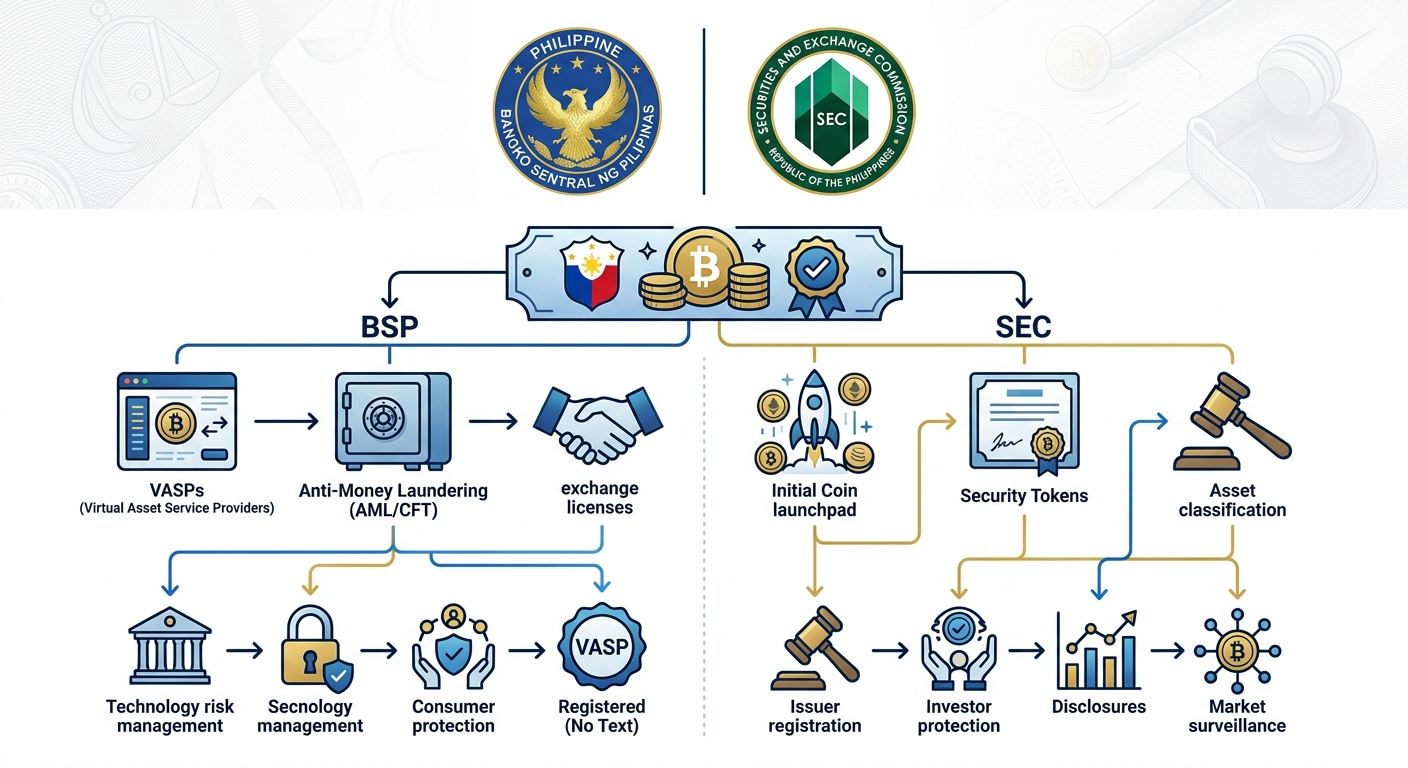
With the BSP's Circular No. 1108 and the SEC's CASP Rules (MC Nos. 04 and 05 of 2025) now both in force, foreign investors entering the Philippine virtual asset space face a bifurcated regulatory landscape that did not exist three years ago. This guide maps the jurisdictional boundaries between the Bangko Sentral ng Pilipinas and the Securities and Exchange Commission, explains the licensing pathways, capitalization requirements, AML/CTF obligations, the BSP's continued VASP license moratorium, and the practical steps a foreign investor must take to operate lawfully in the Philippines' digital asset market.
The Philippine E-Invoicing Mandate: A Comprehensive Compliance Guide for Foreign Companies in 2026
With the December 31, 2026 deadline for mandatory e-invoicing under BIR Revenue Regulations No. 11-2025 fast approaching, foreign companies operating in the Philippines face an urgent compliance obligation that cannot be deferred. This guide provides a complete analysis of who must comply, what constitutes a compliant electronic invoice, the step-by-step implementation process, tax deduction opportunities under the CREATE MORE Act, and the penalties for non-compliance — with every legal citation verified against primary sources.